About Spiranthes spiralis (L.) Chevall.
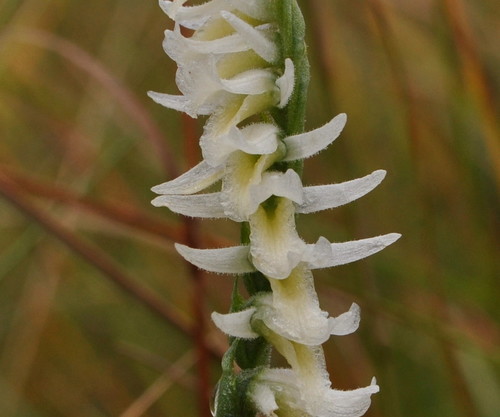
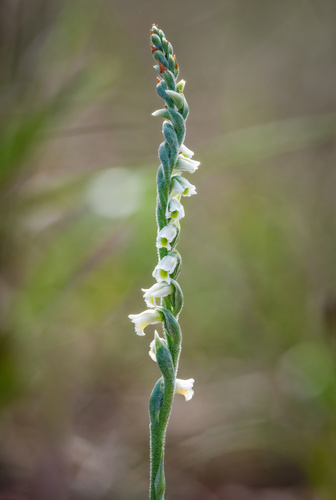
Autumn lady's tresses, with the scientific name Spiranthes spiralis (L.) Chevall., is a perennial polycarp herbaceous plant that grows from tubers, remaining underground in summer dormancy. This species has 30 chromosomes, with 2n=30. Autumn lady's tresses is native to Europe, and small adjacent areas of North Africa and Asia. Its range extends west from Ireland to Portugal; south from Spain (including the Balearic Islands), the coastal mountains of Algeria, Italy (including Sicily), Greece (including Crete), and along the Mediterranean, Aegean, and Black Sea coasts of Turkey through the Caucasus Mountains and northern Iran, east to the Western Himalayas. To the north, its natural range reaches from northern England, the Netherlands, Denmark, the southern Baltic region, and Poland to western Ukraine. It is currently classified as regionally extinct in Denmark, but has been introduced to the Swedish island of Öland, where it is now established. In Switzerland, its most recent known locations are around Lake Lucerne, the Rhine Valley near Chur, the Lake Walen area, and Ticino. In Italy, it is found in the northeast near the sea. In Great Britain and Ireland, its northernmost occurrence is on the Isle of Man; it has never been recorded in Scotland. In Ireland, it has a scattered southern distribution that reaches north to County Sligo, with the only known Northern Ireland colony discovered in 2023 in County Down. In Germany, the species is endangered in Bavaria (the Franconian Heights and Franconian Jura) and Hesse, very endangered in Baden-Württemberg (the Swabian Jura and Alpine foothills) and Rhineland-Palatinate, and near extinction in Saxony-Anhalt, Thuringia, and Lower Saxony. In France, it grows across most of the country, excluding the regions of Champagne-Ardenne and Lorraine, and the departments of Nord, Aisne, Eure, Bas-Rhin, Val d'Oise, and Seine-et-Marne. It is relatively common on the coasts of Brittany and Provence, and in the Orne valley. The original range of S. spiralis was likely Mediterranean. It was only able to spread north between 7000 and 4000 BC after human settlement created suitable habitat by converting forests to agricultural and grazing land. This orchid grows in dry grassy habitats including meadows, garigue, heaths, and pine woodland, generally on calcareous soils. It can be found across a wide variety of substrates, from weathered chalk and limestone to sand and gravel in dunes, and even in slightly acidic heathlands. It has occasionally been found on clay on sloping sites, sometimes grows in lawns, and has even been recorded growing on the top of a wall in Sicily. Soils for this species must be low in nitrogen and phosphorus, and intermediate in moisture (neither extremely dry nor extremely wet). It occurs in a range of plant communities, and is most common in highly diverse Festuca ovina–Avenula pratensis grasslands maintained by intense grazing from sheep or rabbits. These grasslands contain mixed stands of grasses, dicots, and mosses, with a short, continuous turf made up of very small individual plants. In the UK, characteristic abundant species in these grasslands include the grasses Sheep's fescue (Festuca ovina), red fescue (F. rubra), Quaking-grass (Briza media), crested hair-grass (Koeleria macrantha), and Crested dog's-tail (Cynosurus cristatus); the dicots ribwort plantain (Plantago lanceolata), Small burnet (Poterium sanguisorba ssp. sanguisorba), Common Bird's-foot Trefoil (Lotus corniculatus), Common Cat's-ear (Hypochaeris radicata), Mouse-ear hawkweed (Pilosella officinarum), Rough hawkbit (Leontodon hispidus), and Dwarf thistle (Cirsium acaule); and the moss Pseudoscleropodium purum. In the Netherlands, the remaining wild population grows in an old dune grassland belonging to a community similar to Botrychio-Polygaletum, alongside Briza media, Glaucous sedge (Carex flacca), Broad-leaved thyme (Thymus pulegioides), Common milkwort (Polygala vulgaris), and Fairy flax (Linum catharticum). Pollination of autumn lady's tresses is not widely observed. In the Netherlands, the common carder bee (Bombus pascuorum) and red-tailed bumblebee (Bombus lapidarius) are regular visitors. In the Rhône Department of southern France, the honeybee also acts as a pollinator. The silver Y moth (Autographa gamma) has been observed visiting flowers, but no attached pollinia have been recorded on this moth. Pollinators land on the flower's lower lip. Two glands on the rear part of the lip secrete nectar that collects in small cavities directly below the glands. Access to the nectar is very narrow, formed by the protruding edge of the column and the glands, which causes the tongue of a visiting bumblebee or bee to tear the membrane covering the base of the two pollinia. This brings the bee's tongue into contact with an adhesive that hardens immediately when exposed to air, so when the tongue is retracted the pollinia cling to it. After a few days, the lip of maturing flowers opens wider, making access to the nectar gland broader and causing the pollinia-carrying tongue to brush against the flower's stigma to deliver pollen. This developmental sequence, where flowers first release pollen then later become receptive to pollination, is called protandry. Among individual autumn lady's tresses, 52% have flowers arranged counterclockwise, 39% have clockwise arrangements, and 9% have flowers growing all to one side of the inflorescence. Pollinators always land at the bottom of the inflorescence and visit flowers moving progressively upward. Most bumblebees have a strong preference for counterclockwise flower arrangements, with fewer preferring clockwise arrangements. Autumn lady's tresses appears to respond to this pollinator preference by producing multiple inflorescence types, which increases the species' chance of successful fertilization.