About Spiraea douglasii Hook.
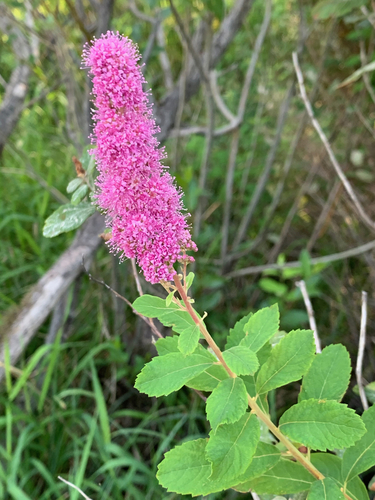
Spiraea douglasii Hook. is a woolly shrub that grows 0.91–1.83 metres (3–6 feet) tall from rhizomes, and forms dense thickets along riversides. Its alternately arranged leaves are 2.5–10.2 centimetres (1–4 inches) long, with toothed edges towards their tips. The undersides of the leaves are whitish and marked by prominent veins. In early summer, this plant produces large clusters of small, deep pink flowers arranged in spire shapes. These clusters later darken and remain on the plant. The seeds are 2 millimetres (1⁄16 in) long, and are dispersed by both animals and strong winds. This species is native to northwestern North America, ranging from Alaska across southwestern Canada and the Pacific Northwest. It has spread to many other regions as an invasive species. It was first introduced to Europe in 1803, and it is particularly invasive in Denmark and Latvia. It can also be found in France, Ireland, Slovenia, Sweden, the United Kingdom, Belgium, Germany and Poland. It grows most commonly in riparian habitat types, including swamps, streambanks, bogs and mudflats. It grows best on moist or semi-wet soils with good drainage, and it tolerates a wide range of soil types as well as gravelly substrates. This spirea is shade-intolerant, so it primarily grows in open marshes alongside sedges, horsetails, wild blueberries, and other swamp vegetation, as well as in seral communities. The species is moderately fire-resistant. Historically, many marshes within its native range would dry out by midsummer, making them prone to wildfire. If the above-ground part of the plant is killed by fire, it can resprout from the stem base or rhizomes after the wildfire. Black-tailed deer browse the foliage of this spirea, but livestock do not favor it, and only eat it occasionally. Its flowers produce nectar that feeds hummingbirds, and small birds eat its persistent seeds during the winter, when other food sources are scarce. The plant provides nesting habitat for bird species such as marsh wrens, and it is a component of grizzly bear habitat. This species can hybridize with white spirea (S. betulifolia) to produce pyramid spirea (S. x pyramidata Greene). Indigenous peoples traditionally used this plant to make brooms and as a surface to hang seafood while cooking. It is grown as an ornamental plant for landscaping, where it grows best in sunny, moist locations. It is recommended for use in riparian revegetation projects in the Pacific Northwest, because it is hardy and grows quickly.