About Spiraea cantoniensis Lour.
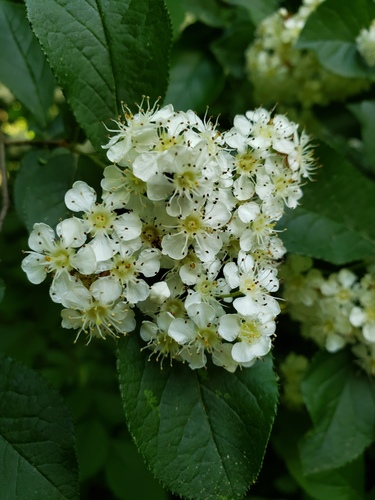
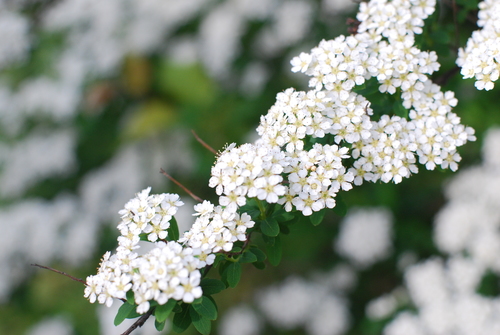
Spiraea cantoniensis Lour. is a deciduous or semi-evergreen shrub that grows 1–2 meters tall, producing numerous thin, arched, flexible, glabrous branches. Its leaves are alternate, simple, and borne on short petioles; the green leaf blades are 2–6 cm long, shaped lanceolate, elliptical-rhomboidal, or slightly obovate, with 3 parallel nerves extending from the base, and irregular crenate-dentate margins on the distal half of the blade. The leaves may turn yellowish red in autumn. It blooms in spring, producing snow-white hermaphroditic, actinomorphic flowers about 1 cm in diameter, arranged in axillary corymbs. Each flower has 5 free sepals, 5 white petals, and numerous stamens that are shorter than the petals. The fruit is a poly-follicle, containing 3 to 5 plurisemined carpids (follicles). This species is native to Southeast China, and has been introduced to Assam, the Azores, South Brazil, Bulgaria, South-Central China, Chita Oblast, Guatemala, Japan, Korea, Nepal, North and South New Zealand, Pakistan, Portugal, Spain, Trinidad-Tobago, and the United States, where it occurs in Alabama, Arkansas, Louisiana, New York, North Carolina, Ohio, and Virginia. In cultivation, it is used as a screening or bordering plant along fence lines, or as a prominent feature plant. May bushes (Spiraea cantoniensis) grow best in full sun to partial shade in well-drained soil, and tolerate light frost, wind, heat, poor soils, and drought. It generally grows best in cooler climates, and should be protected from hot afternoon sun, which can cause leaf burn. This plant should be mulched and watered well. Trimming and fertilisation after flowering are recommended to maintain a compact growth habit and encourage more abundant flowering the next season.