About Spinus tristis (Linnaeus, 1758)
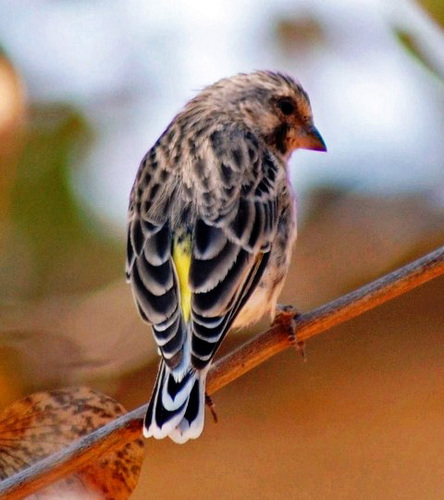
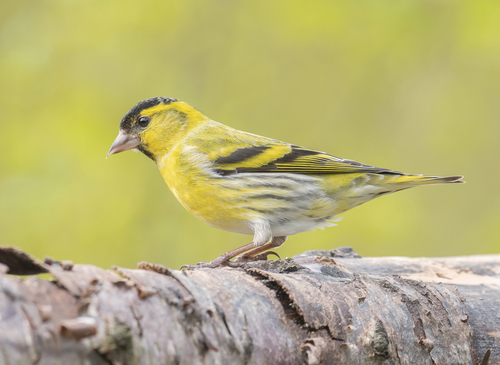
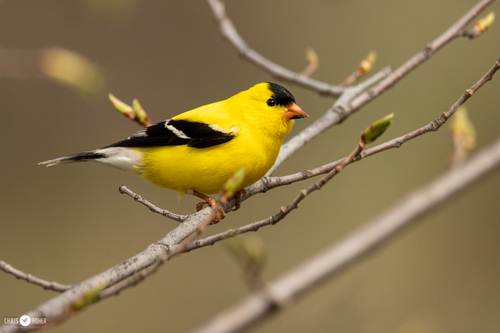
The American goldfinch (Spinus tristis (Linnaeus, 1758)) is a small finch with a total length of 11–14 cm (4.3–5.5 in), a wingspan of 19–22 cm (7.5–8.7 in), and a weight between 11–20 g (0.39–0.71 oz). Standard body measurements are as follows: wing chord 6.5 to 7.8 cm (2.6 to 3.1 in), tail 4.2 to 5.1 cm (1.7 to 2.0 in), culmen 0.9 to 1.1 cm (0.35 to 0.43 in), and tarsus 1.2 to 1.4 cm (0.47 to 0.55 in). Its beak is small and conical; it is pink for most of the year, but turns bright orange after the spring molt in both sexes. The shape and size of the beak helps the species extract seeds from the seed heads of thistles, sunflowers, and other plants. The American goldfinch molts in both spring and autumn, and it is the only cardueline finch that molts twice per year. During the autumn (winter) molt, it sheds all of its feathers. In spring, it sheds all feathers except for the wing and tail feathers, which are dark brown in females and black in males. Markings on these feathers are retained through every molt, including bars on the wings and white markings under and at the edges of the short, notched tail. Sexual dimorphism in plumage color is especially distinct after the spring molt, when the bright color of the male’s summer plumage is used to attract mates. After the spring molt is finished, the male’s body is a brilliant lemon yellow, a color produced by carotenoid pigments from plant materials in its diet. Males also have a striking jet black cap and a white rump that is visible during flight. Females are mostly brown, with a lighter underside and a yellow bib. After the autumn molt, bright summer feathers are replaced by duller plumage: the underside becomes buff-colored, and the upperparts become olive-brown, with a pale yellow face and bib. Autumn plumage is nearly identical in both sexes, though males have yellow shoulder patches. Immature American goldfinches have a dull brown back, pale yellow underside, and dull black shoulders and tail. Markings on the wings and rump are buff-colored rather than white, and this juvenile coloration is the same for both sexes. The species’ song is a sequence of musical warbles and twitters, often ending with a long note. In flight, American goldfinches often give a tsee-tsi-tsi-tsit call, which may also be described as per-chic-o-ree. While incubating eggs, the female calls to her returning mate with a soft, continuous tee-tee-tee-tee-tee sound. Shortly before fledging, young begin using a chick-kee or chick-wee call, which they continue to use until they have fully left the nest. Adults make two distinct defense calls during the nesting period: a sweet call to gather other goldfinches at the nest and distract predators, and a bearbee call to signal to nestlings to quiet down and crouch in the nest to be less noticeable. The American goldfinch prefers open habitats where weeds grow well, including fields, meadows, flood plains, roadsides, orchards, and gardens. It can also be found in open deciduous and riparian woodlands and areas of secondary growth, and it maintains this habitat preference during spring and autumn migrations. The species’ summer breeding range spans across North America from coast to coast. It extends as far north as Saskatchewan and reaches south across North America to North Carolina on the Atlantic coast and northern California on the Pacific coast. The American goldfinch is a short-distance migrant that moves south when the weather turns colder and food becomes less available. Ornithologist Marc Parnell notes that this responsive southward migration is thought to start when daily low temperatures approach freezing, particularly as these temperatures near 0 °F. Migration occurs in compact flocks that travel with an erratic, wavelike flight pattern. The species’ winter range covers southern Canada and extends south through the United States to parts of Mexico. In the northern portion of its winter range, American goldfinches may move closer to available bird feeders. In southern winter ranges, they stay in the same types of areas (fields and flood plains) that they occupy in summer. Introductions of American goldfinches to Bermuda in the 19th century and Tahiti in 1938 were attempted, but the species did not become established in either location.