About Spinus spinescens (Bonaparte, 1850)
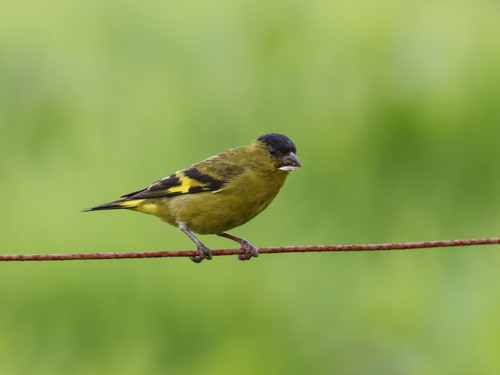
This small green-and-yellow finch has the scientific name Spinus spinescens (Bonaparte, 1850), and is commonly called the Andean siskin. Some sources list it as the smallest average-sized finch species, while others give this title to the lesser goldfinch. Its total length ranges from 9.5 to 11 cm (3.7 to 4.3 in), and a weight of 11.5 g (0.41 oz) falls at the high end of its known weight range. Few standard body measurements are documented, but recorded measurements include a bill length of 1.1 cm (0.43 in) and an average wing chord length around 6.4 cm (2.5 in). Andean siskins have deep green upperparts, with black and yellow markings on their wings and tails. Adult males have a distinctive black cap, which females lack. Females are generally a duller olive overall, with white coloring extending from the belly to the undertail-coverts. Females can be distinguished from female yellow-bellied siskins by their paler, brighter coloration, and their lack of the yellow-bellied siskin's olive throat and yellow undertail-coverts. Females are also similar in appearance to female hooded siskins, but Andean siskins have distinctive white undertail-coverts and more olive-green rather than gray overall body color. The subspecies S. s. nigricauda has duller or darker green upperparts than the nominate subspecies, and its underparts are dull green with no trace of yellow. This subspecies has an entirely black tail, and its wing coverts lack greenish-yellow tips, though it still retains bright yellow bases to the inner primaries and secondaries. The proposed subspecies S. s. capitaneus from the Sierra Nevada de Santa Marta is typically grouped with the nominate subspecies. The Andean siskin's call is a typical goldfinch-like tswee or similar variation, most often given during flight. Its song is also goldfinch-like: a lively, rambling series of high-pitched notes interspersed with rolling trills. The nominate subspecies is found in the coastal mountains of Aragua in northern Venezuela, the Andes of western Venezuela, the Serranía del Perijá along the Colombia-Venezuela border, the Sierra Nevada de Santa Marta of northern Colombia, and from the eastern Andes in Colombia south to Valle, Putumayo, Nariño and Pichincha Province in Ecuador. S. s. nigricauda occurs in the northern, central and western Andes of Colombia, ranging from Antioquia south to Caldas and possibly extending to northern Tolima. This species is common to locally common across its range. It lives in subtropical and páramo zones of the northern Andes. It is usually found at elevations between 1,800 and 3,700 m (5,900 and 12,100 ft), and can occasionally range as low as 1,500 m (4,900 ft) in Colombia. It inhabits scrub or low bushes in open cloud or elfin forests, or along forest edges. It may also be seen on open hillsides with scattered trees or bushes, and occasionally ranges to the edges of cultivated land. Andean siskins are usually found in pairs or small flocks of up to 20 individuals, and occasionally mix into flocks with other finch species, such as the hooded siskin in northern Ecuador. They often perch high in the tops of trees, but generally feed on or near the ground. This species feeds on a wide variety of plant seeds, and shows a particular preference for Espeletia seeds and flowers.