About Spinus pinus (A.Wilson, 1810)
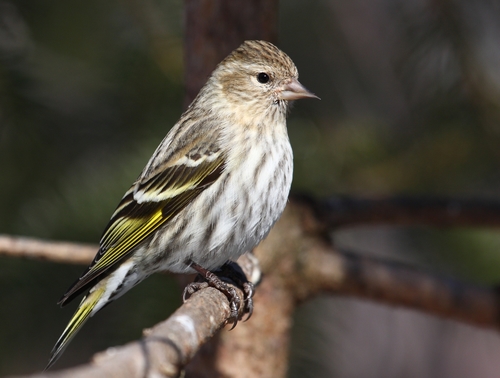
Pinus siskin, the species Spinus pinus, is a fairly small finch, roughly the same size as the widespread American goldfinch. Both sexes have a total length ranging from 11–14 cm (4.3–5.5 in), a wingspan of 18–22 cm (7.1–8.7 in), and a body weight between 12–18 g (0.42–0.63 oz). Adult individuals have brown upperparts, pale underparts, and heavy streaking covering their entire body. They have short, forked tails. Like most finches, they have conical bills, but their bills are more elongated and slender than the bills of other finches that share the same range. Pine siskins variably have yellow patches on their wings and tails, and their wings may also have white streaks. Inexperienced observers may confuse them with other finches or even American sparrows, but they can be identified by their heavy streaking, relatively slender bills, notched tails, yellow or whitish wing patches, and small size. Their breeding range covers almost all of Canada and Alaska, and extends with variable coverage across the western mountains and northern regions of the United States. As their common name suggests, this species breeds mostly in open conifer forests, and the majority of its breeding population is supported by northern pine forests. However, nesting individuals can also be found in stands of ornamental conifers or deciduous trees in partially developed parks, cemeteries, and suburban woodlands. While they prefer to feed in open forest canopies where cone seeds are abundant, they will forage across a wide range of habitats including deciduous forests, thickets, meadows, grasslands, weedy fields, roadsides, chaparral, and residential backyard gardens and lawns. They will gather in flocks at backyard feeders that provide small seeds. Mineral deposits can draw them to otherwise unappealing habitats, such as winter road beds that have been salted to melt snow and ice. Their nests are well-hidden on a horizontal tree branch, most often a conifer branch. This species' migration patterns are highly variable, and are likely tied to food supply. Large numbers of individuals may move far south in some years, while almost no migration occurs in other years. It is one of a small number of species classified as "irruptive winter finches", due to the high variability of its movements based on annual seed crop success.