About Spinus lawrencei (Cassin, 1850)
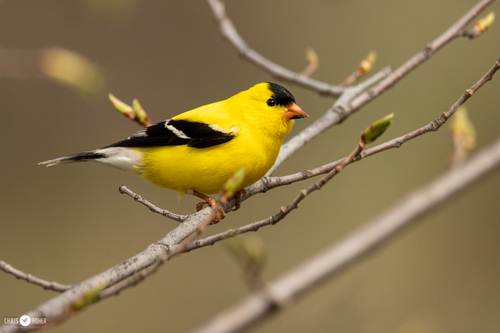
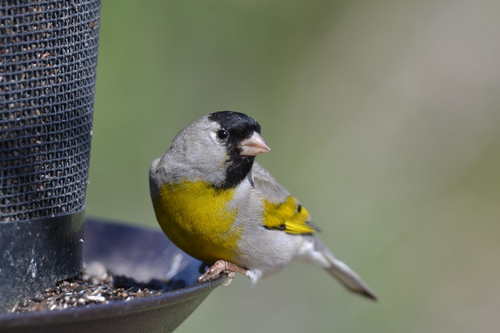
Spinus lawrencei, commonly called Lawrence's goldfinch, measures around 4.75 inches (12.1 cm) long and weighs about 0.4 ounces (11 g). It is slightly larger than the lesser goldfinch and slightly smaller than the American goldfinch, with less yellow in its plumage than both species. Adult birds of both sexes are gray, with pink to grayish flesh-colored bills that are stubbier than the bills of other goldfinches. They have yellow rumps, paired yellowish wing-bars, yellow edges on their flight feathers, and yellow coloring on the breast. Their tail is black and crossed by a white band. Plumage is duller during winter, and brightens again after a spring molt. Males are paler, with black caps and faces and larger areas of brighter yellow. Females are browner, have less duller yellow, and lack the black markings that males have. Juveniles look similar to females but have even duller plumage, plus faint streaks on the upperparts, especially on the underparts. This species has a variety of documented calls: a nasal too-err, a sharp high PIti, and an Itititi. Its diagnostic flight call is described as a high, clear ti-too or tink-ul, which is reminiscent of glass wind-chimes. The song is high-pitched, continuous, and limited in frequency range; it includes wind-chime notes, and especially incorporates imitations of other bird species' calls and other simple, distinctive sounds. Males sing during winter, but sing mostly during the breeding season. Females sing only occasionally and briefly. Lawrence's goldfinch is well known for its wandering habits. Its breeding range extends from Shasta County, California to northern Baja California, mostly covering the Coast Ranges, the foothills of the Sierra Nevada, and the Baja highlands, though it sometimes breeds as far down as the coast. The highest altitude at which it has been recorded breeding is around 8,800 feet (2,700 m) on Mount Pinos. Only a small number of sites see annual nesting, most notably Carmel Valley and the South Fork Kern River. The selection of breeding areas within its range may depend on climate, through the availability of water and preferred foods. During drought years, the species moves to the coast and upslope in the Sierra Nevada; after wet years, it moves to the edges of its range and into the Central Valley, possibly due to increased food supplies. A small number of breeding individuals have been recorded in Arizona. Most, though not always all, birds leave northern, central, and inland southern California in winter. They move into coastal lowlands and the lower sections of the deserts in southeastern California, and range irregularly—sometimes in large numbers—southeast to northern Sonora and northwestern Chihuahua, east to the southern half of Arizona, southwestern New Mexico, and even the area around El Paso, Texas. This winter range roughly corresponds to the Madrean Sky Islands region. In some winters, mysteriously few Lawrence's goldfinches are observed; it is possible the birds stay in poorly surveyed areas of Sonora and Chihuahua that have little coverage by naturalists. The largest eastward irruptions often happen during wet periods, and are synchronized with irruptions of other seedeating bird species including the red-breasted nuthatch, the red crossbill, and the other North American goldfinches. The species' typical nesting habitat is dry, open woodland located close to both brushy areas and fields of tall annual weeds, usually within 0.5 miles (0.80 km) of a small body of water. It may nest in other habitats, including rural residential areas, but does not nest in deserts or dense forests. Outside of the nesting season, it can be found in many open habitats, including deserts, suburbs, and city parks.