About Spinus atratus (d'Orbigny & Lafresnaye, 1837)
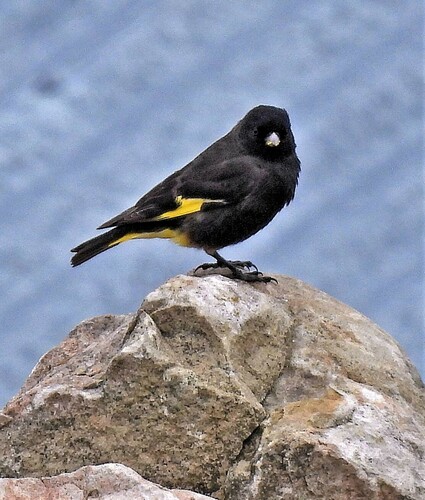
The black siskin, Spinus atratus, reaches an adult length of approximately 13 centimetres, or 5 inches. Males are mostly glossy black, with yellow markings: a band at the base of the primaries, yellow at the base of the tail, and a yellow lower belly. Females have a similar pattern, but their dark plumage is less glossy and more brown-toned than that of males. Within its range, the only bird likely to be confused with the black siskin is the yellow-rumped siskin, Spinus uropygialis. The two species are easily told apart when they are stationary, but the yellow patches on the black siskin’s rump and wings that become visible in flight make the two species look more similar to each other. This species is native to the high Andes Mountains of South America. Its distribution extends from central Peru and northern Chile south to western Argentina. It typically occurs at altitudes between 3,500 and 4,500 metres (11,500 to 14,800 ft), though it can be found at slightly lower elevations at the southern end of its range. Its typical habitat includes rocky slopes, ravines, and tussocky grassland with low shrubs in the Puna grassland ecoregion, and it can also be found around human habitations. It is often observed in pairs or small flocks, sometimes mixing flocks with other finch species, and it generally forages on the ground or in low bushes.