About Spilornis cheela (Latham, 1790)
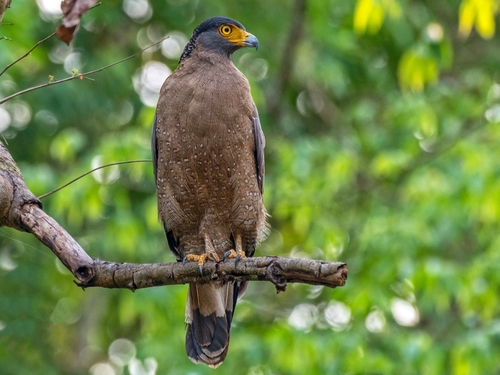
Spilornis cheela, the crested serpent eagle, is a medium-large, stocky dark brown eagle with rounded wings and a short tail. It has a short, black-and-white fan-shaped nuchal crest that creates a thick-necked appearance, and its bare facial skin and feet are yellow. The underside of the bird is spotted with white and yellowish-brown. When perched, the wing tips do not reach the tip of the tail. When soaring, its broad paddle-shaped wings are held in a shallow V. The tail and underside of the flight feathers are black with broad white bars. Young crested serpent eagles have a large amount of white on the head. The tarsus is unfeathered and covered in hexagonal scales, and the upper mandible does not have an overhanging festoon at its tip.
Crested serpent eagles primarily eat reptiles, and hunt for snakes and lizards over forests, often close to wet grassland. They have also been observed preying on birds, large insects including grasshoppers and locusts, amphibians, mammals, fishes, termites, and large earthworms. They occur mainly in areas with thick vegetation, on both low hills and plains. This is a resident species, but it is only found in summer in some parts of its range. Its call is a distinctive Kluee-wip-wip, with the first note high and rising. The birds call frequently from perches in late mornings; they spend much of their time on perches, and rise on thermals in the mornings. In southern Taiwan, males have a larger average home range (16.7 km²) than females (about 7 km²). When alarmed, crested serpent eagles erect their crest, making their head look large and framed by the ruff. They will sometimes follow snakes on the ground, and roost inside trees with dense foliage. A radio-telemetric study of this species in Taiwan found that the birds spend 98% of the day perched, and usually find food during morning hours, using a sit-and-wait foraging strategy.
The breeding season starts in late winter, when crested serpent eagles begin courting and establishing territories. Eggs are laid in early summer. In India, old nests are often refurbished and reused, but a study in Penang found that this species builds new fresh nests each year. A study in India found that most nests are built along riverine trees. The nest is a large platform built high in a tree. Both members of a breeding pair build the nest, but only the female incubates; the male guards the nest while the female forages. In central India, Terminalia tomentosa is often used as a nest tree, while Terminalia bellirica and Dalbergia latifolia are often used in southern India. In Penang, nest trees are typically large and isolated from other trees, with plenty of open space for the eagles to fly in and out. Nests are lined with green leaves collected from nearby, which are placed facing down on the nest floor. The usual clutch size is one egg, though two are sometimes laid; only one chick is successfully raised per breeding season. If eggs are lost, a replacement clutch is laid two to seven weeks later. Eggs hatch after around 41 days of incubation, and young fledge after about two months. Parents defend the nest.
Several species of endoparasitic nematodes, including Madelinema angelae, have been recovered from the intestines of crested serpent eagles. Avian pox virus infection, which causes warts on the face, has been observed in a wild individual in Taiwan. A number of ectoparasitic bird lice, including Kurodaia cheelae, have been described from this species. In Penang, cinereous tits (Parus cinereus ambiguus) tend to nest close to nesting crested serpent eagles, likely to gain safety from predators such as crows, which are driven off by the eagles. Cinereous tits have also been observed visiting eagle nests to collect fur from the remains of dead mammals.