About Spilopelia chinensis (Scopoli, 1786)
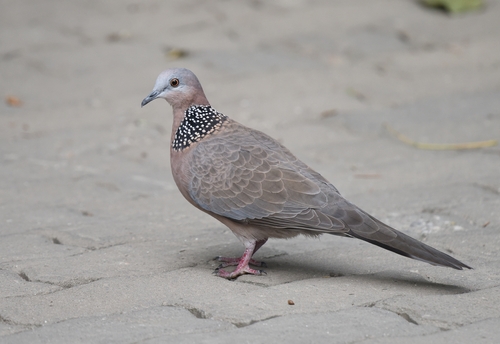
This long, slim dove has a rosy buff base color on its underside, which shades into grey on the head and belly. It has a half collar on the back and sides of the neck, made of black feathers that split into two branches, each with a white spot at the tip. For subspecies found in India and Sri Lanka, median coverts consist of brown feathers tipped with rufous spots, which are divided at the tip by a widening grey shaft streak. The wing feathers are dark brown with grey edges, and the center of the abdomen and vent are white. Outer tail feathers are tipped in white, and become visible when the bird takes flight. Adult males and females have similar plumage, while juveniles are duller than adults and do not develop the characteristic neck spots until they reach maturity. The species measures between 28 and 32 centimeters (11.2 to 12.8 inches) in total length. Abnormal plumage conditions, such as leucism, can sometimes occur in wild individuals. In its native Asian range, the spotted dove (Spilopelia chinensis) occurs across a wide range of habitats, including woodland, scrub, farmland, and areas settled by humans. In India, the species is most often found in moister regions, while the closely related laughing dove (S. senegalensis) occurs more frequently in drier areas. These doves forage mostly on the ground or on low vegetation, searching for seeds and grain. The species has become established in many areas outside its native range, including Hawaii, southern California, Mauritius, Australia, and New Zealand. In Australia, the spotted dove was introduced to Melbourne in the 1860s and has spread outward since; there is not enough evidence to confirm that it competes with native doves. It is now a common urban wildlife species in Australia, found in streets, parks, gardens, agricultural areas, and tropical shrublands across much of eastern Australia and around cities and major towns throughout southern Australia. The introduced Australian populations originally consist of varying proportions of two subspecies, S. c. chinensis and S. c. tigrina. Spotted doves move in pairs or small groups as they forage on the ground for grass seeds, grains, fallen fruits, and seeds from other plants. They may occasionally eat insects, and have been recorded feeding on winged termites. Their flight is quick, with regular wing beats and occasional sharp wing flicks. A characteristic display flight involves taking off at a steep angle with a loud clap of the wings, then gliding slowly downward with the tail spread open. The breeding season spans most of the year in warm regions, but typically occurs in summer in temperate ranges. In Hawaii, spotted doves breed year-round, just like the three other introduced dove species present there. During courtship, males produce cooing calls, perform bowing displays, and conduct aerial displays. In southern Australia, spotted doves breed mostly from September to January, while they breed in autumn in northern Australia. They build their nests mainly in low vegetation, where they construct a flimsy cup-shaped nest from twigs to hold two whitish eggs. Nests are sometimes placed on the ground, or on buildings and other human-made structures. Both parents participate in nest building, incubating the eggs, and feeding the young. The eggs hatch after approximately 13 days, and the young chicks fledge two weeks after hatching. A single pair may raise more than one brood in a breeding season. The vocalizations of the spotted dove include soft cooing in the pattern Krookruk-krukroo... kroo kroo kroo; the number of terminal kroos varies in Indian populations, and is absent in tigrina, chinensis, and other populations found further east. The species has been expanding its range across many parts of the world. Local populations can sometimes rise and fall rapidly, over a span of around five years. In the Philippines, this species may be outcompeting the Philippine collared dove (Streptopelia dusumieri). Their habit of flushing into the air when disturbed makes them a hazard on airfields, as they often collide with aircraft and sometimes cause damage.