About Spilonota ocellana (Denis & Schiffermüller), 1775
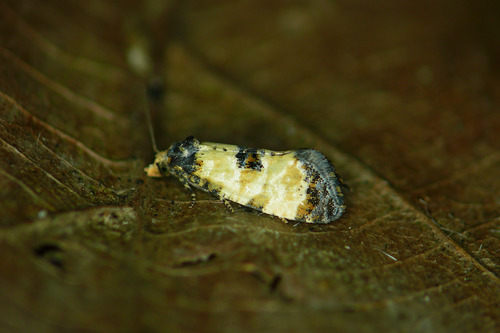
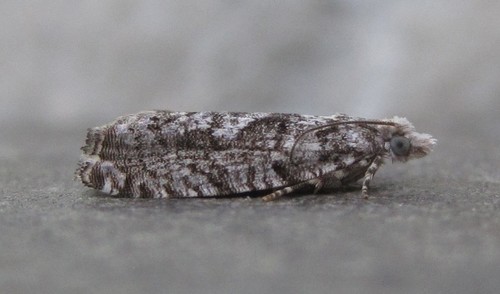
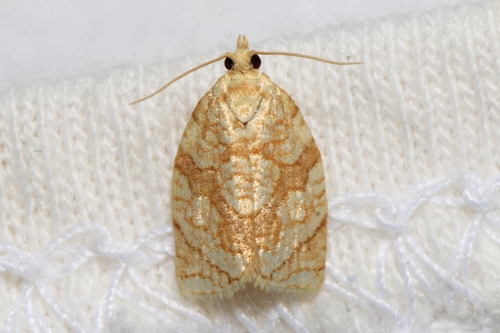
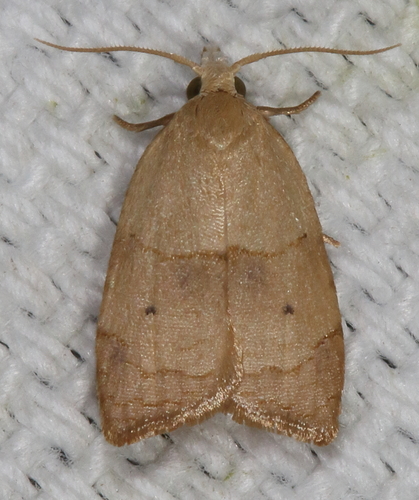
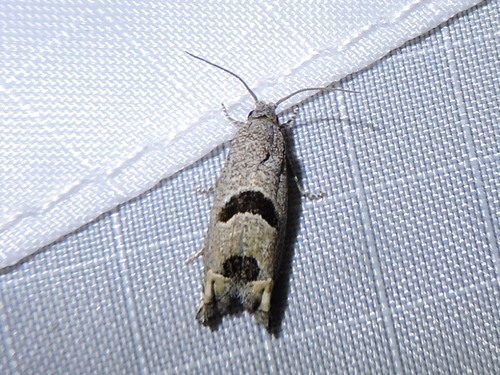
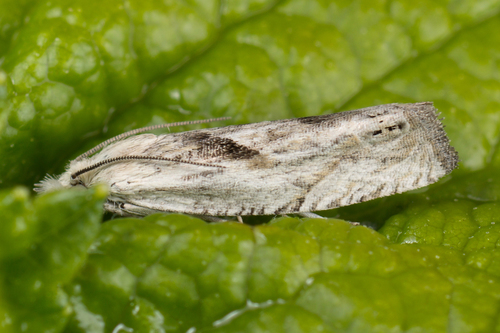
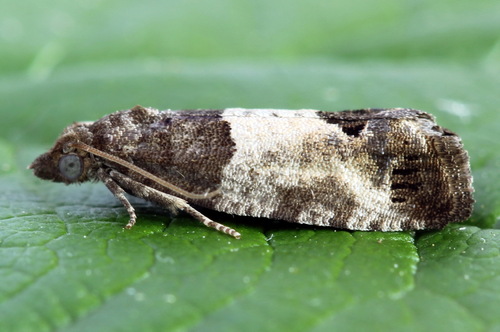
Spilonota ocellana, commonly known as the bud moth, is a moth species belonging to the family Tortricidae. Its scientific name, Spilonota ocellana, was first described by Denis & Schiffermüller in 1775. This species is distributed across the Palearctic realm, with a range extending from North Africa and Europe east to Iran, eastern Russia, the Chinese provinces and regions of Hebei, Inner Mongolia, Jilin, Zhejiang, Fujian, Hubei, Sichuan, Shaanxi, Gansu, and Qinghai, Korea, and Japan. It can also be found on the island of Madeira, and across North America. The wingspan of adult Spilonota ocellana measures 12 to 17 mm. The forewings are whitish, and sometimes have partial grey suffusion, with more or less distinct dark fuscous strigulation. The basal patch of the forewing is dark grey, occasionally mixed with blackish tones, and has a somewhat angled edge; the central fascia forms a dark grey, sometimes indistinct, costal suffusion. A triangular black-edged praetornal spot is present on the forewing. The forewing ocellus is edged with leaden-metallic scales, and encloses several sometimes confluent black dashes. The forewing cilia are dark grey, while the hindwings are a moderately dark grey. Fully grown larvae are pinkish-brown, with a dark fuscous head and dark fuscous second thoracic plate. Larvae can be found feeding from May onwards, and have been recorded feeding on plants including blackthorn, larch, and alder. The larch-feeding form of this species, which is often distinguished as lariciana, is typically somewhat smaller and darker than the standard form. The adult moth flight period occurs from May to October, with the exact timing varying based on the species' location. Spilonota ocellana produces one generation per year. Larvae feed on a wide range of deciduous trees and shrubs, including species from the genera Quercus, Betula, Sorbus, and Vaccinium.