About Spiculaea ciliata Lindl.
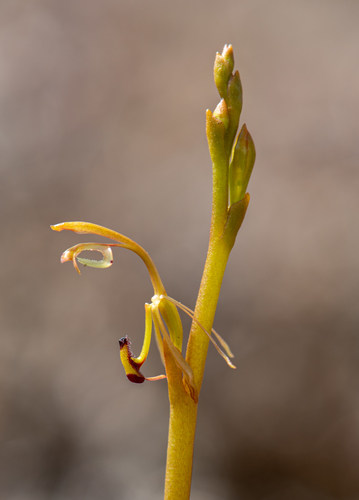
Spiculaea ciliata Lindl. is a terrestrial, perennial, deciduous, sympodial herb. It has a small number of inconspicuous fine roots and an oval tuber that lacks a protective sheath. This tuber grows a replacement tuber and daughter tubers at the ends of short, root-like stolons. A single stalked leaf, measuring around 2 cm long and 1 cm wide, grows at the base of the plant, with a purplish lower surface. The leaf reaches full development before the first flowers form, but withers before these flowers open in late October. Up to ten resupinate flowers grow at the end of a wiry stem that stands 10–18 cm high. The stem is thickest near its top, and gradually withers from the base as the flowers mature. Each flower is straw-coloured, 20 mm long and 10 mm wide, and borne on a short stalk. The dorsal sepal curves over the top of the flower, with its side edges curving downward. The two lateral sepals are shorter than the dorsal sepal, and the two petals are narrower than both sepals and petals. All petals and sepals are separate from one another. As is typical for orchids, one petal is highly modified to form the central labellum. The labellum is shaped like a wingless insect, and attached to the base of the flower’s column by a flexible, hinge-like claw. It is much smaller than the labellum of most other orchids, is rod-shaped and fleshy, and covered in many club-shaped hairs. The sexual reproductive structures of the flower are fused to the column, which has wing-like outgrowths along its sides. Flowering occurs between October and January, and after flowering the plant produces a fruit: a non-fleshy, hairless, dehiscent capsule that holds a large number of seeds. This species grows in shallow sandy soil over granite, between the Darling Scarp, Paynes Find and Mount Ney, within the Avon Wheatbelt, Coolgardie, Esperance Plains, Geraldton Sandplains, Jarrah Forest and Mallee biogeographic regions. The flowers of this orchid (commonly called elbow orchid) have been described as bizarre, and it is unusual for the species to flower during the hottest months of the year. Author Nikulinsky commented: "When most other plants dead or dying, this tiny orchid at its fascinating best. When everything else was brittle underfoot these are still succulent. A specimen continued to flower in my collection in the fridge after I got home, weeks later." Spiculaea ciliata is thought to be pollinated by male thynnid wasps of the genus Thynnoturneria. Males are first attracted to the orchid’s labellum by a pheromone, flying toward the flower from downwind. When at rest, the labellum resembles a wingless female wasp resting on a blade of grass. The wasp attempts to carry the fake female wasp away by flying, and moves upward into the column where the column’s wing-like structures hold the insect in place. This brings the wasp’s abdomen into contact with the flower’s sexual reproductive parts.