About Sphenomorphus indicus (Gray, 1853)
Body Form
The Indian forest skink, Sphenomorphus indicus (Gray, 1853), has a lizard-like body form. The distance from the tip of the snout to the forelimb is contained approximately 1.6 times in the distance between the axilla (armpit) and groin.
Snout Characteristics
The snout is short and obtuse, with a nearly vertical loreal region.
Eyelid Structure
The lower eyelid is covered in scales.
Nasal Scale Features
The nostril is pierced either within a single nasal scale, or between a nasal and a postnasal scale; there are no supranasal scales.
Rostral and Frontonasal Scales
The rostral scale is convex, and makes broad contact with the frontonasal, which is broader than it is long and forms a narrow suture with the frontal scale.
Frontal Scale Features
The frontal scale is as long as the combined length of the frontoparietal and parietal scales, and contacts the first, second, and third supraocular scales.
Supraocular Scales
There are 4 large supraocular scales, followed by 2 very small ones; the first supraocular is not much longer than the second.
Supraciliary Scales
There are 9 or 10 supraciliary scales, with the first being the largest.
Frontoparietal and Interparietal Scales
The frontoparietals and interparietal are distinct scales; the frontoparietals are slightly longer than the interparietal.
Parietal Scale Suture
The parietal scales form a short suture behind the interparietal.
Nuchal Scales
No nuchal scales are present.
Upper Labial Scales
The fifth and sixth upper labial scales are the largest and sit below the eye.
Ear Opening Features
The ear opening is oval, and smaller than the eye opening; no auricular lobules are present.
Midbody Scales
There are 36 or 38 smooth scales around the midbody, with the lateral scales being the smallest.
Pre-anal Scales
There is a pair of large pre-anal scales.
Limb Length Relation
When the limbs are pressed against the body, the hind limb reaches the elbow or does not extend quite that far.
Digit and Subdigital Lamellae
The digits are rather elongate and compressed; the subdigital lamellae are smooth or obtusely keeled, with 17 to 20 lamellae under the fourth toe.
Tail Length
The tail is almost twice as long as the combined length of the head and body.
Dorsal Coloration
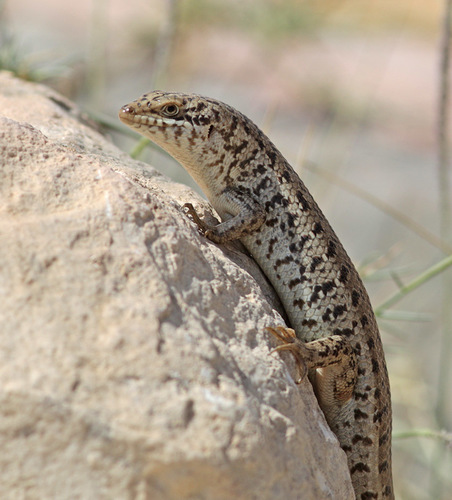
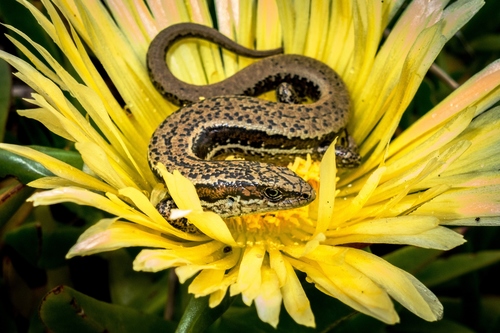
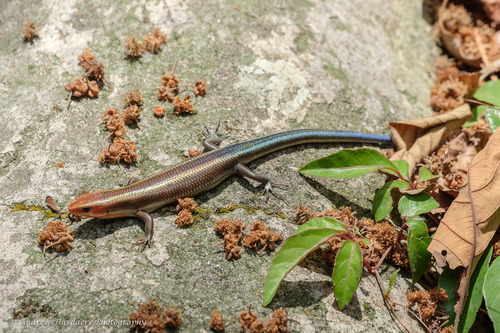
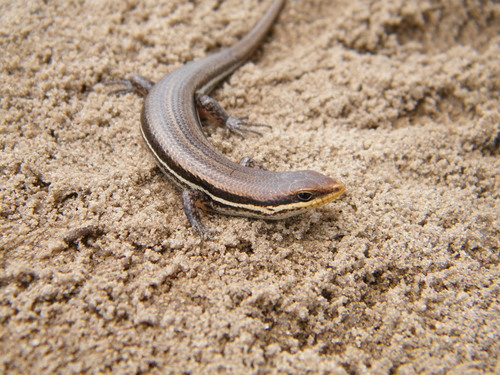
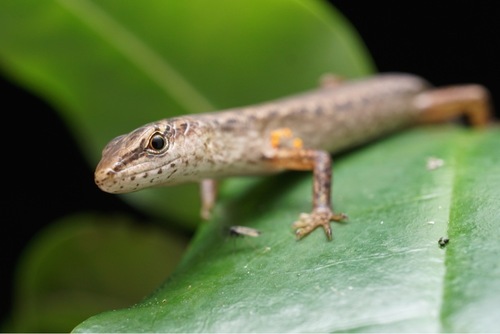
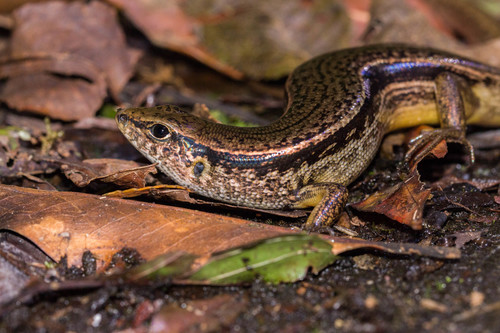
The dorsal (upper) surface is brown or olive, and may be uniform or marked with scattered darker dots.
Lateral Coloration
The sides of the head and body are dark brown, with a light margin along the upper edge; large light spots are usually present on the sides.
Ventral Coloration
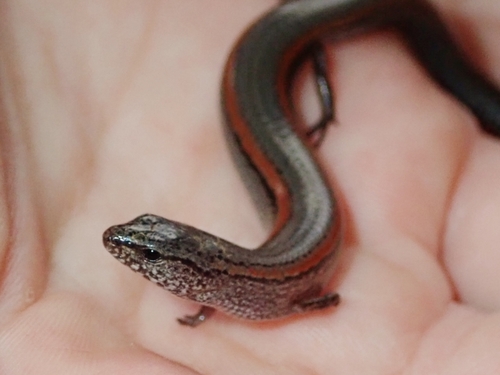
The ventral (lower) surface is whitish.
Size Measurements
The length from snout to vent is 3.5 inches; the tail length is not specified.
Distribution Range
This species is distributed in southern China (including Hainan, west to eastern Xizang (Tibet), and north to Henan, Shaanxi, and Gansu; Nan Ao Island, Guangdong), Bangladesh, Bhutan, Taiwan, Thailand (thought to occur in the Bilauk Tuang mountains per Taylor 1963: 1020), Vietnam, and India (Darjeeling, Sikkim), ranging east to Indochina and south to western Malaysia.
Type Locality
The type locality is Sikkim, Himalayas.