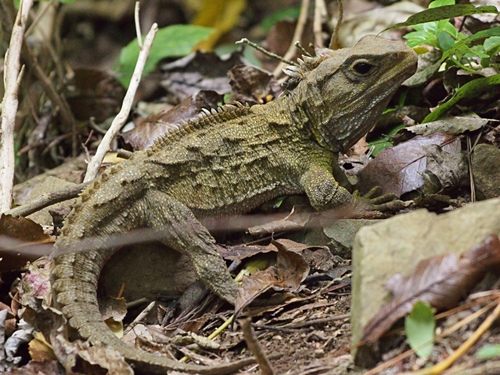
About Sphenodon punctatus (Gray, 1842)
Common Name and Endemic Status
This description covers Sphenodon punctatus, commonly called tuatara, the largest reptiles native to New Zealand.
Sexual Dimorphism in Size
Tuatara are sexually dimorphic, with males reaching larger sizes than females. Adult male S. punctatus measure 61 cm (24 in) in length on average, while adult females measure 45 cm (18 in); the San Diego Zoo records a maximum recorded length of up to 80 cm (31 in).
Body Mass Ranges
Males can weigh up to 1 kg (2.2 lb), and females up to 0.5 kg (1.1 lb). The Brothers Island tuatara population is slightly smaller, with males reaching a maximum weight of 660 g (1.3 lb).
Respiratory System Structure
Tuatara have single-chambered lungs with no bronchi.
Base Coloration
Their base color is greenish brown, which matches their natural habitat and can change over the course of their lifespan.
Skin Shedding Frequency
Adult tuatara shed their skin at least once per year, while juvenile tuatara shed three to four times annually.
Sexually Dimorphic Physical Traits
Beyond size, males and females differ in other traits: the spiny crest along the back, made of triangular soft skin folds, is larger in males and can be stiffened for display, and the male abdomen is narrower than that of the female.
Genomic Characteristics Overview
Genomic analysis of the tuatara has revealed several distinct characteristics.
L2 LINE Element Composition
The most abundant long interspersed nuclear element (LINE) in the tuatara genome is L2, making up 10% of the genome. Most L2 elements are interspersed and remain active; the longest identified L2 element is 4 kb long, and 83% of sequences have a completely intact ORF2p.
CR1 LINE Element Composition
The second most repeated LINE element is CR1, making up 4% of the genome. Phylogenetic analysis shows these CR1 sequences differ greatly from those found in nearby species such as lizards.
L1 LINE Element Composition
L1 elements make up less than 1% of the tuatara genome, a low percentage compared to placental mammals, where L1 elements are typically predominant.
LINE Element Precedent in Sauropsids
Generally, CR1 elements are the predominant LINE elements in most sauropsids, which is not the case for tuatara. This suggests that the repeat content of early sauropsid genomes may have been very different from that of modern mammals, birds, and lizards.
MHC Gene Research Background
Major histocompatibility complex (MHC) genes, which are involved in disease resistance, mate choice, and kin recognition across vertebrates and are known for high polymorphism, have been studied in tuatara.
MHC Gene Characteristics
56 MHC genes have been identified in tuatara, some of which are similar to the MHC genes of amphibians and mammals. Most annotated MHC genes in the tuatara genome are highly conserved, but large genomic rearrangement is observed in distant lepidosaur lineages.
Mammalian Interspersed Repeats
Many of the analyzed repeated elements are present across all amniotes, with most being mammalian interspersed repeats (MIR). Tuatara has the highest diversity of MIR subfamilies recorded in any studied amniote.
SINE and DNA Transposon Diversity
16 recently active short interspersed nuclear element (SINE) families have also been identified. Tuatara has 24 unique families of DNA transposons, with at least 30 subfamilies that have been recently active.
Recent Transposon Activity
This transposon diversity is greater than that found in other amniotes, and researchers have identified thousands of identical copies of these transposons, which indicates recent transposon activity.
Genome Size Ranking
The tuatara genome is the second largest known reptile genome; only the genome of the Greek tortoise is larger.
LTR and Endogenous Retrovirus Content
Around 7,500 long terminal repeats (LTRs) have been identified in the tuatara genome, including 450 endogenous retroviruses (ERVs). While other studied Sauropsida have a similar number of ERVs, tuatara host a very ancient clade of retrovirus known as Spumavirus.
Non-Coding RNA Elements
More than 8,000 non-coding RNA-related elements have been identified in the tuatara genome. The vast majority of these elements, around 6,900, are derived from recently active transposable elements.
Remaining Non-Coding RNA Associations
The remaining elements are associated with ribosomal, spliceosomal, and signal recognition particle RNA.
Mitochondrial Genome Structure
The mitochondrial genome of the Sphenodon genus is approximately 18,000 base pairs in size, and contains 13 protein-coding genes, 2 ribosomal RNA genes, and 22 transfer RNA genes.
DNA Methylation Background
DNA methylation is a common genetic modification in animals, and the distribution of CpG sites within a genome affects this methylation. 81% of CpG sites are methylated in the tuatara genome.
Methylation Level Context
Recent research proposes that this high methylation level may be caused by the large amount of repeated elements in the tuatara genome. This methylation pattern is closer to that of zebrafish, which have 78% methylated CpG sites, while humans only have 70% methylated CpG sites.
Historical Distribution
Tuatara were once widespread across New Zealand's North and South Islands, and subfossil remains have been found in sand dunes, caves, and Māori middens.
Pre-European Range Contraction
They were extirpated from the main North and South Islands before European settlement, and were long restricted to 32 mammal-free offshore islands. These islands are remote and host few animal species, supporting the hypothesis that mammal species absent from the islands caused tuatara to disappear from the mainland.
Kiore Invasion Impact
Polynesian rats, called kiore, have recently become established on several of these offshore islands. On kiore-inhabited islands, tuatara persisted but did not breed, and were much rarer than on rat-free islands.
Pre-Conservation Population Decline
Before modern conservation work began, 25% of distinct tuatara populations had gone extinct over the preceding century.
Mainland Reintroduction Success
The recent discovery of a tuatara hatchling on the mainland confirms that reintroduction efforts to reestablish a breeding tuatara population on the New Zealand mainland have had some success.
Total Global Population Estimate
The total global population of tuatara is estimated to be between 60,000 and 100,000 individuals.
Shared Island Habitat During Nesting Season
During nesting season, burrowing seabirds including petrels, prions, and shearwaters share the tuatara's island habitat. Tuatara use the seabirds' burrows for shelter when available, or dig their own burrows.
Prey Base Supported by Seabird Guano
Seabird guano supports the invertebrate populations that form the main prey base of tuatara, including beetles, crickets, spiders, wētās, earthworms, and snails.
Additional Prey Items
Tuatara also eat frogs, lizards, and bird eggs and chicks. Young tuatara are occasionally cannibalized.
Seasonal Diet Variation
The tuatara diet changes seasonally, and in the summer they primarily consume fairy prions and their eggs.
Feeding Light Requirements
No feeding attempts have been observed in total darkness; the lowest light intensity at which a feeding attempt on a beetle has been recorded is 0.0125 lux.
Nutritional Benefits of Seabird Prey
Seasonally available seabird eggs and young may provide tuatara with beneficial fatty acids.
Territorial Defense Behavior
Both male and female tuatara defend territories, and will threaten and eventually bite intruders. A tuatara bite can cause serious injury; tuatara will bite when approached and will not let go easily.
Female Nest Guarding Behavior
Female tuatara sometimes exhibit parental behavior by guarding nests from other females.
Tuatara Tick Parasitism
Tuatara are parasitized by the tuatara tick (Archaeocroton sphenodonti), a tick species that depends directly on tuatara to survive. These ticks are more prevalent on larger males, because larger males have larger home ranges than smaller individuals and females, and interact with other tuatara more often during territorial displays.
Sexual Maturity Timeline
Tuatara reproduce very slowly, and take 10 to 20 years to reach sexual maturity.
Sperm Speed Characteristics
Despite their slow overall reproduction rate, tuatara sperm is two to four times faster than the sperm of all other previously studied reptiles.
Mating and Egg Laying Frequency
Mating occurs in midsummer, and females mate and lay eggs only once every four years.
Courtship Behavior
During courtship, a male darkens his skin, raises his back crest, and parades toward the female. He then slowly circles the female with his legs stiffened. The female will either allow the male to mount her or retreat to her burrow.
Male Reproductive Anatomy
Adult male tuatara do not have a penis or any other intromittent phallic structure.
Cloacal Mating Process
Mating occurs when the male lifts the female's tail and places his cloacal vent over hers, a process sometimes called a "cloacal kiss". Sperm is then transferred into the female, in the same manner as seen in bird mating.
Loss of Ancestral Intromittent Organ
Along with birds, tuatara are one of the few amniote groups that have lost the ancestral intromittent penis.
Egg Shell Structure
Tuatara eggs have a soft, parchment-like shell 0.2mm thick, made of calcite crystals embedded in a matrix of fibrous layers.
Egg Production Timeline
It takes females between one and three years to produce yolk for eggs, and up to seven months to form the egg shell.
Total Development Period
From copulation to hatching, development takes between 12 and 15 months. As a result, reproduction occurs at two- to five-year intervals, the longest interval recorded for any reptile.
Short-Term Egg Guarding
Some females guard their eggs for up to 10 days.
Primary Egg Threat
The primary threat to unhatched tuatara offspring is not predators, but unrelated female tuatara searching for nest sites, which can destroy existing clutches while digging their own nests. Eggs guarded by their mother from rival females have a higher chance of survival.
Embryo Survival Conditions
Embryo survival is also higher in moist conditions.
Late Reproductive Capability
Wild tuatara are known to still reproduce at around 60 years of age. A well-documented example is "Henry", a male tuatara held at the Southland Museum in Invercargill, New Zealand, who became a father (possibly for the first time) on 23 January 2009 at the age of 111, paired with an 80 year-old female.
Temperature-Dependent Sex Determination
The sex of tuatara hatchlings depends on the incubation temperature of the egg: warmer temperatures tend to produce males, while cooler temperatures tend to produce females. Eggs incubated at 21 °C (70 °F) have an equal chance of developing into males or females.
Sex Ratio Temperature Thresholds
At 22 °C (72 °F), 80% of hatchlings are likely to be male, while at 20 °C (68 °F), 80% are likely to be female. At 18 °C (64 °F), all hatchlings will be female.
Sex Determination Factors
Some evidence indicates that tuatara sex determination is controlled by both genetic and environmental factors.
Growth Rate Characteristics
Tuatara likely have the slowest growth rates of any reptile, and continue growing for the first 35 years of their lives.
Lifespan Estimates
The average tuatara lifespan is around 60 years, but they can live well over 100 years; tuatara may be the reptile with the second longest lifespan after tortoises. Some experts estimate that captive tuatara could live as long as 200 years.
Longevity Genetic Associations
This longevity may be related to genes that protect against reactive oxygen species. The tuatara genome has 26 genes that encode selenoproteins and 4 selenocysteine-specific tRNA genes.
Selenoprotein Functions
In humans, selenoproteins function in antioxidation, redox regulation, and synthesis of thyroid hormones. While it has not been fully proven, these selenoprotein genes may contribute to tuatara's long lifespan, or may have evolved in response to the low levels of selenium and other trace elements in New Zealand's terrestrial ecosystems.


