About Sphecodina abbottii Swainson, 1821
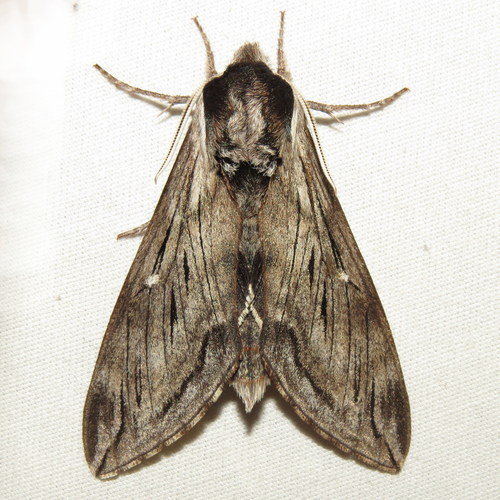
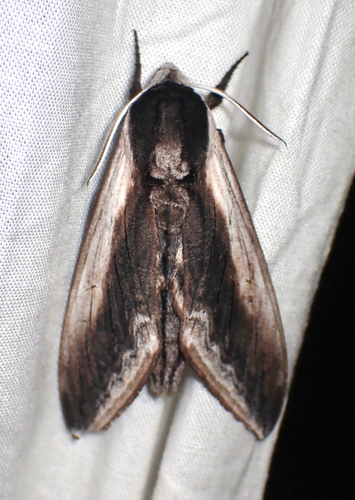
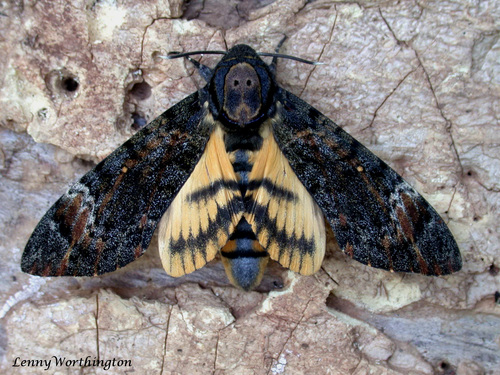
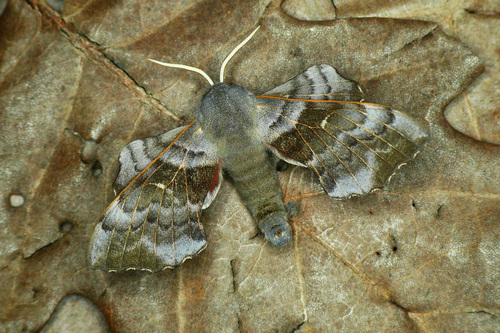
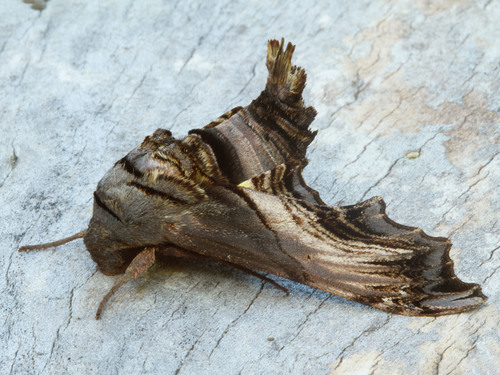
This species, Sphecodina abbottii Swainson, 1821, is a moth with distinctive physical and behavioral traits across its life cycle. Adults have underwings marked by a prominent yellow band; when in flight, they produce a buzzing sound that makes them resemble bees. Fresh adult forewings are violet grey, featuring a barklike pattern of swirling black lines, as described by David Beadle and Seabrooke Leckie. When at rest, adult moths raise their abdomens; their camouflage lets them blend in well on tree bark, where they look like broken branches. Early larval instars are pale greenish white. Young larvae have a horn near the hind end, which develops into a brown knob as larvae mature. Fully grown final instars measure 75 mm in length and occur in two distinct color patterns. The first pattern has brown bands that form ten large pale green spots along the back, plus an eyespot on the rear; this form may mimic grapes. The second pattern is completely brown with a wood-grain pattern, and also has a rear eyespot. On final instars, the knob strongly resembles a vertebrate eye, even including a small white spot that mimics an eye reflection. If pinched or prodded, the larva will squeak and bite at its attacker. This moth is distributed across central and eastern North America. It has not been recorded from most of Florida.