About Sphecius grandis (Say, 1823)
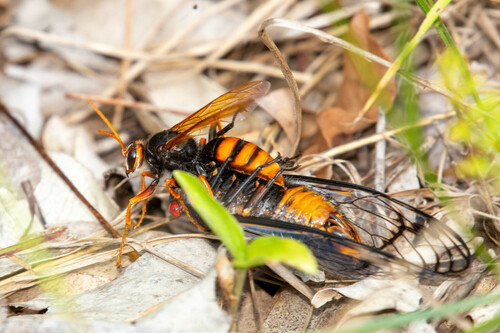
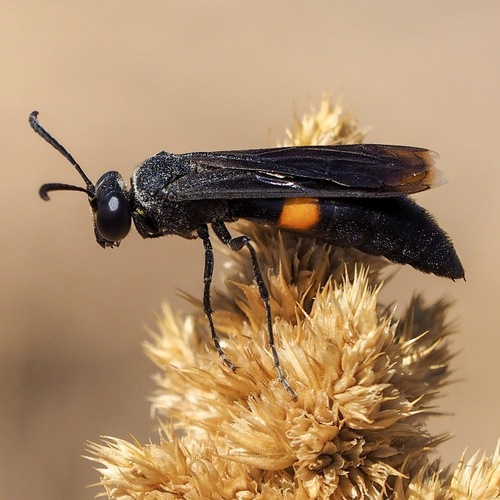
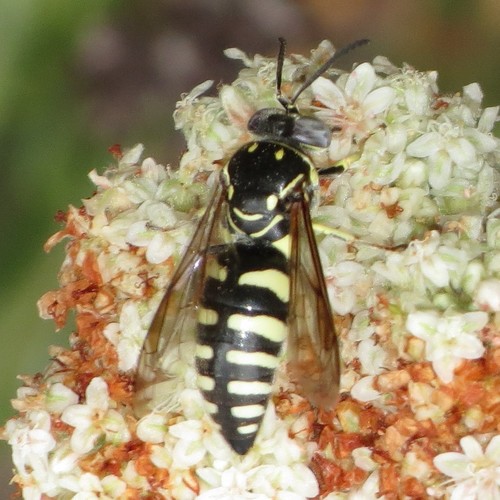
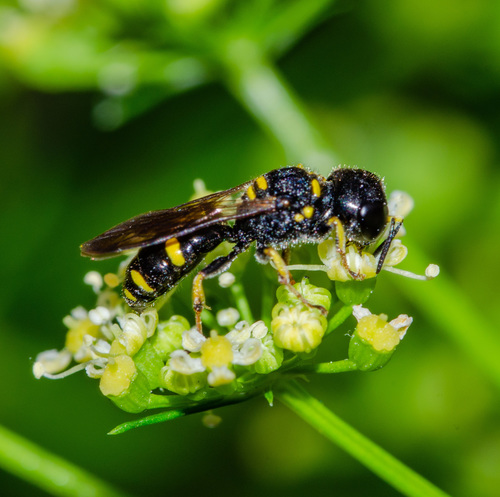
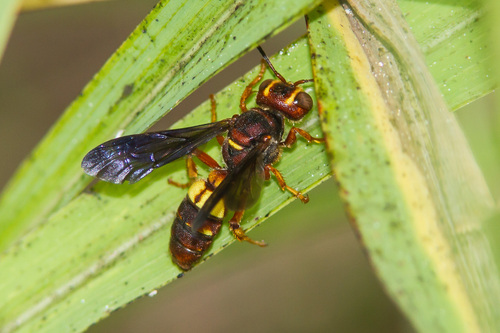
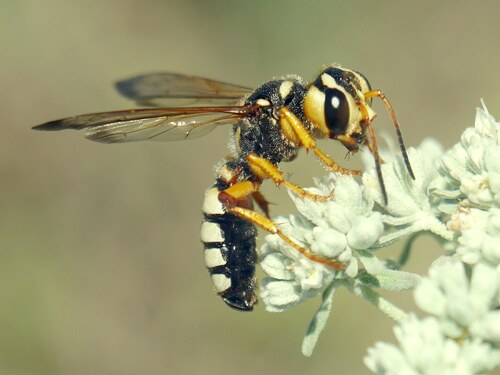
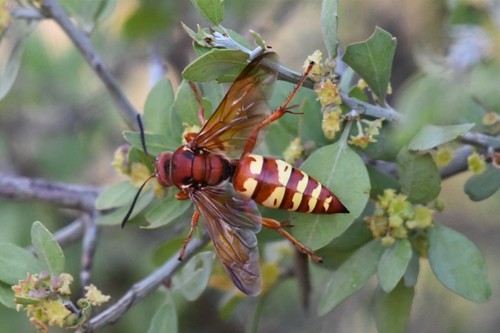
The western cicada killer, Sphecius grandis, ranges in length from 3 to 5 cm (1 to 2 in). It is very similar to its close relative the eastern cicada killer, Sphecius speciosus, with a rufous black body color, amber stripes, and a yellow abdomen. This species has rufous spots on its first and second tergites; yellow markings are usually present from the first to fifth tergite, though there is some individual variation. On average, female forewing length measures between 2.5 and 3 cm (0.98 and 1.18 in). Females are larger than males, and live for one year, which is just long enough to produce a single brood, while males die only a few days after emerging, which is just enough time to mate with a female. In A Natural History of the Sonoran Desert, author Steven J. Phillips notes that western cicada killers superficially resemble "huge yellowjackets or hornets", and describes them as "powerful fliers with compound eyes". On average, males weigh 95 mg, while females are much heavier at 256 mg; this weight difference is likely due to the additional mass of ovaries, developing eggs, and nutritional reserves in females. Despite this size difference, the ratio of flight muscle mass to total body mass is identical for both sexes. Distinguishing S. grandis from the other four New World Sphecius species (S. convallis, S. hogardii, S. speciosus, and S. spectabilis) is difficult. Originally, female S. convallis were distinguished from female S. grandis by S. convallis having yellow markings only on the first to third gastral tergites, while S. grandis was said to have yellow markings on all tergites. Researchers later found this trait was not reliable for correct identification, because marking position varies even within the same species. In 2004, Charles W. Holliday and Joseph R. Coelho created a new identification key for Sphecius species, after examining 4,451 wasps across the five New World species. They found that 98% of examined female S. convallis had yellow markings on gastral tergites one to four or fewer, while 98% of S. grandis had yellow markings from tergite one to five or more. The 2% of S. grandis with overlapping marking patterns to S. convallis can be identified by the punctation density and color of the first tergum compared to the second. Marking patterns on male S. grandis match those of females of the species. Western cicada killers are generally found at higher altitudes than most other Sphecius species, and co-occur (are sympatric) with S. convallis and S. speciosus, even though S. grandis averages a higher elevation than S. convallis. One study recorded a mean elevation of 755 m ± 23.3 m for S. grandis, compared to lower mean elevations for other measured species: 219 m ± 4.7 m for S. speciosus, 582 m ± 30.9 m for S. convallis, and 18 m ± 5 m for S. hogardii. This species occurs in both the Nearctic and Neotropical realms, ranging from Central America north to the Western United States. In the U.S., it is found in New Mexico, California, every state west of the Rocky Mountains except Wyoming, plus Kansas, Oklahoma, and Nebraska. S. grandis is most commonly found in riparian zones. It has been recorded in multiple regions of Mexico: Baja California Norte, Baja California Sur, Coahuila, Nuevo Leon, Tamaulipas, and Yucatán. It has also been observed in Granada, Nicaragua; Guanacaste, Costa Rica; and Honduras.