About Spatula platalea (Vieillot, 1816)
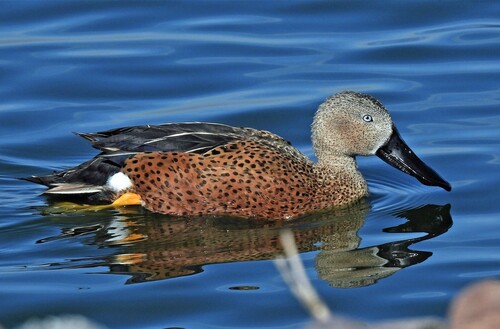
This species, Spatula platalea, commonly called the red shoveler, has a spatula-shaped bill, a green speculum, and light blue upper wing coverts. Male shovelers range in color from red to paler red or pink shades, while females typically have large, dark bills. Adults measure around 45–56 centimetres (18–22 inches) in length, weigh 523–608 grams (1.153–1.340 pounds), and have a wingspan of 66–73 centimetres (26–29 inches). The red shoveler breeds in the southern half of South America. Its breeding range extends north from Tierra del Fuego to Chile, most of Argentina, and the Falkland Islands, with small isolated breeding populations in southern Peru, Bolivia, and Paraguay. Isolated populations also occur further inland and in coastal areas of extreme southern Brazil and Uruguay. It lives in shallow lakes and pools with dense reed beds, intertidal mangrove swamps, and marshes, and can also be found in brackish waters including coastal lagoons, deltas, and estuaries. The diet of red shovelers includes herbs, grasses, pond weeds, widgeon grass, algae, eelgrass, and small invertebrates. Its bill has a lamellate filtering mechanism that lets the bird extract small food items from water. Pairs form on wintering grounds after typically noisy courtship. After a clutch of 7–8 eggs is laid, incubation takes 25–26 days, and chicks fledge after 40–45 days. Red shovelers are partially migratory; the southernmost populations migrate north for the winter.