About Spatula cyanoptera (Vieillot, 1816)
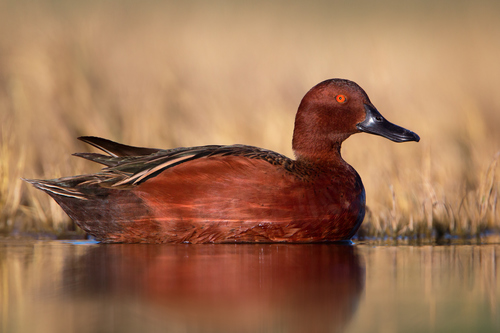
This species, Spatula cyanoptera, is commonly known as the cinnamon teal. Adult males have a cinnamon-red head and body, a brown back, a red eye, and a dark bill. Adult females have a mottled brown body, pale brown head, brown eyes, and a grey bill. They closely resemble female blue-winged teal, but have richer overall color, less distinct lores, eye line, and eye ring, along with a longer, more spatulate bill. Juvenile males resemble female cinnamon teal or female blue-winged teal, but have red eyes. Adults measure 16 inches (41 cm) in length, have a 22-inch (560 mm) wingspan, and weigh 14 ounces (400 g). They undergo two adult molts per year, plus a third molt in their first year. The cinnamon teal is an aquatic bird, and is also able to run and walk on land to hunt small prey such as bugs and insects. When not foraging for bugs in water or on land, they sleep. Females sleep huddled together, while males stay awake and alert to protect the group. Unlike most ducks that produce loud quacking, the cinnamon teal is quieter. Females make a loud quack when needed, while males produce a nasal, whistling call. Their breeding habitat consists of marshes and ponds in the western United States and extreme southwestern Canada; they are rare visitors to the east coast of the United States. A young male cinnamon teal was spotted in Grimsby, Ontario, and became a tourist attraction due to its rarity outside of western Canada. Cinnamon teal generally select new mates each year. They are migratory, and most individuals winter in northern South America and the Caribbean, generally not migrating as far as blue-winged teal. Some individuals winter in California and southwestern Arizona. Two subspecies of cinnamon teal live in the Andes of South America. The smaller subspecies, S. c. cyanoptera, is widespread at low elevations below 1000 meters, including coastal Peru and southern Argentina, while the larger subspecies S. c. orinomus lives at elevations of 3500–4600 meters in the central Andes.