About Spartium junceum L.
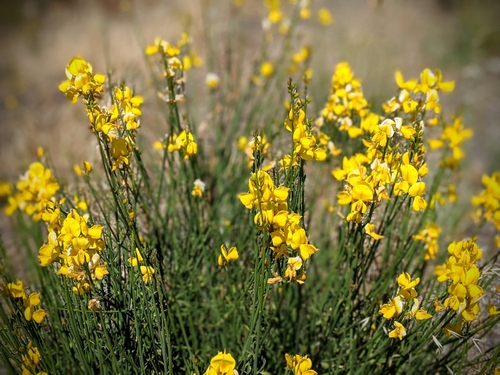
Spartium junceum L. is a vigorous deciduous shrub that typically grows 2–4 meters (7–13 feet) tall, and rarely reaches 5 m (16 ft). Its main stems are usually up to 5 centimeters (2 inches) thick, and occasionally up to 10 cm (4 in). It produces thick, somewhat succulent grey-green shoots that resemble rushes, with very sparse small deciduous leaves. The leaves measure 1 to 3 cm (1⁄2 to 1+1⁄4 in) long and up to 4 millimeters (1⁄8 in) wide. Leaves are not critical to the plant, as most photosynthesis occurs in the green shoots; this is a water-conserving adaptation to dry climates, and the leaves drop off early. In late spring and summer, the shoots are covered in an abundance of fragrant yellow pea-shaped flowers that are 1 to 2 cm across. By late summer, mature black legume seed pods form, reaching 8–10 cm (3–4 in) long. The pods burst open, often with an audible crack, to spread seed away from the parent plant. This species is native to the Mediterranean region, including southern Europe, southwest Asia and northwest Africa, where it grows in sunny locations, usually on dry, sandy soils. A small number of intoxication cases from Spartium junceum have been recorded, including accidental ingestion of different plant parts by children. All parts of the plant contain toxic alkaloids. These alkaloids first cause temporary stimulation of nicotinic cholinergic receptors, followed by long-lasting inhibition from receptor desensitization. One alkaloid, sparteine, affects the heart by reducing its sensitivity and conductivity. Symptoms of poisoning vary based on dose, exposure method, and time since exposure; they include irritation of the oral and pharyngeal mucosa, hypersalivation, vomiting, stomach pain and diarrhea. Severe cases may involve neurological symptoms such as mydriasis, headaches, delirium and convulsions, alongside hypotension, bradycardia, and coma. Spartium junceum is used as an ornamental plant for gardens and landscape plantings, and has received the Royal Horticultural Society's Award of Garden Merit. In Bolivia and Peru, where it is called retama (not to be confused with the genus Retama), it has become invasive in some areas. It is one of the most common ornamental plants there, and is often found growing along sidewalks in La Paz. It has a long history of traditional use: it has been used to produce fiber, especially for tying vines, grown as a hedge for its nitrogen-fixing properties, used as a flavoring, and processed for its essential oil known as genet absolute. Its fibers have been used to make cloth, it produces a yellow dye, and its branches are used to make brooms.