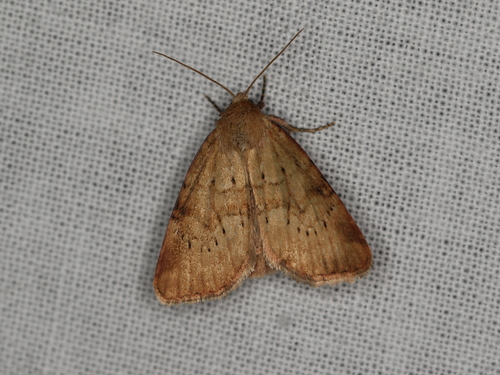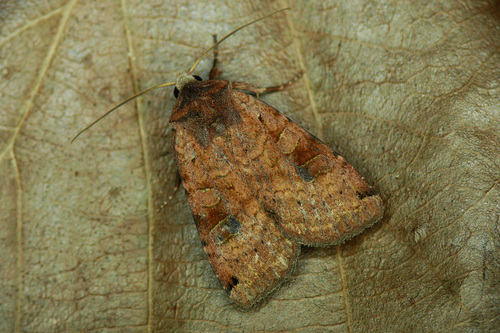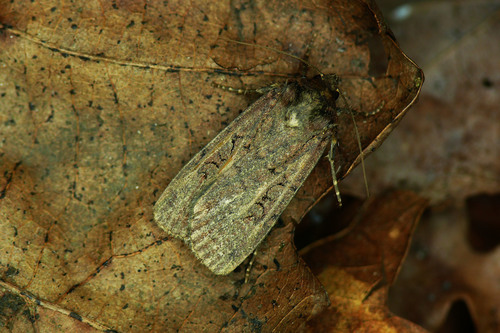
About Spaelotis ravida (Denis & Schiffermüller), 1775
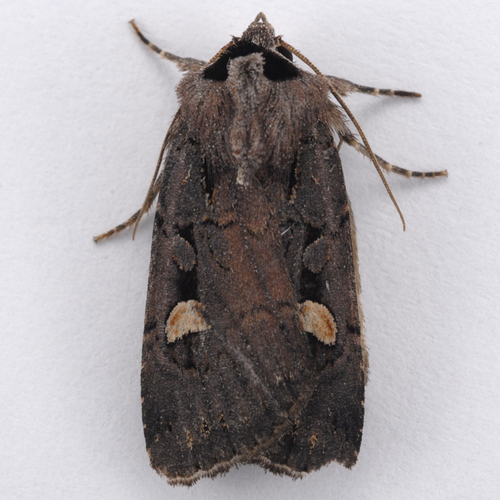
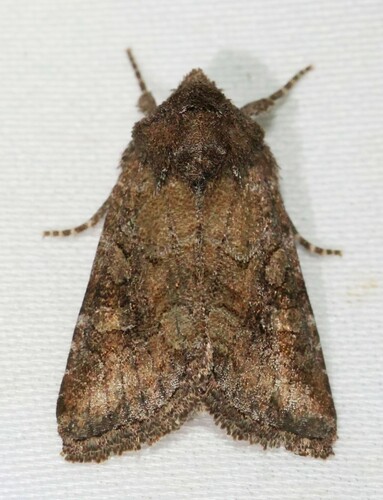
Spaelotis ravida, commonly known as the stout dart, is a moth species belonging to the family Noctuidae. It was first formally described by Michael Denis and Ignaz Schiffermüller in 1775. This species is distributed across the Palearctic realm. The wingspan of adult Spaelotis ravida measures approximately 42 to 50 mm. In his description, Meyrick notes that male individuals have ciliated antennae. The forewings are fuscous, with a rosy tinge toward the costa, and feature an obscure blackish median dash starting from the base. The sub-basal, first, and second lines are slightly paler with obscure darker edges, and are distinct on the costa. The orbicular and reniform markings are partially outlined in black; sometimes they are connected by a blackish mark or touch one another, and the orbicular marking is rather elongated. The subterminal line is pale, with somewhat darker suffusion on its anterior side. The hindwings are fuscous-whitish, and become darker toward the posterior. The larva is ochreous-brown, with a somewhat paler dorsal line. It has a subdorsal series of curved, or sometimes nearly straight, oblique yellowish marks, edged with dark fuscous along the upper edge. The larval head is grey, with fuscous markings. Adult moths are active in flight from July to August. The larvae feed on plant species from the genera Artemisia, Cirsium, Rumex, and Taraxacum. Spaelotis ravida is suspected to have ceased being a resident species in the United Kingdom after disappearing during the first decade of the 21st century.