About Sorghum halepense (L.) Pers.
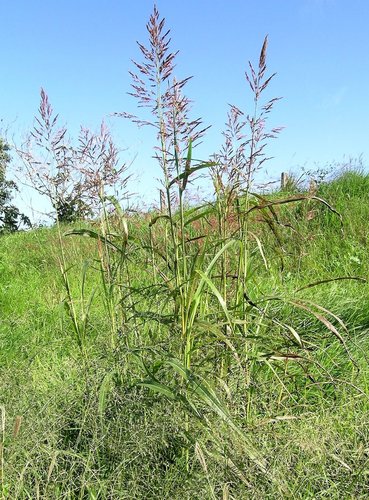
Johnson grass (also written as Johnsongrass), with the scientific name Sorghum halepense, is a grass species belonging to the family Poaceae. It is native to Asia and northern Africa, and has been introduced to every continent except Antarctica, as well as most large islands and archipelagos. Johnson grass reproduces via both rhizomes and seeds.
It has been used as forage and to control erosion, but is often classified as a weed for several reasons. Foliage that wilts from frost or hot, dry weather can hold enough hydrogen cyanide to kill cattle and horses if eaten in quantity, and can also cause bloat in these herbivores from accumulated excess nitrates; it is edible when these conditions do not apply. It grows and spreads very quickly, and can outcompete and eliminate other cash crops planted by farmers. This species grows in crop fields, pastures, abandoned fields, rights-of-way, forest edges, and along streambanks. It grows best in open, disturbed, rich bottom ground, especially in cultivated fields. Populations of Johnson grass resistant to the common herbicide glyphosate have been found in Argentina and the United States. It is counted as one of the ten worst weeds in the world. In the United States, 19 states list Johnson grass as either a noxious or quarantined weed. Along with Sorghum bicolor, it is a parent of Sorghum × almum, a forage crop that is also considered a weed in some locations.
Johnson grass is named for Colonel William Johnson, an Alabama plantation owner who sowed its seeds on river-bottom farmland around 1840. The species was already established in several US states a decade before this, having been introduced either as a potential forage crop or accidentally as a contaminant in seed lots. In Talladega County, Alabama, in the early 20th century, opinions of Johnson grass were mixed. It was recognized as a nutritious, palatable, and productive forage, but many farmers still found it undesirable. Fields of Johnson grass became "sod bound", producing insufficient new growth, unless plowed every two to three seasons. A genetic study that used microsatellite markers to examine Johnson grass populations across 12 US states confirmed the species was introduced to the US from Alabama and North Carolina. The study also found a previously unreported independent introduction in Arizona. After the construction of trans-continental railroads, the two original founding populations began to intermix around Texas, shifting genetic diversity away from the original introduction centers.
The 1889 book *The Useful Native Plants of Australia* records that Sorghum halepense is a "strong, erect-growing species, varying from two to ten feet high, succulent when young, a splendid grass for a cattle run, though not much sought after by sheep. It is a free seeder. The settlers on the banks of the Hawkesbury (New South Wales) look upon it as a recent importation, and seed of it has been distributed under the name of Panicum speciabile. (WooUs) Coast of Queensland, New South Wales, and Western Australia."