About Sorex trowbridgii Baird, 1857
Scientific Naming and Body Shape
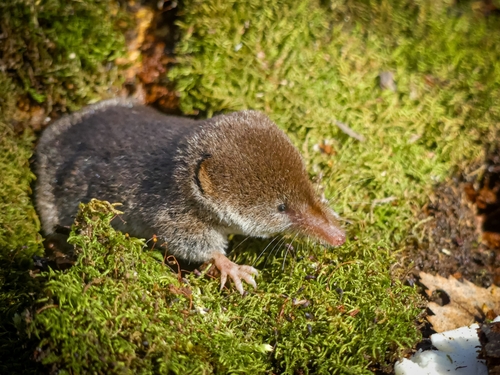
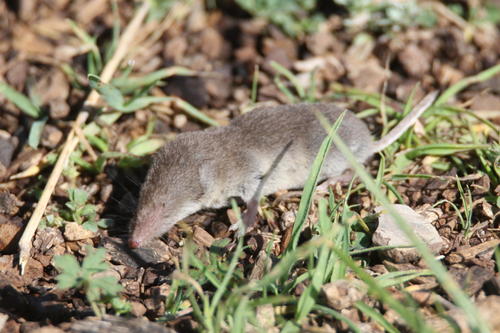
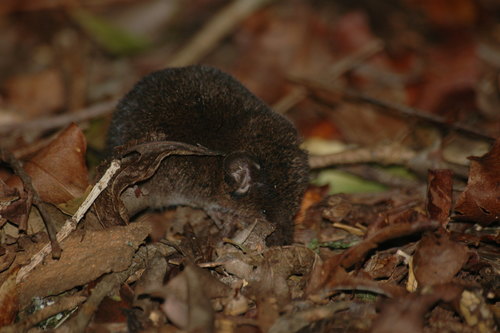
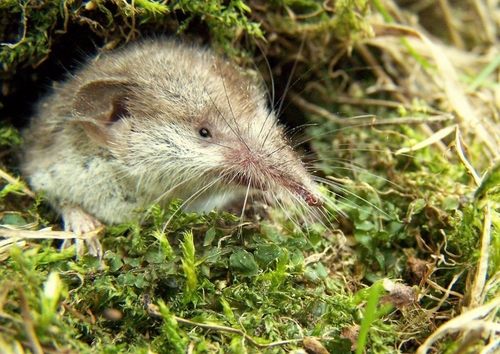
Trowbridge's shrew, scientifically named Sorex trowbridgii Baird, 1857, is a medium-sized shrew with a long tail.
Weight
Non-breeding individuals weigh approximately 3.8 g (0.13 oz), while breeding individuals average around 5 g (0.18 oz).
Annual Fur Color Variation
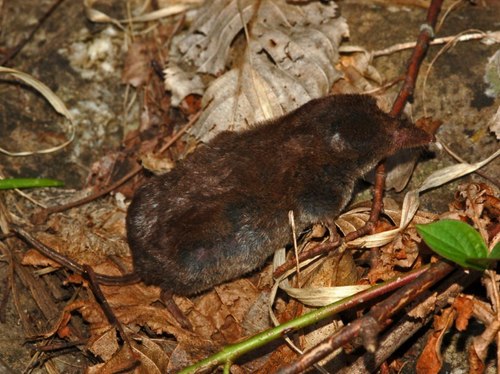
Their fur color changes annually: they have a darker, more brownish coat in summer and a lighter gray coat in winter.
Molting Pattern
They grow two coats per year via one summer molt and one winter molt.
Coat Characteristics
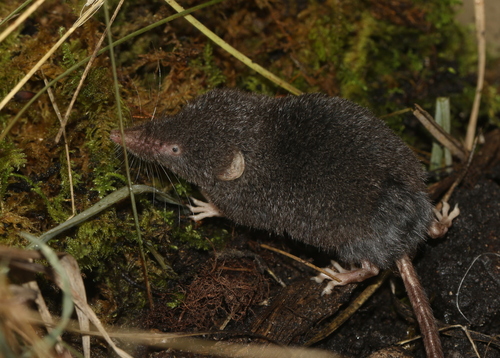
The winter coat is thick and gray, and the summer coat is lighter and dark brown.
Tail Hair Age Variation
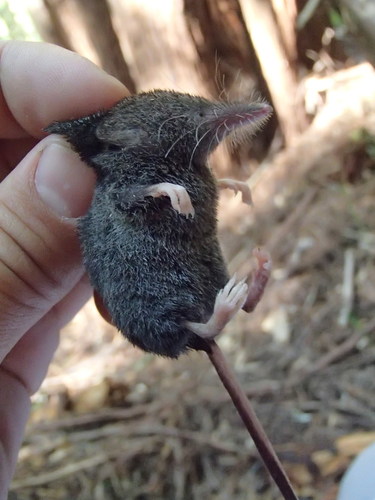
Young shrews have a hairy tail that becomes less hairy as they age.
Tail Coloration and Identification Trait
The tail is bi-colored, darker on the top than the bottom, with a sharp line separating the two colors; this trait helps distinguish Trowbridge's shrew from similar species.
Whiskers and Ear Features
Trowbridge's shrew has many long whiskers, and its ears are mostly covered in fur.
Foot Structure and Color
They are pentadactyl, with feet colored whitish to light tan.
Dental Pigmentation and Formula
The caps of their teeth have dark reddish-brown pigmentation, and their dental formula is 1.5.1.3 / 1.1.1.3 = 32.
Skull Size Comparison
The skull is similar in size to the skulls of other long-tailed shrews.
Unicuspid Identification Feature
This species can be told apart from closely related shrews by its third unicuspid, which is smaller than the fourth.
Additional Skull Distinguishing Features
Additional distinguishing skull features include a post-mandibular foramen, a more posteriorly positioned orbit, and specific positioning of the lacrimal and infraorbital foramina relative to the molars.
Dusky Shrew Differentiation Traits
Four traits distinguish Trowbridge's shrew from the dusky shrew: a curved first upper incisor, a bicolored tail, a pigmented ridge on upper unicuspid teeth separated from the cingulum by a longitudinal groove, and a medial tine on the first upper incisor that sits above the tooth's pigmented area.
General Distribution
Trowbridge's shrew is found along the western coast of North America.
Northern Range Extent
Its range extends from extreme southwestern British Columbia, south of Burrard Inlet, through western Washington and western Oregon.
California Distribution Split
In northern California, the distribution splits: the western population continues south through the Coast Ranges to Santa Barbara County, while the eastern population extends south through the Warner Mountains and Sierra Nevada to Kern County.
Subspecies Distribution
Different subspecies occupy different regions across this range.
Elevation Range
The species occurs from sea level up to an elevation of 1,820 m (5,970 ft).
General Habitat Requirements
It inhabits forested areas where the ground is littered with debris that provides cover.
Logged Area Habitat Use
It may stay in logged areas if sufficient ground cover remains.
Forest Habitat Types
It can be found in dry forests, moist forests, and swampy woodlands.
Destruction Island Habitat
Populations on Destruction Island off the Washington coast live in deep rank grass near salmonberry patches.
Streamside Occurrence
Trowbridge's shrew is less commonly found near streams.
Southern Range Habitat
In the southernmost parts of its range, it may occur in chaparral.
Ecological Niche Role
Trowbridge's shrew fills an important ecological niche.
Known Predators
Known predators include raptors such as the barred owl (Stirix varia) and the Pacific giant salamander (Dicamptodon sp.).
Domestic Cat Interaction
Domestic cats are known to kill Trowbridge's shrews, but usually do not eat them.
Documented Parasites
Documented parasites include multiple species of ticks, mites, chiggers, fleas, worms, and single-celled organisms.
Population Abundance Assumption
Because Trowbridge's shrew is the most frequently captured shrew within its range, it is assumed to be the most abundant shrew species in this area.
Lifespan
Their lifespan is approximately 1.5 years.
Annual Activity Pattern
They do not hibernate and remain active year-round.
Seasonal Population Variation
Their population is roughly twice as abundant in fall as it is in spring.
Primary Diet Components
Insects are their primary food source, but they also eat spiders, worms, and centipedes.
Common Stomach Content Items
Stomach content analysis shows the most commonly consumed items are centipedes (Chilopoda), spiders (Araneae), invertebrate internal organs, slugs and snails (Gastropoda), and unidentified invertebrate material.
Reproductive Season Food Consumption
Food consumption is highest during the reproductive season.
Vegetable Matter Consumption
They also eat plants, and consume more vegetable matter than other shrews in the genus Sorex.
Winter Plant Food Sources
In winter, they may feed on conifer seeds from Douglas-fir and pine, as well as other plant seeds.
Dispersal Barrier Hypothesis
It is unclear whether Trowbridge's shrew is a strong swimmer like some other shrew species, so rivers may act as a barrier to dispersal for this species.
Range Data Limitation
Some information about the species' full range is extrapolated from studies of other species.
Sexual Maturity Body Mass Change
When Trowbridge's shrews reach sexual maturity, they gain overall body mass.
Breeding vs Non-Breeding Weight
As noted, non-breeding shrews weigh around 3.8 g (0.13 oz) while breeding shrews average 5 g (0.18 oz).
Breeding Season Reproductive Organ Changes
In males, testes size increases during breeding; in females, uterine horns widen.
Post-Breeding Reproductive Organ Atrophy
Both structures atrophy once the breeding season ends.
Sexual Maturity Climate Variation
The age when sexual maturity begins varies with local climate, maturing earlier in warmer areas.
Sexual Maturity Gender Difference
Males reach sexual maturity an average of two weeks earlier than females.
Concurrent Pregnancy and Lactation
Pregnant lactating females have been recorded, so it is suspected that females can become pregnant while nursing young from an earlier brood.
Average Brood Size
Average brood size ranges from 3 to 5.
Northern Range Reproductive Variation
In more northern parts of the range, pregnant females have fewer embryos, and the breeding season is shorter.
Regional Breeding Season Timing
The breeding season runs from March to May in Washington, and from February to June in California.