About Sorbus commixta Hedl.
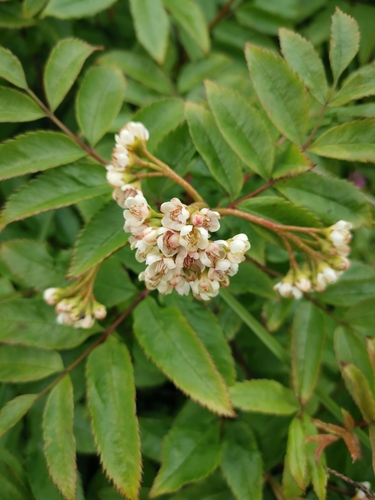
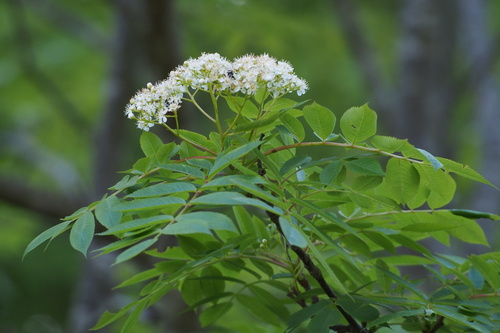
Sorbus commixta Hedl. is a small to medium-sized deciduous tree that reaches 7–10 m (23–33 ft) tall, and rarely grows as tall as 18 m (59 ft). It naturally grows in mixed forests and on mountain slopes. This species has a rounded crown and bark that ranges from brownish to silvery-grey. Its leaves are pinnate, and 20–30 cm (8–12 in) long overall. Each leaf is made up of 11–17 leaflets, which measure 4–7 cm (2–3 in) long and 1–2.5 cm broad, with an acuminate apex and serrated margins. In autumn, the leaves turn deep purple or red. The 6–10 mm diameter flowers have five white petals and 20 yellowish-white stamens. Flowers are borne in corymbs 9–15 cm (4–6 in) in diameter, produced from late spring to early summer. The fruit is a bright orange to red pome 7–8 mm in diameter, which matures in autumn. Plants native to Hokkaidō, the Kuril Islands, and Sakhalin are sometimes separated as Sorbus commixta var. sachalinensis; this variety has larger leaflets that can grow up to 9 cm long. Sorbus commixta is cultivated as an ornamental tree, and is hardy in USDA zones 5-9. It grows best in moist, well-drained soil located in full sun. A number of cultivars have been selected for cultivation; the most popular are 'Embley', which has fastigiate branching, and 'Serotina', which flowers later in early summer. The 'Embley' cultivar has received the Royal Horticultural Society's Award of Garden Merit.