About Sorbus aucuparia subsp. glabrata (Wimm. & Grab.) Hedl.
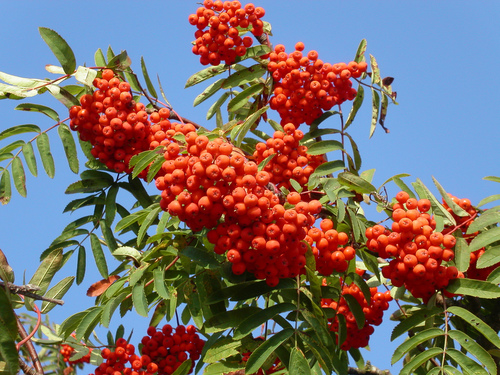
Sorbus aucuparia, the parent species of Sorbus aucuparia subsp. glabrata, grows as a small tree or shrub reaching 5 to 15 m (15 to 50 ft) in height. It has a wide, loose, roundish or irregular crown, and often develops multiple trunks. Individual trunks are slender and cylindrical, growing up to 40 cm (15+1⁄2 inches) in diameter; branches extend outward and angle upward. Young bark is yellowish-gray, shiny, and becomes gray-black with lengthwise cracks that peel in small flakes on older trees. Elongated lenticels on the bark are bright ocher colored. Sorbus aucuparia rarely lives longer than 80 years, making it one of the shortest-lived tree species in temperate climates. Its wood has broad reddish-white sapwood and light brown to reddish-brown heartwood. It is diffuse-porous, flexible, elastic, and tough, but not durable, with a dried density of 600 to 700 kg/m³ (1,000 to 1,200 pounds per cubic yard). Roots grow wide and deep, and the plant can produce root sprouts and regenerate after coppicing. Its leaves are pinnately compound, with 4 to 9 pairs of leaflets arranged along a round central vein, plus a single terminal leaflet. Leaves grow up to 20 cm (8 in) long and 8 to 12 cm (3 to 4+1⁄2 in) wide, with paired leaf-like stipules at the base of the petiole, and are arranged alternately along branches. This alternate arrangement, paired with the presence of stipules, distinguishes it from common ash (Fraxinus excelsior), which has opposite leaves and no stipules. Leaflets are elongated-lanceolate, 2 to 6 cm (3⁄4 to 2+1⁄4 in) long and 1 to 2.5 cm (1⁄2 to 1 in) wide, with sharply serrated margins. Except for the outermost leaflet, leaflets have very short stems or sit directly against the central vein. Newly sprouted leaflets are covered in gray-silvery hairs, but become mostly hairless after fully unfurling. The upper leaf surface is dark green, while the underside is grayish-green and felted. Crushed young leaflets have a marzipan scent, and the base of each leaflet is asymmetrical. Foliage emerges in May, and turns yellow in autumn, or dark red when growing in dry locations. Buds are usually longer than 1 cm (3⁄8 in), and are covered in flossy to felted hairs that fade over time; these hairs cover dark brown to black bud scales. Terminal buds are oval and pointed, and are larger than axillary buds, which are narrow, oval, pointed, held close to the twig, and often curve toward it. Sorbus aucuparia is monoecious, reaching reproductive maturity at 10 years old and produces abundant fruit nearly every year. It flowers from May to June, and occasionally flowers again in September, producing many large, upright, bulging yellowish-white corymbs that each hold around 250 flowers. Individual flowers are 8 to 10 mm (3⁄8 inch) in diameter, with five small yellowish-green triangular sepals that may be hairy or hairless. They have five yellowish-white round or oval petals, up to 25 stamens fused with the corolla to form a hypanthium, and an ovary with two to five styles; the style is fused to the receptacle. Flowers have an unpleasant odor of trimethylamine, and their nectar is high in fructose and glucose. The fruit are round pomes 8 to 10 mm (5⁄16 to 3⁄8 inch) in diameter that ripen from August to October. Unripe fruit are green, and typically turn orange or scarlet when ripe. The sepals remain as a black five-pointed star on the surface of ripe fruit. Each corymb holds 80 to 100 pomes, and each pome contains a star-shaped ovary with two to five locules, each holding one or two flat, narrow, pointed reddish seeds. Fruit flesh contains carotenoids, citric acid, malic acid, parasorbic acid, pectin, provitamin A, sorbitol, tannin, and vitamin C; seeds contain glycoside. On average, fruit persist for 100.6 days, contain 2.5 seeds each, and are 73.0% water by weight. Dry fruit weight is made up of 8.9% carbohydrates and 3.1% lipids. The base species Sorbus aucuparia has a chromosome number of 2n=34. Sorbus aucuparia is divided into five accepted subspecies. Sorbus aucuparia subsp. aucuparia is found across most of the species' total range, and is less common in southern regions. Sorbus aucuparia subsp. fenenkiana (Georgiev & Stoj.) has thin, sparsely hairy leaflets and depressed-globose fruit, and is restricted to Bulgaria. Sorbus aucuparia subsp. glabrata (Wimm. & Grab.) Hedl., the subspecies described here, has less hair than other subspecies, and is found in Northern Europe and the mountains of Central Europe. Sorbus aucuparia subsp. praemorsa (Guss.) has hairy leaflets and ovoid fruit, and is found in Southern Italy, Sicily, and Corsica. Sorbus aucuparia subsp. sibirica (Hedl.) is nearly hairless, and is found in Northeastern Russia. The full species Sorbus aucuparia occurs across nearly all of Europe and the Caucasus, ranging north to Northern Russia and Siberia. It is not native to Southern Spain, Southern Greece, Sardinia, the Balearic Islands, the Azores, and the Faroe Islands. It was introduced to North America as an ornamental species, and has naturalized very successfully across the continent, from Washington to Alaska, eastward across Canada and into the northeastern United States. It grows widespread from low plains up to mountains, reaching as high as the alpine tree line, where it grows as the only deciduous tree species within krummholz. In the Alps, it grows at elevations up to 2,000 m (6,600 ft). It occurs north of the boreal forest at the arctic tree line; in Norway, it is found as far north as the 71st parallel north. Sorbus aucuparia is undemanding, can tolerate shade, is frost hardy, and withstands winter dryness and short growing seasons. It is also resistant to air pollution, wind, and snow pressure. It most often grows on moderately dry to moderately damp, acidic, low-nutrient, sandy, loose soil. It frequently grows in stony soil or clay soil, and may also grow in sandy soil or wet peat. It grows best on fresh, loose, fertile soil with average humidity, and cannot tolerate saline soil or waterlogging. It occurs in all types of open woodland, grows as a pioneer species on fallen dead trees or in clearcut areas, and is found along forest edges and roadsides. Its seeds germinate easily, so it may even establish on inaccessible rock outcrops, ruins, branch forks, or hollow trees. Exceptionally large specimens have been recorded in Europe: the tallest known individual in the United Kingdom grows in the Chiltern Hills of South East England, reaching 28 m (92 ft) tall with a 56 cm (22 in) trunk diameter. In Germany, an unusually large specimen near the village of Wendisch Waren in Mecklenburg-Vorpommern stands over 15 m (49 ft) tall, is around 100 years old, and has a 70 cm (28 in) trunk diameter. The tallest known specimen in Ireland is an 18 m (59 ft) individual growing at Glenstal Abbey, County Limerick. In ecology, Sorbus aucuparia is pollinated by bees and flies. Its seeds are not digested by birds, so they are dispersed when birds pass intact seeds in their droppings. The fruit is eaten by around 60 species of birds and several mammal species. It is especially favored by thrushes and other songbirds, and is also eaten by cloven-hoofed game, red fox, European badger, dormouse, and squirrel. Migratory birds including Bohemian waxwing, spotted nutcracker, and redwing eat the fruit during winter. Cloven-hoofed game also heavily browse the plant's foliage and bark. Sorbus aucuparia roots form symbioses most often with arbuscular mycorrhizal fungi, and less commonly with ectomycorrhizal fungi. The species is usually eventually outcompeted and replaced by larger forest trees. In Central Europe, it commonly grows in association with red elderberry, goat willow, Eurasian aspen, and silver birch. It is highly flammable, and does not tend to accumulate plant litter. Other Sorbus species readily hybridize with S. aucuparia, which can lead to hybrid speciation. Known hybrids include Sorbus × hybrida, a small tree with oval serrated leaves and two to three pairs of leaflets that is a hybrid with Sorbus × intermedia, and S. thuringiaca, a medium-sized tree with elongated leaves and one to three pairs of leaflets that are sometimes fused along the central vein, which is a hybrid with S. aria. The main pests of S. aucuparia are the apple fruit moth Argyresthia conjugella and the mountain-ash sawfly Hoplocampa alpina. The rust fungus Gymnosporangium cornutum causes leaf galls on the plant. Mature leaves are not palatable to insects, but they are used by insect larvae, including the moth Venusia cambrica, the case-bearer moth Coleophora anatipennella, and leaf-mining moths of the genus Stigmella. The snail Cornu aspersum feeds on Sorbus aucuparia leaves, and the plant can also be affected by fire blight.