About Sorbaria sorbifolia (L.) A.Braun
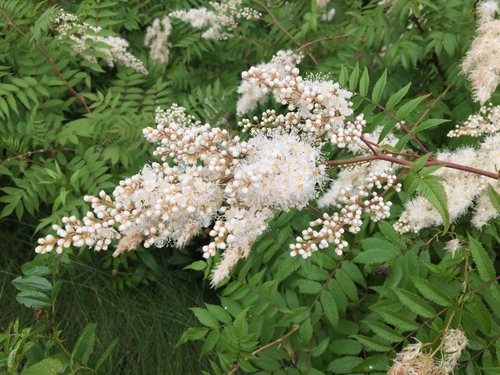
Sorbaria sorbifolia, commonly known as false spiraea (also spelled false spirea), is a species of flowering plant in the Rosaceae family. Additional common names for this plant include false goat's beard, sorb-leaved schizonotus, and Ural false spirea; in Chinese it is called 珍珠梅, pinyin zhen zhu mei, which translates literally to 'pearl plum'. This is a deciduous shrub that grows to between 1 and 1.5 metres (3.3 to 4.9 feet) tall. It produces compound, alternate, toothed leaflets that are often compared in appearance to ferns or sumac. Its Latin specific epithet sorbifolia translates to 'with leaves like Sorbus (mountain ash)'. When grown in good light, its leaves may turn red in autumn before falling off. Its white, showy flowers emerge in July and August, and grow in clusters at the ends of branches. Sorbaria sorbifolia grows naturally in temperate regions of Asia, including Siberia, the Russian Far East, northern China, Japan, and Korea. It has been introduced as a garden ornamental plant to other areas, including Europe and North America. The compact cultivar 'Sem' has multicoloured leaves in shades of yellow, bronze, and red, and produces more erect flower panicles than the wild species. This cultivar has received the Royal Horticultural Society's Award of Garden Merit. Sorbaria sorbifolia is classified as an invasive alien species in Finland.