About Somatochlora hineana Williamson, 1931
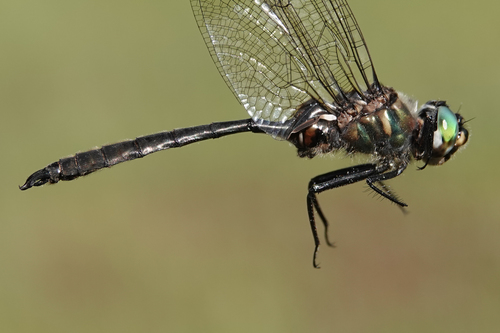
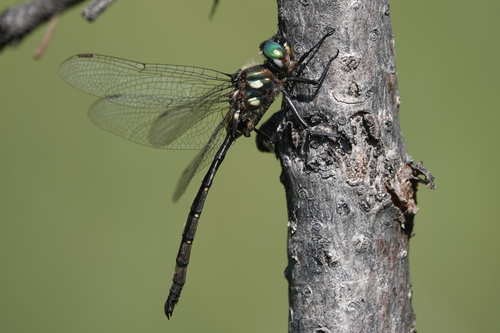
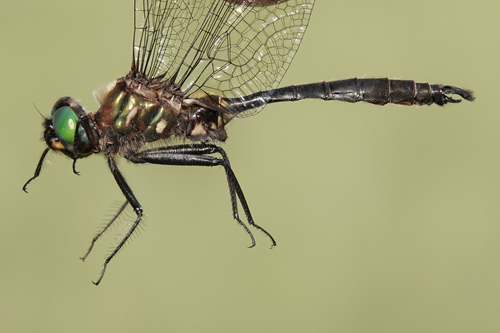
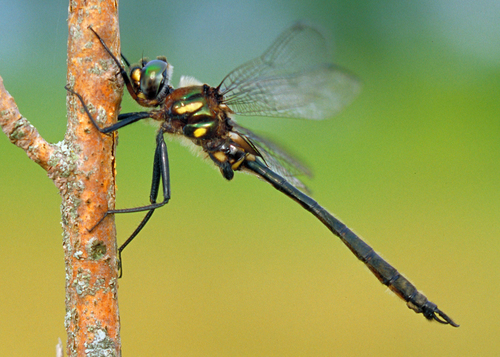
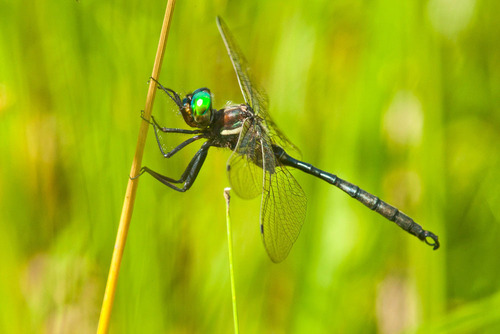
The appearance of Hine's emerald (Somatochlora hineana Williamson, 1931) changes over its lifespan. In the larval stage, nymphs have no unique features that set them apart from nymphs of other dragonfly species. A mature nymph is approximately 0.9 inches (2.3 cm) long. Several traits do distinguish adult Hine's emeralds from other dragonfly species. Adults have a distinct dark-green thorax marked with two yellow lateral stripes, and have uniquely shaped reproductive structures for both males and females. The eyes of a newly matured Hine's emerald are brown for the first 1–3 days of adulthood, and turn emerald green after this period. Their wings stay clear with amber coloring at the base until the end of their lives, when they become smoky in color. On average, a mature Hine's emerald is 2.5 inches (6.4 cm) long with a 3.5-inch (8.9 cm) wingspan. Females are slightly longer than males on average.
Hine's emeralds live in wetland, pond and pool, wet meadow, forest, and marsh habitats. Typical habitats for this species share several key characteristics: they contain slow-moving, mineralized streams; they include both open areas (for foraging) and wooded areas (for resting); they have crayfish burrows that nymphs use for shelter; they have exposed or lightly covered bedrock; and they provide dispersal pathways such as roadways, forest clearings, streams, and railroads. Other habitat features, like vegetation, differ between regions. The current range of Hine's emerald covers parts of the United States and Canada; within the U.S., it is found in Illinois, Michigan, Missouri and Wisconsin, and within Canada, it occurs in parts of Ontario. Historically, this species also lived in Ohio, Indiana, and Alabama, but it is likely no longer present in these states due to habitat modification. It is currently unknown whether Hine's emerald ever occurred in other U.S. states. Hine's emerald dragonfly was first formally described in 1931 near Indian Lake in Logan County, Ohio. The IUCN Red List records 47 confirmed existing locations for the species, including Ontario (Canada) and the U.S. states of Illinois, Michigan, Missouri, and Wisconsin; no recent sightings have been made in the former range states of Ohio, Alabama, and Indiana.
The current designated critical habitat for Hine's emerald totals 26,531 acres, concentrated across multiple counties in Illinois, Michigan, Missouri, and Wisconsin. Adjusted expected 20-year protection costs for this habitat range from $10.5 million to $25.2 million. The 2010 final critical habitat ruling differs substantially from the earlier initial proposal and first designation. The 2006 Critical Habitat Proposed Rule proposed 27,689 acres for protection, and considered excluding all Missouri populations and two Michigan populations. The 2007 original ruling designated only 13,221 acres for protection, meaning the 2010 ruling doubled the size of Hine's emerald critical habitat.
Multiple agencies work to protect Hine's emerald habitats. State and county agencies protect the habitats of three Hine's emerald subpopulations in Illinois. The University of Wisconsin and the Wisconsin Department of Natural Resources (WDNR) protect the Hine's emerald habitat at the Gardner Swamp Wildlife Area, which hosts the Ozaukee County, Wisconsin population; WDNR also protects the habitat of the Hine's emerald population in southwest Wisconsin. In Missouri, the U.S. Forest Service or the Missouri Department of Conservation protects most of the habitat for two of the state's Hine's emerald subpopulations. State and federal agencies protect habitats in the Northern Recovery Unit, covering five out of the 16 known subpopulations.
Before reproduction can take place, a male Hine's emerald must first establish a territory close to a body of water, ranging from 2–4 square metres (6.6–13.1 sq ft) in area. Males patrol their territories and defend them against other dragonflies of both their own and other species. Mating begins when a female flies into a male's territory; the male chases the female, latches onto her body, and the pair fly to nearby shrubs to copulate. After mating, the female repeatedly dips her abdomen into shallow water to lay her fertilized eggs. Hine's emeralds reproduce only once, and die shortly after reproduction. They breed in the months of June, July, and August.
Several species prey on Hine's emeralds: crayfish, turtles, amphibians, and other aquatic animals prey on nymphs, while spiders, frogs, birds, and large dragonflies prey on adults. Some of these predator-prey interactions may benefit Hine's emeralds. A 2006 paper suggests that devil crayfish (Lacunicambarus diogenes) help support populations of the Hine's emerald nymphs that they prey on. As Hine's emerald habitats dry out in late summer, crayfish burrows remain wet; nymphs that use these burrows have higher survival chances during droughts. The use of digger crayfish (Creaserinus fodiens) burrows by Hine's emerald nymphs has also been recorded in the Minesing Wetlands of Ontario. It is not known whether Hine's emeralds have similar mutually beneficial relationships with any other species.