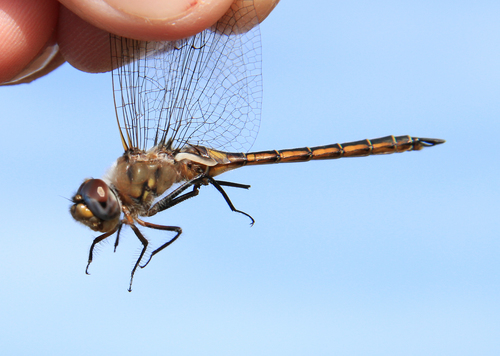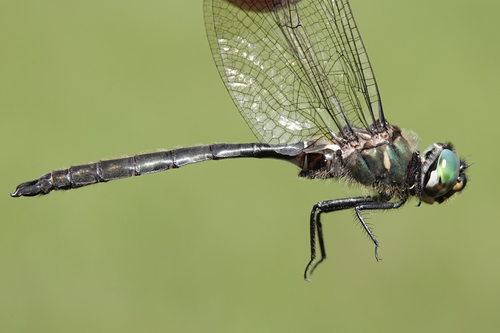
About Somatochlora brevicincta Robert, 1954
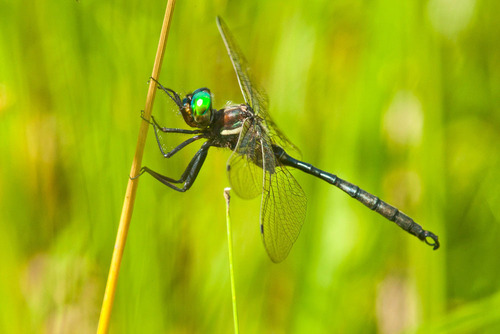
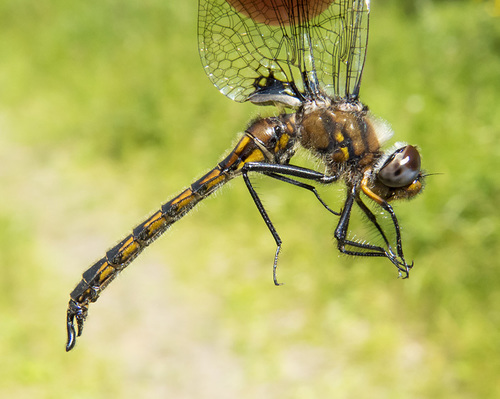
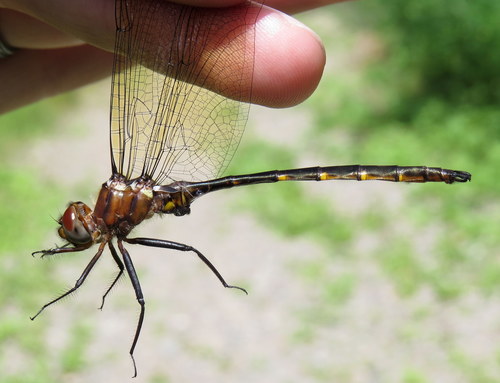
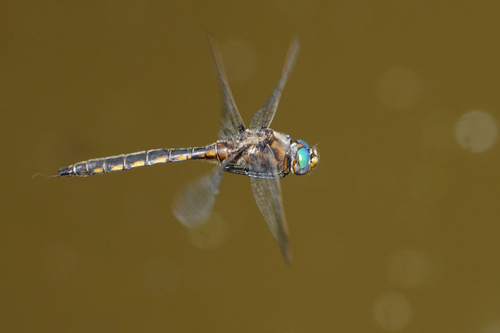
Somatochlora brevicincta (Quebec Emerald) is a dark northern emerald dragonfly. It has no prominent field marks other than its distinct rings, which places it in the ringed group of Somatochlora. These dragonflies are moderately sized and robust: their body length is typically around 5 cm (2.0 in), and their wingspan is around 6 cm (2.4 in), with size variation between the sexes. Females found in British Columbia are distinctly smaller than females from Eastern North America.
Somatochlora brevicincta is a trans-continental North American dragonfly found in Canada and the United States. Its type specimen was collected in the Lake Mistassini region of Quebec, around 50.5°N, 74°W. Before 1995, it had only been observed in a few isolated peatlands in Quebec. It currently is a documented resident of British Columbia, Ontario, Quebec, New Brunswick, and Newfoundland, and belongs to a group of subarctic species that are rarely found below 45 degrees N. It has been observed as far northwest as Willison Lake, British Columbia, and as far southeast as Piscataquis County, Maine. It is assumed to exist at scattered sites across Canada between these two locations. There are a small number of breeding populations in the United States, and the species was discovered relatively recently in Minnesota. The sparse number of observations of this species may be a result of inadequate surveying. An interactive map, photos, and catalogue of observed specimens is available on the Global Biodiversity Information Facility website. Because S. brevicincta is rare but broadly distributed across North America, with no documented evidence of intermediate populations connecting western and eastern groups, it is possible that the species actually encompasses more than one distinct species, though no supporting arguments for this hypothesis have been published to date.
Most odonates are warm-adapted, so their abundance and diversity decrease with increasing latitude and altitude. Somatochlora brevicincta prefers lentic bodies of water such as fens and heaths, and favors these habitats when they are found within or bordering bogs, rather than the open, firm-edged secondary ponds that occur within these bogs. Its microhabitat is characterized by water-suspended or water-saturated sphagnum and graminaceous emergents, which indicates a weakly minerotrophic environment. This species breeds in small water-filled hollows called flarks that are home to sedges, rushes, and mosses. Corduliid dragonfly larvae live in shallower water with leaf litter, so larvae of this species are vulnerable to habitat destruction caused by removal of detritus and riparian trees.
Because Somatochlora brevicincta is so rarely observed, its specific mating system and reproductive strategy remain largely unstudied. As a genus, Somatochlora are known to mate in tree tops for prolonged periods, sometimes for up to an hour. Most odonate species are promiscuous: both sexes mate multiple times over their lifespan. Female Corduliidae are inseminated with free sperm, and sometimes exhibit delayed oviposition. Oviposition behavior in dragonflies depends on many factors, including substrate type. Quebec Emeralds lay eggs epiphytically: their eggs are stuck to vegetation such as moss at or above the water surface. Females oviposit unaccompanied by their mate, skimming the water's surface and rapidly tapping it with the tip of their abdomen.
Quebec Emeralds are predators in both their nymph and adult life stages. Nymphs prey on other insect larvae, and can also feed on tadpoles and small fish. Adults feed indiscriminately on flying insects including mosquitoes, midges, and smaller dragonflies.