About Somatochlora arctica (Zetterstedt, 1840)
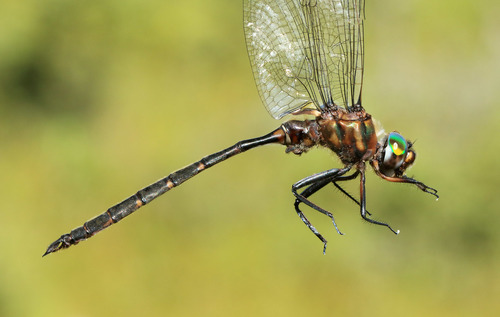
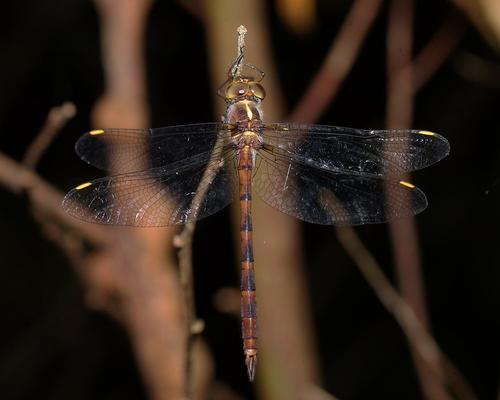
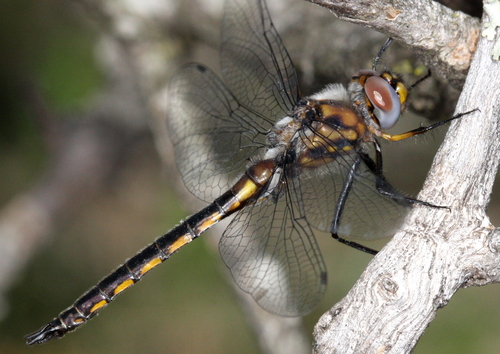
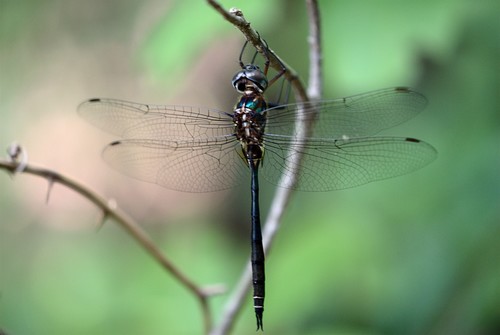
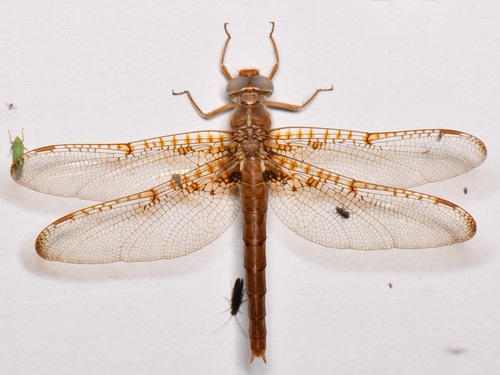
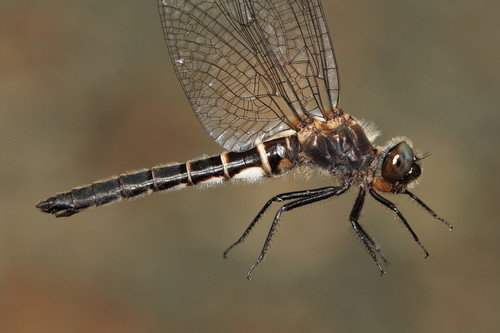
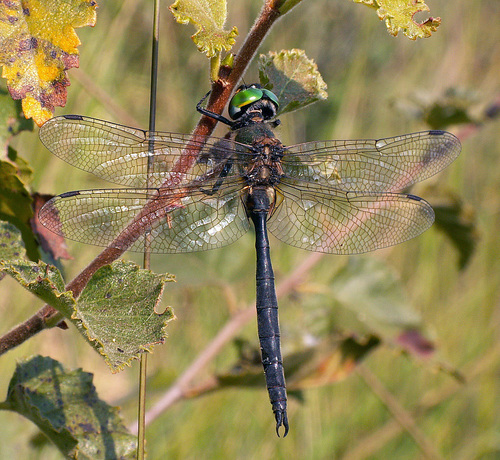
Somatochlora arctica, commonly called the northern emerald, is a member of the genus Somatochlora, a group of generally medium-sized dragonflies with metallic green to black colouration and bright green eyes. Northern emeralds are smallish dragonflies, typically 41 to 51 millimetres (1.6 to 2.0 in) long with a wingspan of around 67 millimetres (2.6 in). They have a blackish abdomen, with bronzey green head and thorax; their thoraxes are lighter and hairy. Females have two characteristic oval yellow spots on the abdomen next to the thorax, a feature shared with females of the brilliant emerald dragonfly. Both sexes have distinct yellow spots on their faces next to the eyes, which are bright green in mature individuals. Northern emerald wings are not fully clear, but rather suffused with a yellowish tint that is strongest near the wing's leading edge. The wing base is also pale ochre, particularly on the male's lower wing. Populations from west Siberian bogs on the Vasyugan Plain have wings smoked with amber-brown; a similar pattern has been observed in Somatochlora flavomaculata specimens from the same region. The pterostigmata, which are pigmented spots on the front corner of each wing, are black-brown in males, dark brown in adult females, and paler brown in immature individuals. The accessory membrane, a small structure at the base of the wing next to the thorax often used for species identification, is white in both sexes, but narrower in females. The legs are mixed black and brown: male legs are mostly black, with only one side of the first femur (third leg segment) brown, while all femurs are brown in females. Males have a distinct trait: the two abdominal segments closest to the thorax, plus the base of the third segment, are enlarged, giving the superficial impression of a long thorax and shortened abdomen. The abdomen has a narrow waist before widening again, reaching its widest point in the middle. Female abdomens do not have a narrowed waist; when viewed from above, they have a rectangular shape that tapers gently toward the tip. The tip of the abdomen's tenth segment holds a set of short appendages. Both sexes have an upper pair called cerci (or upper anal appendages), while males also have a lower pair called epiprocts. In females, the upper appendages are small and leaf-like. Male upper appendages are fairly long and caliper-shaped; the epiprocts are smaller, short, triangular, and slightly curved. The female's vulvar scale, an ovipositor-like organ used to place eggs with relatively low precision, is triangular, pointed, and spout-like. It extends from the abdomen at roughly a 30° angle, and is slightly longer than the ninth abdominal segment. Northern emeralds are physically very similar to alpine emeralds (Somatochlora alpestris), and the two species must be distinguished primarily by the morphology of their anal appendages. This physical similarity led the two species to be traditionally grouped together. However, a 2025 phylogenetic study found that the shared physical traits used for this grouping were often the result of convergent evolution. Molecular data from the study showed this traditional classification was incorrect, with S. arctica and S. alpestris belonging to very different groups within the genus Somatochlora. The northern emerald is considered a bog specialist. Larvae develop and hunt in bog pools, especially among waterlogged sphagnum moss; adults can be found flying around bogs, in wet meadows and heaths, open woodlands, and lightly treed moors. Early 20th century observations by Kenneth Morton in the Austrian Tyrol recorded northern emeralds as abundant in local wet meadows. Breeding typically occurs in wet areas near woodlands, where adults hunt. A 2024 study published in the Journal of Insect Conservation investigated the abundance of northern emerald larvae across different habitat conditions. The study found little correlation between S. arctica larval abundance and water acidity, temperature, or depth. However, larvae were significantly more abundant in pools located close to woodland with high Sphagnum coverage. Larvae usually live in moss clumps roughly 15 centimetres (1⁄2 ft) below the surface of bog pools. If pools dry out, larvae can be found in deep clumps of wet, half-rotten moss up to 30 centimetres (1 ft) below the surface. Due to their elusive habits, larvae are difficult to locate for observation; one field guide recommends sifting underwater sphagnum clumps with a sieve or colander to collect them. In Scandinavia, this species occurs near sea level, while in more southerly parts of its range such as the Alps, it occurs in subalpine regions. Within its montane range, it is replaced at higher altitudes by S. alpestris. It is most common between 835 and 2,205 metres (2,740 to 7,234 ft) above sea level, though there is one record of a female laying eggs at just 550 metres (1,800 ft) in a sphagnum moss clump. Even in areas where S. arctica and S. alpestris overlap, the two occupy different habitat niches: S. alpestris typically hunts over open water, while S. arctica occupies wet meadows. Morton documented this separation on a small stream with one clear water section and another section with reeds: S. alpestris was only found in the open water area, while S. arctica was only found in the directly adjacent reeds and nearby meadow. Northern emeralds are distributed across the northern Palearctic realm, with a scattered range from Ireland to Japan between approximately the 40th and 74th parallels. The IUCN Red List describes its scattered European distribution as broadly centered on a diamond bounded by Switzerland, the Netherlands, Slovakia, and the northern Scandinavian Peninsula. It is common across Fennoscandia, but has a thin distribution in mainland Europe outside the Alps. It is scarce in western Europe, but common in upland areas of central Europe, particularly the Alps of France, Switzerland, northern Italy, and western Austria. In the Netherlands, it is only found in a few locations on the eastern border and is considered rare; nearby it occurs in the Ardennes, other parts of eastern France, and the Massif Central. It has also been recorded in the Pyrenees. In Poland, the northern emerald is a rare species. It is known from a small number of alpine peat bogs in Romania, where its habitat is threatened by climate change. Its distribution outside Europe is even sparser, with patchy observations across Russia, as well as northern Japan, North Korea, Manchuria, and southern Kazakhstan. It is common in the wetlands of the Vasyugan Plain in central Russia, the largest peatlands in the world. In Japan, northern emeralds have been recorded from Nagano in central Honshū and from Hokkaido. In the Russian Far East, it occurs on the disputed islands of Kunashir and Iturup, the Kamchatka Peninsula, and Sakhalin Island. Northern emeralds mate in the dragonfly wheel formation. First, the male uses appendages at the tip of his abdomen to grasp the female behind her head, a position called tandem formation. The male then leads the female into the tree canopy. The female then curls her abdomen to reach the male's secondary genitalia, located on the underside of his thorax, to fertilize her eggs. Mating can last up to an hour. After mating completes, the female leaves to deposit her eggs alone, unlike in some dragonfly species where the male guards the female during oviposition. Typical oviposition sites are small pools closely sheltered by vegetation, such as clumps of underwater sphagnum moss. The larval stage is the main life stage of the northern emerald, and lasts at least two years. Northern emerald larvae are distinctly hairy, and moult multiple times during development. Unlike some other Somatochlora species, their larval abdomens have no spines on the back or sides. The femur (the third and longest segment of the hind leg) is relatively short, only reaching as far as the abdomen's sixth segment. The larval mask, a prehensile lower lip used to catch prey, has numerous somewhat shallow crenations, each of which bears five bristles. Larvae are squat, and their longish legs give them a spider-like appearance. Mature larvae are usually 17 to 20 millimetres (0.67 to 0.79 in) long, less than half the length of the adult. Between May and June, mature larvae climb out of the water onto the stems of nearby plants such as sedges. The adult dragonfly emerges over a two-hour period, leaving behind the larval exoskeleton, called an exuvium. The newly emerged callow adult takes a short maiden flight, usually into the available woodland canopy. It can take several days for the callow to develop its full mature colouration. Adult northern emeralds only live for eight weeks or less.