About Somateria spectabilis (Linnaeus, 1758)
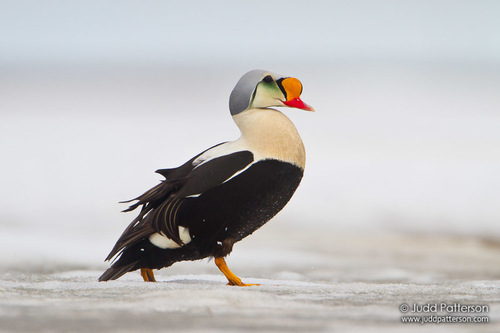
The king eider (scientific name Somateria spectabilis (Linnaeus, 1758)) is a large sea duck. It measures 50–70 cm (20–28 in) in length, with a wingspan of 86–102 cm (34–40 in). On average, males are heavier than females: the mean weight of males is 1.668 kg (3.68 lb), and the mean weight of females is 1.567 kg (3.45 lb). An individual king eider's mass can vary significantly between seasons, ranging from as low as 0.9 kg (2.0 lb) to as high as 2.2 kg (4.9 lb). Like all eiders, this species is sexually dimorphic: males are slightly larger, and in breeding plumage, they are far more colorful than females. Breeding-plumage males are easily recognizable, with a mostly black body, buff-tinged white breast, and multicolored head. Their head, nape, and neck are pale bluish grey, their cheeks are pale green, and their bill is red, marked by a thin black line that separates it from the face. The bill also has a white nail and a large, distinct yellow knob. Some of the bird's tertials curve upward to form 'spurs' along its back. Females are occasionally called 'queen eider' in colloquial use; they have an overall warm brown color, with slightly paler coloration on the head and neck. The feathers on a female's upperparts and flanks are marked with blackish chevrons, while the feathers on her head and neck have fine black streaks. She has a buffy spot at the base of her bill, and a buffy eye ring that extends into a downward curving stripe behind her eye. Sources variously describe her bill as black or grey, and her legs and feet are greenish grey. Juvenile king eiders are greyish brown. Late in their first autumn, young males moult into darker plumage that has white on the breast and rump; it takes three years for them to develop full adult plumage. Multiple published studies cover the identification and ageing of king eiders: Chandler, R.J. (1987). "Identification and ageing of first-winter male King Eider". British Birds. 80 (12): 626–627; Ellis, Pete (1994). "Ageing and sexing of King Eiders". British Birds. 87 (1): 36–37; Dawson, Jane (1994). "Ageing and sexing of King Eiders". British Birds. 87 (1): 37–40; Suddaby, D.; Shaw, K.D.; Ellis, P.M.; Brockie, Keith (1994). "King Eiders in Britain and Ireland in 1958–90: occurrences and ageing". British Birds. 87 (9). on behalf of the Rarities Committee: 418–430. Archived from the original on 2019-08-21. Retrieved 2015-03-14. The king eider has a circumpolar distribution and is found across the entire Arctic. It breeds on Arctic coasts of Alaska, Canada, Greenland, Svalbard, and Russia, occupying a range of tundra habitats. It winters in arctic and subarctic marine areas, most prominently in the Bering Sea, west Greenland, eastern Canada, and northern Norway. Wintering king eiders can form large flocks on appropriate coastal waters, and some flocks contain over 100,000 birds. The species also appears annually off the northeastern United States, Scotland, and Kamchatka. The king eider changes its foraging strategies based on the season. For most of the year, it lives at sea, where it dives to catch benthic invertebrates. During the breeding season, it forages more often in freshwater lakes and ponds, where it feeds by dabbling, primarily eating small invertebrates it plucks from the water surface. Its diet includes mollusks, crustaceans such as king crabs, sea urchins, starfish, and sea anemones. In Yup'ik, the king eider is called qengallek (pronounced [qə.ˈŋaː.ɬək]), and it is a regular source of fresh meat for people in the spring. The birds begin their migration past the Yukon–Kuskokwim Delta in late April, and are hunted in large numbers. In May, several hundred thousand king eiders pass Point Barrow in northern Alaska as they travel to their breeding grounds in Alaska and Canada.