About Solidago sempervirens L.
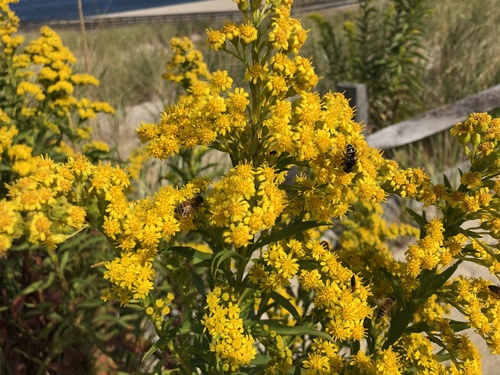
Solidago sempervirens L. is a succulent herbaceous perennial that grows 4–6 feet (120–180 cm) tall. Unlike most other species in the Solidago genus, it has toothless, hairless leaves that are thicker than the leaves of most other Solidago species. Its flower heads are arranged in a large paniculiform inflorescence at the top of the plant, and the branches of this inflorescence often bend backwards toward the base. This species blooms from late summer well into fall, which is later in the growing season than most of its close relatives. It produces wind-dispersed achenes as fruits. The flower heads are usually yellow, and clusters of buds grow at the ends of the plant's short branches. In its natural habitat, S. sempervirens grows primarily in seashore areas. It is found along coasts of the Atlantic Ocean, the Caribbean, and the Gulf of Mexico, ranging from Central America north to Newfoundland. It grows on sand dunes, in salt marshes, and on the banks of estuaries. It also occurs naturally inland along the St. Lawrence Seaway and the Great Lakes, and has expanded its range further inland along roadsides over the past 30 years. It is highly tolerant of both saline soils and salt spray, and most often grows on coastal dunes and in salt marshes. Two varieties of this species are recognized: Solidago sempervirens var. mexicana (L.) Fernald, distributed from Massachusetts south to Central America and the West Indies, and Solidago sempervirens var. sempervirens, distributed from Newfoundland south to Virginia, and introduced in the Great Lakes region. S. sempervirens is a seashore plant with high salinity tolerance. It is occasionally cultivated as an ornamental plant, and grows best in sunny locations with sandy soil where it faces little competition from other plant species.