About Solidago puberula Nutt.
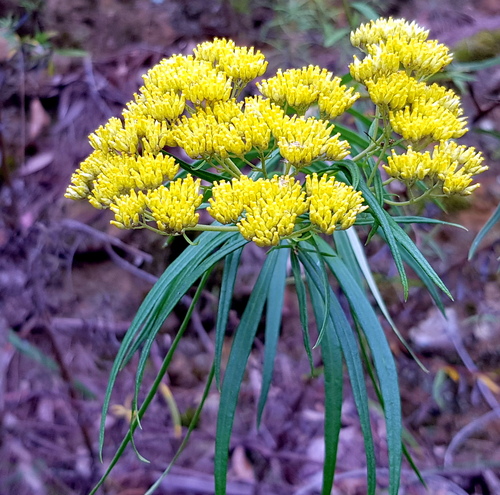
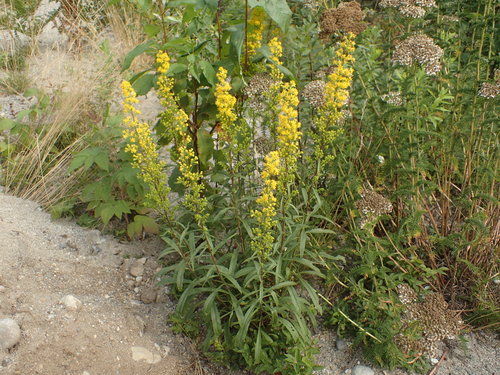
Solidago puberula Nutt., commonly called downy goldenrod, is a plant species native to eastern North America. Its natural range extends from Nova Scotia and Ontario in the north, southward to Florida and Louisiana. Two subspecies of Solidago puberula are widely recognized: Solidago puberula subsp. puberula and Solidago puberula subsp. pulverulenta. Solidago puberula subsp. pulverulenta has smaller but more numerous leaves than the nominate subspecies. Halfway up the stem, subsp. pulverulenta typically has 50–110 leaves that measure 10–40 mm (0.39–1.57 in) long. By contrast, subsp. puberula has 10–60 leaves that measure 40–50 mm (1.6–2.0 in) long halfway up the stem. Solidago puberula is a perennial herb that grows up to 100 cm (39.5 in) tall, and it has a branched woody rootstock. This species can produce between 1 and 5 puberulent, or hairy, stems. Its leaves are toothed, tapering at the tip, and covered in fine hairs on both sides. The plant produces 15–250 flowering heads, arranged in an elongated, paniculiform cluster. Each flowering head contains 9–16 yellow ray flowers, plus 6–15 disc flowers. Each individual disc flower grows up to 3 mm (0.12 in) long.