About Solidago nemoralis Aiton
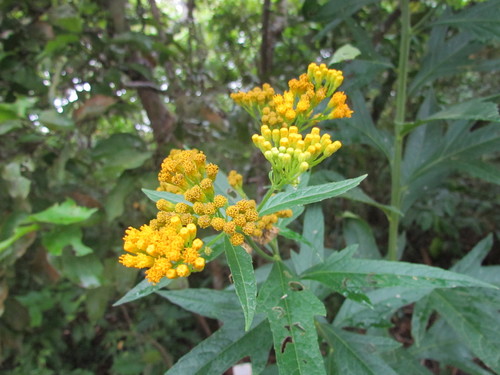
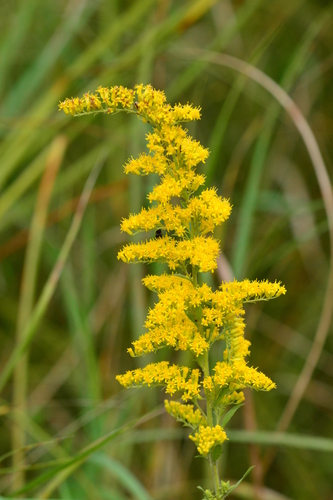
Solidago nemoralis Aiton is a perennial herb in the goldenrod group. This species is one of the smaller goldenrods, growing between 20 centimeters and 1 meter, or 8 to 40 inches, tall from a branching underground caudex. It produces 1 to 6 erect stems, and occasionally more. Stems range in color from reddish to gray-green, and bear lines of short white hairs. Lower leaves grow up to 10 centimeters, or 4 inches, long, with leaf blades attached to winged petioles. Leaves on the upper half of the stem are narrower, shorter, and do not have petioles. Its spreading inflorescence can hold up to 300 flower heads. Each flower head holds 5 to 11 yellow ray florets, each a few millimeters long, that surround up to 10 yellow disc florets. This species flowers in late summer and fall. Its fruit is a rough-textured cypsela around 2 millimeters long, tipped with a pappus of slightly longer bristles. There are two recognized subspecies: Solidago nemoralis ssp. decemflora, a tetraploid taxon with larger flower heads and narrower basal leaves found in west-central North America; and Solidago nemoralis ssp. nemoralis, a diploid or tetraploid taxon found in the eastern regions of the species' total range. This plant grows in forests, woods, prairies, grasslands, and disturbed areas including old fields and roadsides. It acts as a pioneer species and can become weedy. A wide variety of insect pollinators visit its flowers, including honey bees, carpenter bees, sweat bees, plasterer bees, sphecid wasps, vespid wasps, butterflies, moths, beetles, hoverflies, tachinid flies, flesh flies, blow flies, and muscid flies. Several insects feed on its foliage, including the goldenrod scarlet plant bug, leaf-footed bugs, and various caterpillars. American goldfinches feed on this species' fruits. Native American peoples have used this plant for a range of purposes. The Houma people have used it medicinally to treat jaundice. The Goshute have used its seeds for food. The Navajo have used it as incense. It is also cultivated for landscaping and garden use, including in butterfly gardens.