About Solidago canadensis L.
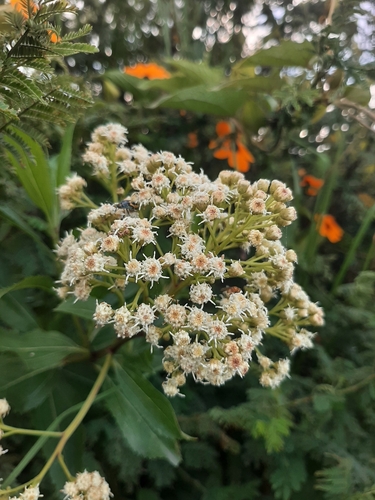
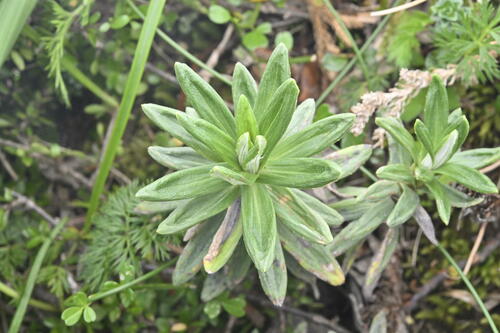
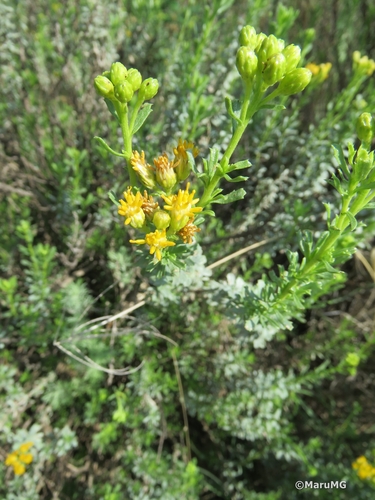
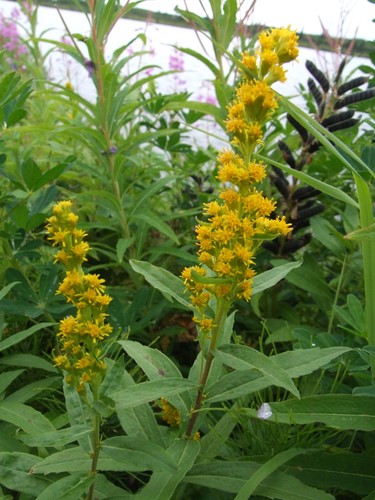
Solidago canadensis L. is a herbaceous perennial plant. Its stems grow 2–4 feet (60–120 centimeters) tall, and sometimes reach 6 ft (180 cm) in height. This species has a wide distribution and includes several varieties, which show significant morphological variability. Its leaves are shaped lanceolate to broadly linear, arranged alternately along the stems, measure 4–6 inches (10–15 centimeters) long and 1 inch (2.5 cm) wide, and are often prominently toothed. The stems bear lines of white hairs, while the undersides of the leaves are covered in fine hairs. Its flowers have yellow rays, grouped into small heads that form branched pyramidal inflorescences, and flowering takes place from July to October. This plant has a rhizomatous growth habit that allows it to form large colonies of clonal plants. Solidago canadensis is native to northeastern and north-central North America, and is winter hardy in USDA hardiness zones 3–9. It grows in a wide variety of habitats, and is typically one of the first species to colonize an area after a disturbance like fire; it rarely persists once shrubs and trees become established in the area. It can be found in both very dry locations such as roadsides and waterlogged locations such as moist thickets. A wide range of insect species visit Canada goldenrod to access its pollen and nectar, including bees, wasps, flies, beetles, butterflies, and moths. It is especially strongly favored as a nectar source by bumblebees and paper wasps, such as Polistes parametricus and P. fuscatus. Besides wasps, it is also frequently visited by honeybees and some butterflies, including monarchs. Deer sometimes browse Solidago canadensis, and it rates from good to fair as a food source for domestic livestock like cattle and horses. Solidago canadensis can be extremely aggressive, and tends to form monocultures or near-monocultures in parts of its native range, such as southwest Ohio clay loam. It produces abundant seeds, and also spreads rapidly via spreading rhizomes. Its root system is very tough: plants pulled from the ground before freezing and left exposed on top of soil have survived winter temperatures as low as -26 °C (-14 °F). This species is grown as an ornamental plant in flower gardens. It is sometimes incorrectly blamed for causing hay fever, which is actually caused by ragweed plants that bloom at the same time.