About Solidago altissima L.
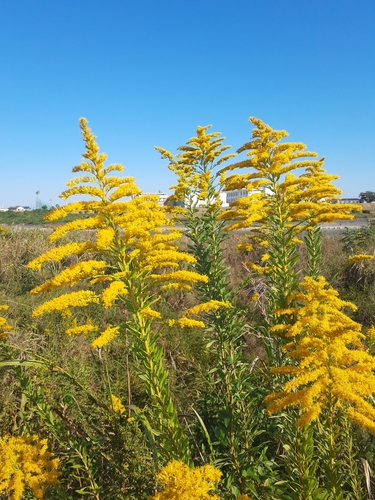
Solidago altissima, commonly known as tall goldenrod, grows 1 to 2 meters (40 to 80 inches) tall, and its stems are covered in fine hairs. Its leaves grow along the stem, rather than forming a rosette close to the ground. A single plant can produce up to 1500 small yellow flower heads, arranged in a large conical cluster. For the main subspecies, Solidago altissima subsp. altissima, involucres typically measure 3–4 millimeters; for Solidago altissima subsp. gilvocanescens, involucres usually measure 2–3 millimeters. Solidago altissima is widespread across most of Canada, the United States, and northern Mexico. It is common across much of its range and is fairly tolerant of landscapes disturbed by human activity. S. a. subsp. altissima is native to eastern Canada, excluding Newfoundland and Labrador, and is also found in the Canadian provinces of Saskatchewan and Manitoba. In the United States, this subspecies is found east of the Mississippi River, excluding Wisconsin, Illinois, and North Carolina; it also occurs in all U.S. states directly west of the Mississippi River, plus Nebraska, Kansas, Oklahoma, Texas, Utah, Arizona, and California. In Mexico, this subspecies is native to the northern region excluding the Baja California Peninsula, Sonora, and Sinaloa, and ranges south through all other Mexican states as far as Oaxaca and Veracruz, excluding Mexico state, Morelos, Puebla, Tlaxcala, and Mexico City. It is native to all the regions of Canada, the U.S., and Mexico where it grows. It has been introduced to East China, South Central China, Taiwan, New South Wales, Korea, and Transcaucasus. S. a. subsp. gilvocanescens (Rydb.) Semple is found in western Canada and Ontario. In the United States, it occurs only east of the Mississippi River in Illinois, and extends west through the Great Plains states. In Mexico, its distribution overlaps that of S. a. subsp. altissima except in the western part of the range. Solidago altissima is self-incompatible: pollen from a single plant cannot pollinate that same plant's female flower parts. Like other goldenrod species, the leaves and inflorescences of tall goldenrod are widely used to produce natural dye. Resulting colors range from bright yellow to deep olive green, depending on the mordants used, the plant's growing conditions, and whether the plant has been affected by gall-inducing herbivores.