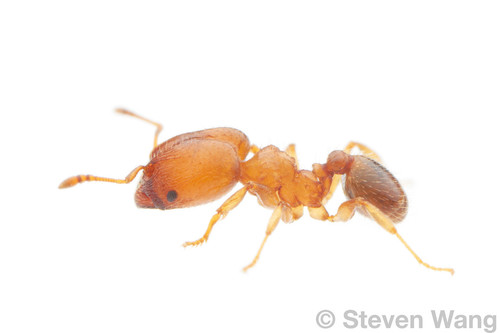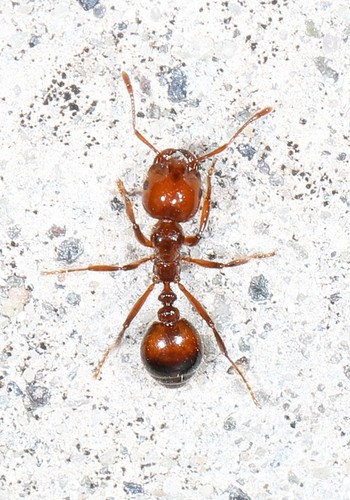
About Solenopsis invicta Buren, 1972
The red imported fire ant (Solenopsis invicta Buren, 1972) has polymorphic workers, ranging from 2.4 to 6.0 mm in size. The head measures 0.66 to 1.41 mm in length and 0.65 to 1.43 mm in width. In major workers, the head is 1.35 to 1.40 mm long and 1.39 to 1.42 mm wide. The antenna scapes are 0.96 to 1.02 mm, and the thoracic length is 1.70 to 1.73 mm. The head widens behind the eyes with rounded occipital lobes. Unlike S. richteri, the lobes peak beyond the mid - line, and the occipital excision is less crease - like. In major workers, the scapes don't extend beyond the occipital peak by one or two scape diameters, a more noticeable feature in S. richteri. In medium - sized workers, the scapes reach the occipital peaks, and in the smallest workers, they exceed the rear border. Small and medium workers have more elliptical - sided heads, with small workers' heads wider in the front. The major workers' pronotum lacks angular shoulders and a sunken posteromedian area. The promesonotum is convex, and the propodeum base is rounded and convex, with the base and declivity of equal length. The promesonotum suture can be strong or weak in larger workers. The petiole has a thick and blunt scale, less rounded above compared to S. richteri and sometimes subtruncate. The postpetiole is large and broad, broader than long in larger workers, less broad in front and broader behind, with a transverse impression on the rear dorsal surface (weaker in S. richteri). The sculpture is similar to S. richteri. Punctures where pilosity arises are often elongated on the head's dorsal and ventral portions. The thorax has striae, less engraved and with fewer punctures than S. richteri. The petiole has punctates on the sides. The postpetiole has a strong shagreen with distinct transverse punctostriae when viewed from above, and deep, small punctures on the sides (larger and shallower in S. richteri). Pilosity is similar to S. richteri, with erect hairs of varying lengths, long on the pronotum and mesonotum sides and in longitudinal rows on the head. There are numerous appressed pubescent hairs on the petiolar scale (sparse in S. richteri). Workers are red and somewhat yellowish, with a brown or black gaster. Gastric spots in larger workers are less brightly coloured than in S. richteri and usually cover a small part of the first gastric tergite. The thorax is concolorous, from light reddish - brown to dark - brown, and the legs and coxae are lightly shaded. In large workers, the occiput and vertex of the head are brown, while other parts like the front, genae, and clypeus center are yellowish or yellowish - brown. The anterior borders of the genae and mandibles are dark - brown. The scapes and funiculi are the same colour as the head or the occiput. In small to medium - sized workers, light - coloured areas are restricted to the frontal region, with a dark arrow - or rocket - shaped mark. Nests may have different colour variations. Queens have a head length of 1.27 to 1.29 mm and a width of 1.32 to 1.33 mm. The scapes are 0.95 to 0.98 mm, and the thorax is 2.60 to 2.63 mm. The head is almost indistinguishable from S. richteri, but the occipital excision is less crease - like, and the scapes are shorter. The petiolar scale is convex like S. richteri. The postpetiole has straight sides (concave in S. richteri). The thorax is almost identical, but the clear space between the metapleural striate area and propodeal spiracles is a narrow crease or absent. The side of the petiole is punctate, and the postpetiole sides are opaque with punctures but no irregular roughening. The anterior dorsum is shagreen, and the middle and rear have transverse puncto - striae, all with erect hairs. The anterior of the petiole and postpetiole has appressed pubescence also seen on the propodeum. The queen's colour is similar to workers: a dark - brown gaster, light - brown legs, scapes, and thorax with dark streaks on the mesoscutum. The head is yellowish or yellowish - brown in the center, the occiput and mandibles are similar in colour to the thorax, and the wing veins are colourless to pale brown. Males are similar to S. richteri, but the upper borders of the petiolar scales are more concave. In both species, the postpetiole's and petiole's spiracles strongly project. The male's body is concolorous black, and the antennae are whitish. The wing veins are colourless or pale brown. The red imported fire ant can be misidentified as S. richteri. They can be distinguished through morphological examinations of the head, thorax, and postpetiole. In S. richteri, the head sides are broadly elliptical, lacking the cordate shape of the red imported fire ant. The occipital lobes near the mid - line and occipital excision are more crease - like. The scapes are longer, the pronotum has strong angulate shoulders (almost absent in the red imported fire ant), and there is a shallow sunken area in the posterior dorsum of the pronotum in larger workers (absent in the red imported fire ant). The red imported fire ant's promesonotum is strongly convex (weakly convex in S. richteri), the propodeum base is convex and shorter (elongated and straight in S. richteri), and it has a wide postpetiole with straight or diverging sides (narrower with converging sides in S. richteri). The transverse impression on the posterodorsal postpetiole is strong in S. richteri but weak or absent in the red imported fire ant. S. richteri workers are 15% larger, blackish - brown, and have a yellow stripe on the dorsal gaster. Red imported fire ants are native to tropical central South America, with a range from southeastern Peru to central Argentina and southern Brazil. In South America, it has a long north - south but narrow east - west distribution. The northernmost record is Porto Velho in Brazil, and the southernmost is Resistencia in Argentina, about 3,000 km apart, with a width of about 350 km (narrower in southern Argentina, Paraguay, and northern Amazon basin). Most records are around the Pantanal region of Brazil, which may be its original homeland. Hydrochore dispersal via floating ant rafts may explain the far - south populations. The western range extent is unknown, but it may be extensive in easternmost Bolivia. They are native to Argentina, likely the source of the US invasion, found in several provinces. In Brazil, they are in northern Mato Grosso, Rondônia, and São Paulo. They are parapatric with S. saevissima in Brazil, with contact zones in Mato Grosso do Sul, Paraná, and São Paulo. In Paraguay, they are found throughout the country, and in northeastern Bolivia and northwestern Uruguay. They can dominate altered areas and live in various habitats, surviving the South American rain - forest weather. Nests are common along roads and buildings in disturbed areas, around floodplains, water sources, and in many other environments like agricultural areas, coastlands, and urban areas. In urban areas, colonies prefer open, sunny areas. They are mostly found at 5 to 145 m above sea level. Mounds are 10 to 60 cm high and 46 cm in diameter, with no visible entrances. Workers access the nest through tunnels up to 25 feet from the central mound. Mounds are oval - shaped, with the long axis north - south, and are oriented towards the sun in the morning and before sunset. Ants spend energy on nest construction and brood transport for thermoregulation. Inside, mounds have narrow horizontal tunnels, subterranean shafts, and nodes connecting to chambers 10 to 80 cm deep, with about 200 ants per chamber. Red imported fire ants are resilient to flooding and drought. When sensing rising water, they form floating balls or rafts with workers outside and the queen inside, transporting the brood to the highest surface. The raft can last up to 12 days. Ants underwater use bubbles to reach the surface. They are more aggressive when rafting, delivering higher venom doses. Necrophoric behavior occurs; workers discard waste. Unsaturated fats like oleic acid elicit corpse - removal behavior. Workers respond differently to dead workers and pupae, and discard Metarhizium anisopliae - infected pupae at a higher rate. They have a negative impact on seed germination, damaging or moving seeds. They collect elaiosome - bearing seeds more and store them in surface trash piles. Nuptial flight occurs in spring and summer, usually two days after rain, between noon and 3:00 pm. On average, 690 alates participate in a North Florida flight. Males leave the nest first. Workers are excited by alates' mandibular glands, form holes for alates to emerge, and show alarm - recruitment behavior. Males fly higher than females. A flight lasts about half an hour, and females fly less than 1.6 km. About 95% of queens mate once. In polygyne colonies, most males are sterile. Ideal flight conditions are humidity above 80%, soil temperature above 18 °C, and ambient temperature 24 - 32 °C. Queens are often 1 - 2.3 miles from the original nest. Colony founding can be individual or in groups (pleometrosis). Multiple - queen colonies start with more workers but may face queen - queen and queen - worker fighting, with only one queen surviving. A single queen lays 10 - 15 eggs 24 hours after mating, applying venom with a possible signal for workers. Eggs hatch in a week, and the queen lays 75 - 125 more. Larvae are covered in membranes and need worker assistance to hatch. The larval stage has four instars, lasting 6 - 12 days, followed by a 9 - 16 - day pupal stage. The queen stops egg - laying until the first workers mature (2 weeks to 1 month). Young larvae are fed regurgitated oils, trophic eggs, secretions, and the queen's wing muscles. The first workers are small (minims or nanitics), starting foraging and mound construction. Larger workers develop within a month, and the mound is noticeable in six months. A mature queen can lay 1,500 eggs per day. Colonies grow fast; a 15 - 20 - worker colony in May can reach over 7,000 by September, produce reproductive ants at one year, and have over 25,000 workers at two years, doubling to 50,000 at three years. A mature colony can house 100,000 - 250,000 individuals (or more than 400,000). Polygyne colonies can grow larger. Temperature affects colony growth, with growth ceasing below 24 °C and accelerating at higher temperatures. Nanitic brood develops faster. Access to insect prey and plant resources colonized by hemipterans accelerates growth. Monogyne colonies with diploid males have high mortality and slow growth. Worker life expectancy depends on size, averaging 62 days, with larger workers living 50 - 140% longer. In the lab, workers can live 70 days to 490 days, with a maximum of 679 days. Queens live 2 to nearly 7 years and can control sex ratios and sexual production through pheromones.