About Solanum vescum F.Muell.
Solanum vescum, commonly known as green kangaroo apple or gunyang, is a small fruiting shrub in the Solanaceae family, native to eastern and southeastern Australia. It was first formally described in 1855 by Ferdinand von Mueller, the Victorian government botanist, after being collected near the mouth of the Snowy River. Its specific epithet comes from the neuter form of the Latin adjective vescus, which means "edible".
This is a soft green shrub that grows to between 1 and 2 meters (3.3 to 6.6 feet) high. Unlike many other Solanum species, it does not have spines. Its juvenile leaves are ovate with three or four deep lobes, measuring 15 to 30 centimeters (5.9 to 11.8 inches) long and 11 to 24 centimeters (4.3 to 9.4 inches) wide. Adult leaves are narrowly lanceolate; unusually for a Solanum, they may have no lobes at all, or otherwise have 2 to 4 lobes per side.
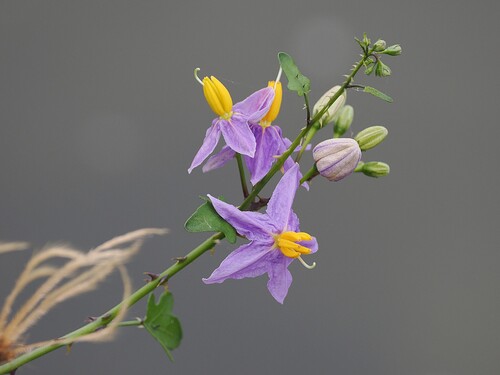
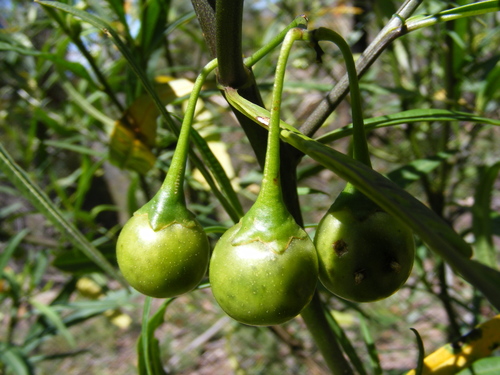
Its small purple flowers bloom in winter and spring, and are followed by globular fruit that is 2 to 2.5 centimeters (0.79 to 0.98 inches) in diameter. The fruit is yellowish- or ivory-green, often streaked, and grows in bunches of 5 to 20.
Solanum vescum ranges from southeastern Queensland through eastern and central New South Wales, with Moree and Narrabri marking its western limit, then through Victoria and into Tasmania. It grows as an understory shrub in a variety of forest habitats, including rainforest, and wet and dry sclerophyll (Eucalyptus) forest. The Gunai people of Gippsland traditionally ate this species. It grows prolifically from seed after bushfire, so local Indigenous people practiced controlled burns to encourage it to grow and produce fruit.