About Solanum sturtianum F.Muell.
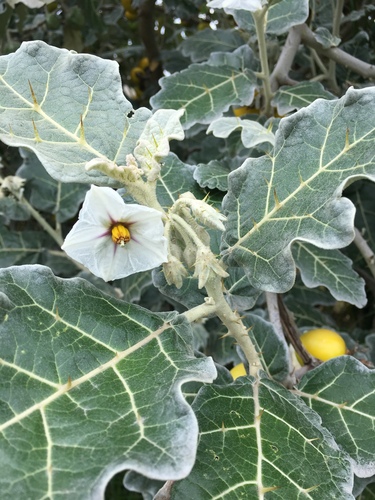
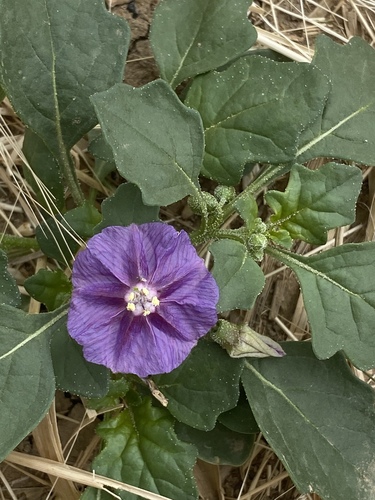
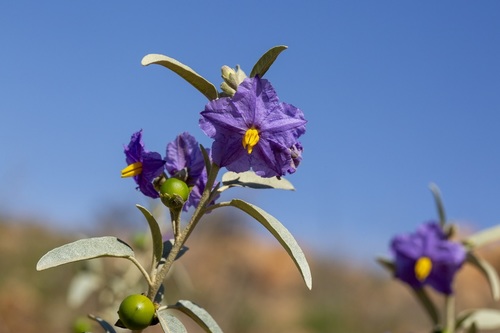
Solanum sturtianum F.Muell. is a highly distinctive perennial shrub recognizable by its silvery-green foliage and bright purple flowers. It averages 1 m (3 ft 3 in) in height, and can grow as tall as 3 m (9.8 ft). It grows in connected groups called colonies, linked by shallow underground rhizome root systems. These rhizomes store nutrients to help the species survive desert climates, and produce clonal daughter plants from the parent plant. The stem and leaves are densely covered in star-shaped (stellate) hairs, and prickles are scattered across the stem 0.3–0.7 mm (0.012–0.028 in) apart, both traits typical of the Solanum genus. It flowers from March to October; each flower has five distinct purple petals, yellow staminodes, and a green central stigma. Its leaves are shaped like elongated spearheads, measuring 30–60 mm (1.2–2.4 in) in length, with straight edges and pointed tips. Most often, the upper (adaxial) leaf surface is silvery-green, while the lower (abaxial) leaf surface is grey-green. The most distinct feature of this species is its dark black, dry fruit, which measures 10–15 mm (0.39–0.59 in) and holds approximately 60 seeds. Each seed is roughly 3 mm (0.12 in) long, has an approximate viability rate of 78%, and can remain dormant until soil moisture levels are sufficient for germination. This species is native to Australia. More than 940 recorded observations of it are held by the Australasian Virtual Herbarium. It grows in arid zones across most Australian states, with a notably large population in Western Australia, which aligns with the fact that 26 of the 70 Solanum genus species endemic to Australia are found only in Western Australia. It is not normally present in Victoria, though one single occurrence was recorded on the Victorian border in 2011. This shrub prefers rocky terrain, and is common in drainage lines, pastures, and other disturbed soil sites. In agricultural areas and along stock routes, it is treated as a noxious weed and removed with herbicides. Bees are responsible for 93% of the species' pollination, with genera Braunsapis and Amegilla being the most impactful pollinators. Unlike many other Solanum species, Solanum sturtianum does not have open terminal anther pores, so pollen must be milked from the anthers or dug out of terminal pores. Larger bee genera like Braunsapis and Amegilla can complete this task more successfully, using their larger bodies and wings to vibrate pollen free within seconds. Nectar glands located on the back of the flower attract ants and bees; this is a unique trait of Solanum sturtianum, as most related species do not produce nectar. Sturt's nightshade is a hermaphrodite, meaning individual plants have both stamens and a stigma, so most bees end up pollinating flowers on the same plant. If pollination and seed formation do not occur, the species' ability to reproduce via cloning reduces the selective pressure of failed sexual reproduction, though it also limits genetic variation. The plant produces a glycoalkaloid component that helps it adapt to extreme climates, and reduces attacks from herbivores, fungi, bacteria, and other pathogens. The extreme bitterness of the plant means its seeded fruit is not used as a food source, which increases the species' survivability. Its rapid growth rate and ability to form colonies can also suppress the growth of other plants by outcompeting them for limited resources. While it can grow in a range of climates, it prefers arid zones with gravelly, disturbed soils that ease seed dispersal. An arid zone is classified as an area with a moisture index lower than 0.4 and an average annual rainfall of less than 250 mm, which explains why seeds have adapted to stay dormant until sufficient moisture is available for germination. Solanum sturtianum is extremely toxic to animals when eaten, with most poisoning cases occurring in sheep and cattle travelling along stock routes. Poisoning is caused by glycoalkaloid, a secondary metabolite produced by the plant. While glycoalkaloids work to prevent snails and other pest species from eating the plant's leaves and fruit, they also cause harmful effects in larger grazing animals. The toxin is concentrated most heavily in unripe fruit, which is common to most poisonous species in the Solanum genus. Clinical signs of poisoning appear in affected animals after they consume water. The toxin causes gastrointestinal upset that leads to blood in the faeces, drowsiness, weakness, restlessness, and ultimately death. As little as 400 grams of the plant can cause fatal poisoning in sheep, while 700 grams can cause fatal poisoning in cattle.