About Solanum sessiliflorum Dunal
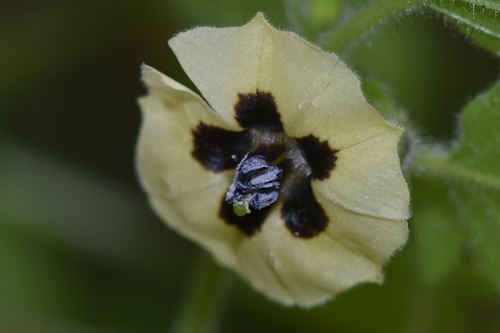
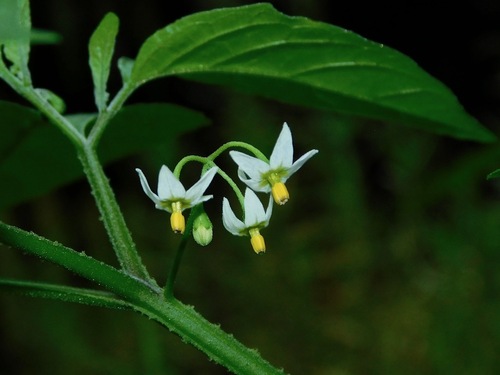
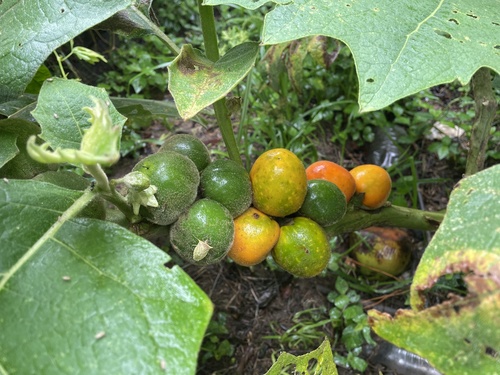
Solanum sessiliflorum, commonly called cocona, is a tropical shrub belonging to the Solanaceae family. This plant has sturdy branches, large, serrated, hairy leaves. It looks very similar to its close relatives naranjilla (S. quitoense) and pseudolulo (S. pseudolulo), but can be told apart from these species by its lack of spines. It lacks the typical purple coloration usually found on naranjilla, and it can hybridize with these and other closely related Solanum species. Its flowers look like large potato flowers, with light green petals. Cocona is native to the Andean region of South America, where it is occasionally grown for human consumption. It is harvested in parts of South America around the Amazon rainforest, including Purús Province in eastern Peru. The fruit of cocona is an edible berry that can be red, orange, or yellow. In temperate climates, cocona can also be grown as an indoor ornamental plant. It is quite sensitive to spider mites, so care must be taken to avoid keeping it in overly dry air during winter. Like naranjilla, cocona is also highly sensitive to aphids and nematodes. As a subtropical plant, it can tolerate cool weather, but frost will kill it or severely damage it. During summer, it can be grown outdoors or in a cold greenhouse. When grown from seed, cocona plants can produce fruit between 9 and 24 months after planting. Solanum georgicum and Solanum hyporhodium were previously (and sometimes still are) classified as part of this species, but they are generally treated as separate species today.