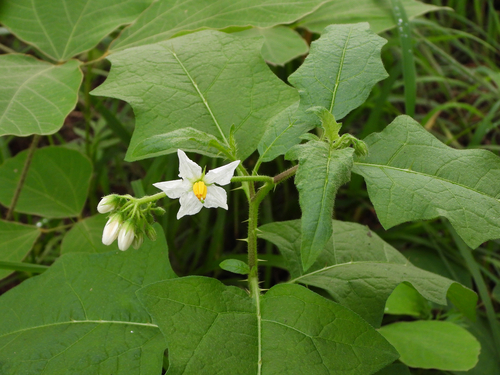
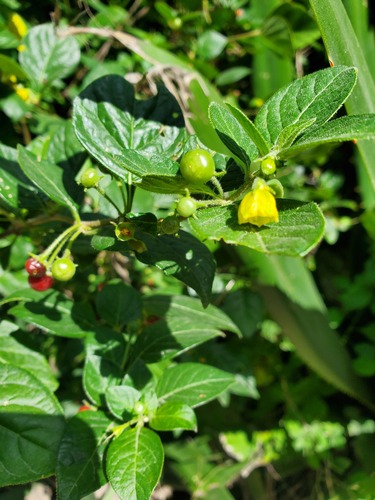
About Solanum nigrum L.
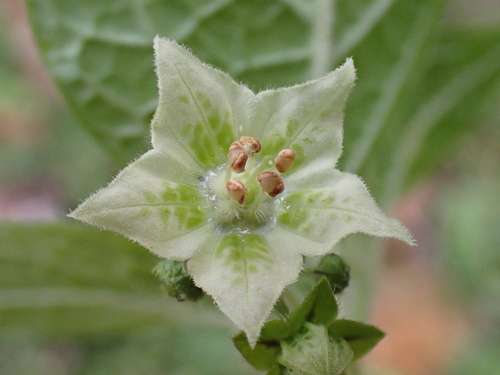
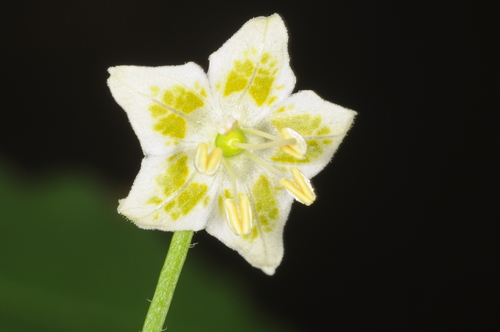
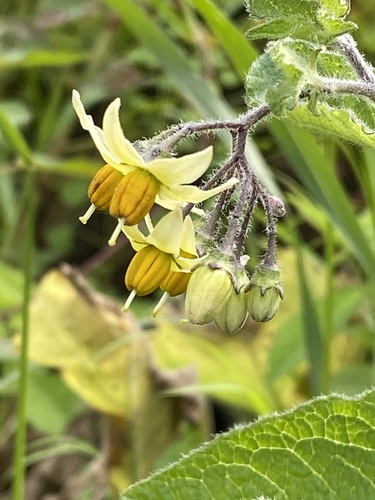
Solanum nigrum L., commonly called black nightshade, is a common herb or short-lived perennial shrub that grows in many wooded areas and disturbed habitats. It reaches a height of 30 to 120 cm (12 to 47 in). Its leaves measure 4.0 to 7.5 cm (1.6 to 3.0 in) long and 2 to 5 cm (1 to 2 in) wide, and are ovate to heart-shaped with wavy or large-toothed edges. Both leaf surfaces can be hairy or hairless, and the petiole is 1 to 3 cm (0.5 to 1 in) long with a winged upper portion. The plant's flowers have greenish to whitish petals that recurve as they age, and surround prominent bright yellow anthers. Its berries are mostly 6 to 8 mm (0.24 to 0.31 in) in diameter, and are dull black or purple-black; a separate strain found in India produces berries that turn red when ripe. Solanum nigrum is sometimes confused with the more toxic deadly nightshade (Atropa belladonna), which belongs to a different genus in the Solanaceae family. The two can be distinguished by their fruit: black nightshade berries grow in bunches, while deadly nightshade berries grow individually. Another difference is that black nightshade has white petals, while deadly nightshade has purple petals. Solanine levels in Solanum nigrum have been tested, and fatal poisoning from the plant is rare. Symptoms of solanine poisoning can develop when immature green fruit or mature leaves are eaten raw. Symptoms typically appear 6 to 12 hours after ingestion, and initial symptoms include fever, sweating, vomiting, abdominal pain, diarrhea, confusion, and drowsiness. Death from ingesting large amounts of the plant is caused by cardiac arrhythmias and respiratory failure. Livestock have also been poisoned by nitrate toxicity from grazing on mature leaves and green berries of Solanum nigrum. In central Spain, the great bustard (Otis tarda) may act as a seed disperser for European black nightshade (Solanum nigrum). Black nightshade is highly variable, and many recommend avoiding eating its berries unless you have confirmed the plant is a known edible strain. Toxin levels may also be affected by the plant's growing conditions. The toxins in Solanum nigrum are most concentrated in unripe green berries, and all immature fruit should be considered toxic. Most suspected poisoning cases are due to consumption of leaves or unripe fruit. There are ethnobotanical records of Solanum nigrum young leaves and shoots being boiled as a vegetable, with the cooking water discarded and replaced multiple times to remove toxins. Solanine is practically insoluble in water and can be destroyed by boiling, but not by baking; this pattern may not hold for the plant's leaves. Young cooked leaves of Solanum complex species are a source of many useful nutrients, with levels similar to those found in spinach. Berries from the Solanum nigrum complex have been consumed since ancient times. Some uses attributed to Solanum nigrum in literature may actually apply to other black nightshade species within the same species complex, so correct species identification is essential for any food or medicinal use. Solanum nigrum has been widely used as food since early times, and its fruit was recorded as a famine food in 15th-century China. Despite toxicity concerns with some forms, ripe berries and boiled leaves of edible strains are eaten. Thoroughly boiled leaves, which have a strong and slightly bitter flavor, are used like spinach as horta, and added to fataya pies and quiches. Ripe black berries are described as sweet and salty, with hints of liquorice and melon. Among the Abagusii people of Kenya, Solanum nigrum (called rinagu in singular, amanagu in plural) is a vegetable delicacy; it is blanched then sautéed, or boiled to soften, then salted or sautéed and eaten with ugali, a corn meal dish. It is prepared in a similar way across the rest of Kenya, where it is called managu. In Tanzania, Solanum nigrum (called mnafu or mnamvu in Kiswahili) is a popular green vegetable. Sautéed with chicken or pork and eaten with ugali, it is an expensive meal at most urban restaurants. The Iraqw people of northern Tanzania have traditionally used Solanum nigrum (called manakw) as a vegetable for generations, eating it with xwante, a special stiff porridge made from corn, millet or sorghum flour. An ethnobotanical survey conducted in the mid-1990s on the islands of Zanzibar and Pemba found that Solanum nigrum is called vwevwe in Kiswahili there. In India, the berries are casually grown and eaten, but are not cultivated for commercial use. In South India, the leaves and berries are routinely consumed as food after cooking with tamarind, onion, and cumin seeds. The berries are referred to as "fragrant tomato". Although not very popular across much of its growing range, the fruit and dishes made from it are common in Tamil Nadu, Kerala, southern Andhra Pradesh, and southern Karnataka, and are used both fresh and dried. In Ethiopia, children pick and eat the ripe berries, and all affected people ate berries during famines. Women and children also collect the leaves, cook them in salty water, and consume them like any other vegetable. Farmers in the Konso Special Woreda report that because Solanum nigrum matures before maize is ready to harvest, it is used as a food source until their crops are ready. The Welayta people of the nearby Wolayita Zone do not remove Solanum nigrum that grows in their gardens, as they also cook and eat its leaves. In Ghana, the plant is called kwaansusuaa, and is used to prepare various soups and stews, including the popular palm nut soup commonly eaten with banku or fufu. In South Africa, very ripe hand-selected fruit called nastergal in Afrikaans and umsobo in Zulu is cooked into a runny purple jam, though the fruit used there is more likely to be Solanum retroflexum. In Greece and Turkey, the leaves are called istifno, and are known as stifno in Crete. They are one of the ingredients in the boiled green salad known as horta. In Indonesia, young fruits and leaves of cultivated forms are used; the plant is called ranti in Javanese and leunca in Sundanese. The fruit and leaves are eaten raw as part of the traditional salad lalapan, or the fruit is cooked (fried) with oncom. It was imported into Australia from Mauritius in the 1850s as a vegetable during the gold rush, but Solanum nigrum is now prohibited for trade as a food by the Australia New Zealand Food Standards Code. In ancient Hawaii, young shoots, leaves, small white flowers, and small black berries were eaten. Leaves, along with other greens, were cooked by placing hot stones among them in a covered gourd. The plant has a long history of medicinal use dating back to ancient Greece. In the fourteenth century, the plant was recorded under the name Petty Morel, used for canker and mixed with horehound and wine to treat dropsy. It was a traditional European medicine used as a strong sudorific, analgesic, and sedative with powerful narcotic properties, but was considered a "somewhat dangerous remedy". Internal use has fallen out of favor in Western herbalism due to its variable chemistry and toxicity, but it is used topically as a treatment for herpes zoster. There is widespread disagreement over whether the leaves and fruit of Solanum nigrum are poisonous, but many countries grow the plant as a food crop. Its toxicity may vary depending on the region and specific species grown. Native Hawaiians use the berries' juice as a laxative, and consume boiled young leaves to relieve sore throats and coughs. Solanum nigrum is an important ingredient in traditional Indian medicines. Infusions are used to treat dysentery, stomach complaints, and fever. Plant juice is used on ulcers and other skin diseases. The fruits are used as a tonic, laxative, and appetite stimulant, and to treat asthma and excessive thirst. Traditionally the plant was used to treat tuberculosis. In Tamil Nadu, India, the plant's leaves are used to treat winter mouth ulcers. In North India, boiled extracts of leaves and berries are also used to alleviate liver-related ailments, including jaundice. Root juice is used against asthma and whooping cough. Solanum nigrum is widely used in oriental medicine, where it is considered to be antitumorigenic, antioxidant, anti-inflammatory, hepatoprotective, diuretic, and antipyretic. Some experiments indicate that the plant inhibits growth of cervical carcinoma in mice. The plant's active ingredient solanine inhibits the proliferation of different cancer cells in vitro, including breast cancer and pancreatic cancer. Its anti-tumor mechanism works mainly through the induction of different cell and molecular pathways, leading to apoptosis and autophagy of cancer cells, and inhibiting tumor metastasis. Water extracts of Solanum nigrum have shown cytotoxic activity that reduces ROS generation in the human melanoma cell line A-375. Solanum nigrum is known to contain solasodine, a steroidal glycoalkaloid that can be used to make 16-DPA progenitor; cultivating the plant's hairy roots could be a possible commercial source of this compound. The plant is also used to treat gastric ulcers. Experiments on mouse gastric ulcer models and control groups found that extract from black nightshade powder and methanol could significantly affect the secretion of gastric acid and protease in mice, greatly reducing the mice's gastric ulcer index. Solanum nigrum, Tasmannia pepper leaf, anise myrtle, and lemon myrtle all share a high concentration of polyphenols and polysaccharides, which play a role in inhibiting iNOS and COX-2 activities, making this combination "a viable approach to inhibit inflammation and carcinogenesis and to prevent cancer." Uttroside B, a saponin, has been identified as a bioactive chemotherapeutic agent against hepatocellular carcinoma, obtained from the methanolic extract of Solanum nigrum. Lankalapalli et al. isolated uttroside B and determined its structure through derivatization that produced an enol ether, and characterized it via detailed 2D NMR analysis. Uttroside B and uttroside A can be differentiated by the functional group at the C-22 position: uttroside B has a hydroxyl group, while uttroside A has a methoxy group. The structural similarity of uttroside B and uttroside A makes it difficult to differentiate the two molecules using NMR or other techniques. Recently, this research group published a correction to a NMR figure for the structure of uttroside B, which allows differentiation of the two molecules via a characteristic 13C NMR chemical shift difference: the hemiketal carbon C-22 has a shift of 110.5 ppm for uttroside B and 112.5 ppm for uttroside A. The US Food and Drug Administration has granted orphan drug designation for uttroside B against hepatocellular carcinoma. Black nightshade is cultivated as a food crop on several continents, including Africa and North America. The leaves of cultivated strains are eaten after cooking. A garden form with fruit approximately 1.27 cm (0.50 in) in diameter is occasionally cultivated.