About Solanum mammosum L.
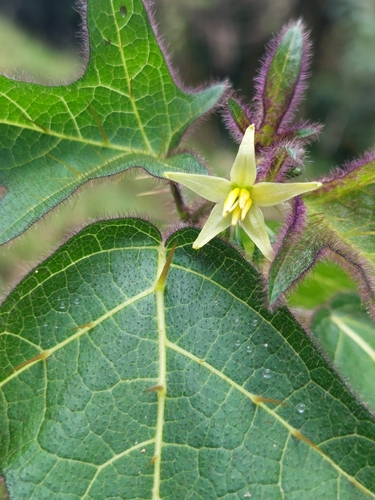
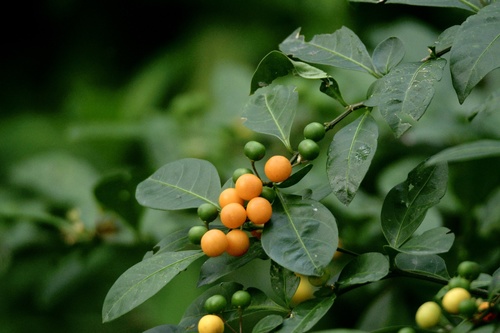
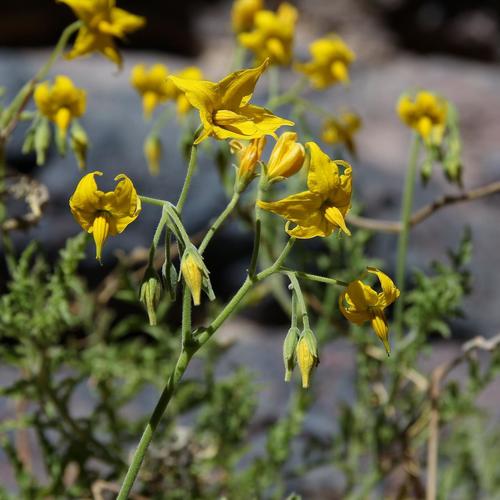
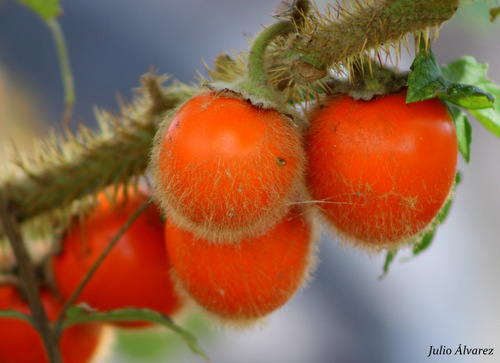
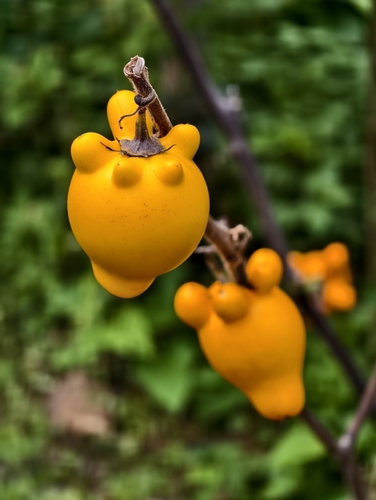
This species, Solanum mammosum L., has thin simple leaves arranged in an alternating branching pattern, with prominent venation. Hairy thorns cover its stem and branches. Its inflorescence holds five to eight purple elongating buds. The fruit is a berry, with waxy yellow skin and reddish-brown seeds, and the plant is propagated via seed distribution. Eastern cultures have long used this plant's fruit. In Asia, it is primarily used as decorative foliage for religious and festival floral arrangements. Fruit are imported to make Chinese New Year trees, valued for their golden color and the cultural belief that the fruit's five "fingers" represent family longevity. In Chinese culture it is called five-fingered eggplant (五指茄), while in Japan it is known as horned eggplant (ツノナス), fox eggplant (キツネナス), or foxface (フォックスフェイス). Fruit juice can be used as a detergent replacement for washing powder, similar to the soap nut. The Kofan People of Colombia and Ecuador use the plant as an insect repellent, mainly against cockroaches. Its repellent properties come from the toxic steroidal glycoalkaloid it contains. While mature fruit of this plant is poisonous, unripe fruit can be cooked and eaten as a vegetable. Unripe fruit is a good source of calcium, phosphorus, iron, and vitamin B. One common preparation method is boiling the whole fruit and drinking the resulting liquid. In the Philippines, both the fruit is eaten and the leaves are prepared into a tea that is classified as anodyne, a mild narcotic.