About Solanum L.
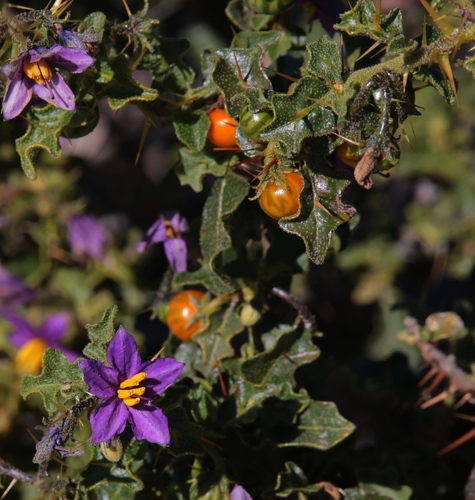
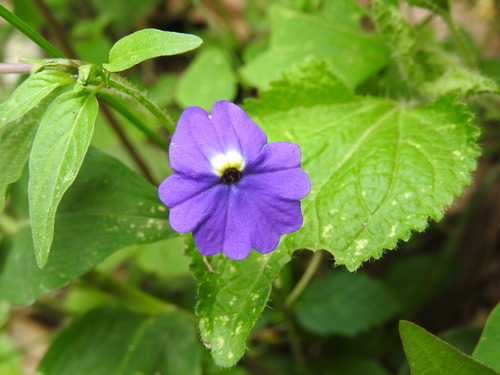
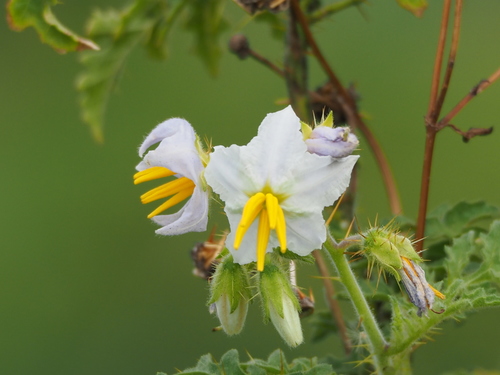
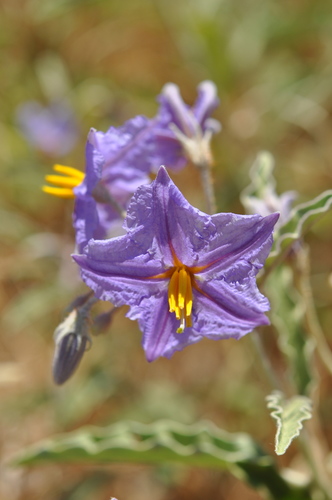
This Solanum species, commonly known as silverleaf nightshade, is a perennial plant that grows 10 cm (3.9 in) to 1 m tall. Its stems are covered in nettle-like spines that are less than 0.5 cm (0.20 in) long; spine coverage ranges from very few on some plants to very dense on others. Both leaves and stems are covered with downy lying hairs called trichomes that hide the plant surface, giving the plant a silvery or grayish appearance. Its leaves grow up to 15 cm long and 0.5 to 2.5 cm wide, with shallowly waved edges. This leaf shape distinguishes it from the closely related Carolina Horsenettle (S. carolinense), which has wider, more deeply indented leaves. Flowers bloom from April to August; each flower has five petals united into a star shape, with color ranging from blue to pale lavender, and occasionally white. Five yellow stamens and a pistil form a projecting center at the middle of the flower. The plant produces glossy berries that are yellow, orange, or red; these berries persist through the winter and may turn brown as they dry out. This species can grow in poor soil with very little water. It spreads via both rhizomes and seeds, and is common in disturbed habitats. It is very difficult to control, because root segments less than 1 cm long can regenerate into whole new plants. Its global distribution includes the Mediterranean region, South Australia, South Africa, the United States, Mexico, and South America. In the United States, its range extends from Kansas south to Louisiana, and west through the U.S. states along the Mexican border into Mexico. In South America, it is found in Uruguay, Argentina, and Chile. It may have originated in North America and been accidentally introduced to South America, or the opposite may be true. It is classified as a noxious weed in 21 U.S. states, and in countries including Australia, Egypt, Greece, India, Israel, Italy, South Africa, and Zimbabwe. A 15-year research study identified key factors that support the species' expansion: elevation between 0 and 100m, fine-textured soils with medium water availability in the subsoil, high base saturation in topsoil, and low organic carbon content in topsoil. It also appears to prefer areas used for agriculture, multi-lane roadsides, and areas near human settlements. Another study focused on allelopathic interactions between this species and other plants found that white oak extract impedes the germination of silverleaf nightshade. A five-year study found that frequent mowing of silverleaf nightshade helps turn it into a 'superweed', resulting in plants with deeper taproots, spikier stems, and greater toxicity to grazing caterpillars. The entire plant is toxic to humans and livestock, even when dried. Ingestion of silverleaf nightshade has been linked to cases of ivermectin toxicosis in horses that received the recommended dosage of the drug. It is speculated that metabolites from the plant disrupt the blood–brain barrier, allowing ivermectin to enter the brain and spinal cord and disrupt neurotransmitter function. The plant's thin spines can cause weed dermatitis. Historically, Pima Native Americans used the plant's berries as a vegetable rennet, and Kiowa people used the plant's seeds combined with brain tissue to tan leather.