About Solanum cinereum R.Br.
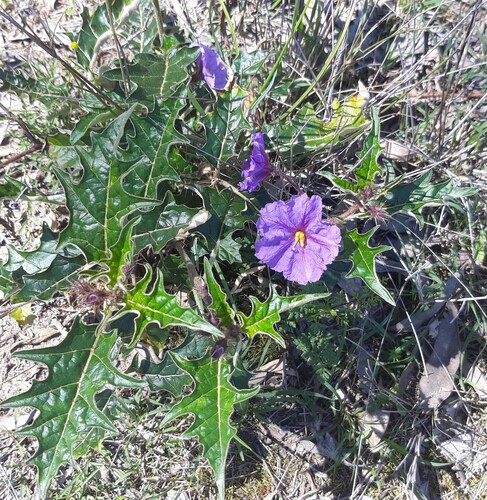
Solanum cinereum (common name Narrawa burr) is a small perennial shrub with an upright, sparse, sprawling or bushy growth habit, reaching up to 1 metre (3 ft 3 in) in height. Its leaves are oval to elliptic, measuring 6–10 cm (2.4–3.9 in) long and 3–6 cm (1.2–2.4 in) wide, with heavy lobing. The upper leaf surface is shiny, smooth, dark green, and bears conspicuous long spiny thorns that grow up to 15 mm (0.59 in) long. The lower leaf surface is whitish to light yellow, densely covered in small star-shaped hairs. Leaf petioles are 5–15 mm (0.20–0.59 in) long. Flowers are borne singly or in small clusters, and have four yellow stamens. The flowers are 20–30 mm (0.79–1.18 in) in diameter, with mauve to purple colouring, and grow from a peduncle that is usually 2–10 mm (0.079–0.394 in) long. Flowering occurs mostly from spring to autumn. The fruit is a globose-shaped berry, usually 15–20 mm (0.59–0.79 in) in diameter, pale green with darker streaks that turns brown when it reaches maturity. Narrawa burr grows in woodland, dry forests and disturbed sites in New South Wales, Victoria, Queensland and the Australian Capital Territory. It is considered a weed in farmland, because it is poisonous to sheep, cattle, and possibly horses.