About Solanum acerifolium Humb. & Bonpl. ex Dunal
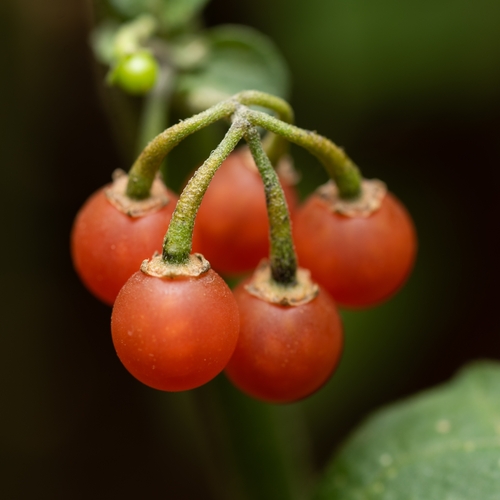
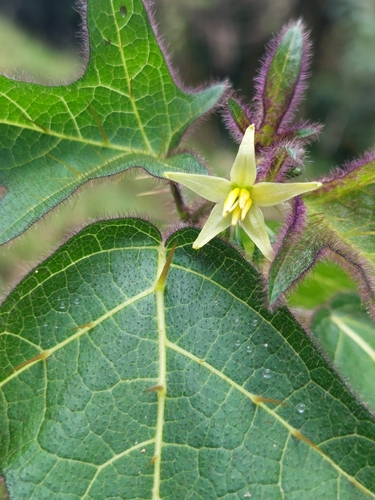
Solanum acerifolium Humb. & Bonpl. ex Dunal is an upright annual herbaceous plant. It usually reaches heights between 0.5 and 3 meters (1 foot 8 inches to 9 feet 10 inches). It most often grows with a single stem, but occasionally grows multiple stems that emerge from its base. Its stems are pubescent, with viscid-villous hairs and straight, acicular prickles. These acicular prickles densely cover all parts of the stem, and are typically between 0.1 and 1.5 centimeters long. Upper flowering branches usually have fewer prickles, and are more glabrous, retaining only the viscid-villous hairs. This species can grow in a wide variety of habitats, including forest clearings, pastures, roadsides, and ravines. It has also been observed growing near and within coffee plantations. It is possible that coffee commerce has helped this species successfully spread across countries in southern Mexico and South America. It typically grows at altitudes between 1200 and 2000 meters. Its distribution spans two continents, occurring across southern Mexico, Guatemala, Honduras, Nicaragua, Costa Rica, Panama, Trinidad, Colombia, Venezuela, Peru, and eastern Brazil. Like many other species in the Solanum genus, Solanum acerifolium is pollinated via buzz-pollination by buzzing bees. Buzz-pollination occurs when buzzing bees mechanically shake the flower's anthers while in contact with the bees' bodies. Throughout the full range of this species, flowering and fruiting can occur year-round, though flowering and fruiting may happen seasonally depending on latitude.