About Smyrnium olusatrum L.
Smyrnium olusatrum L., commonly known as alexanders, is a stout, hairless (glabrous) biennial plant that typically grows 150 cm (60 inches) tall, and may reach up to 180 cm in exceptional cases. It has a solid stem up to 22 mm in diameter that becomes hollow and grooved as it ages. Its root system consists of a tuberous taproot that can grow 60 cm long, plus fibrous lateral roots. Stem leaves grow in a spiral arrangement, though upper stem (cauline) leaves are often opposite, and sometimes form whorls of three. Each leaf has an inflated, purple-striped, fleshy petiole with papery margins near the base. The compound leaves are broadly diamond-shaped, divided 2 or 3 times in a ternate pattern (and sometimes a pinnate pattern), and may be slightly hairy near the base. Individual leaflets are dark green on the upper surface and pale green on the lower surface; they are flat, lobed, and serrated, with obtuse teeth that each have a tiny white hydathode at the tip.
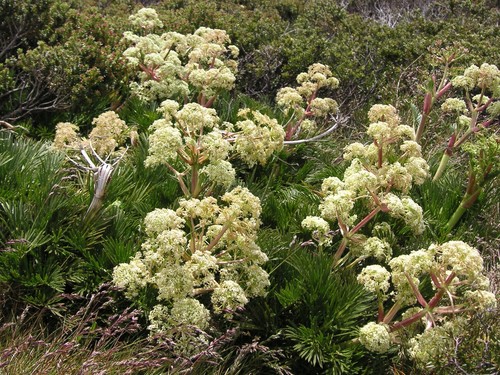
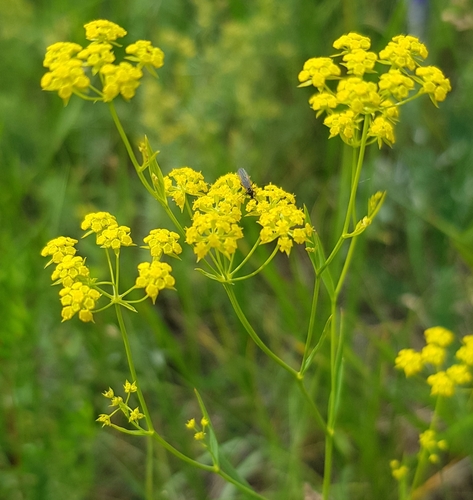
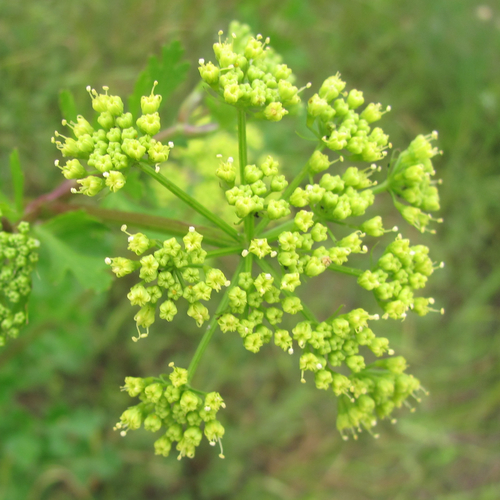
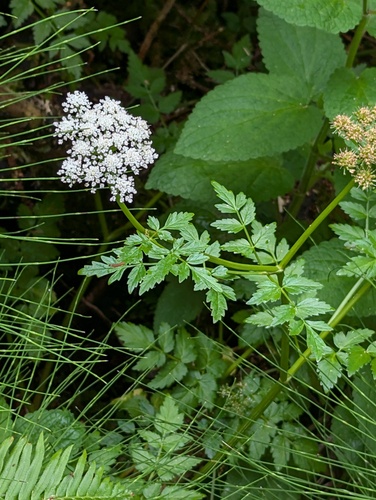
Inflorescences grow at the end of stems or in leaf axils, and are compound umbels made up of smaller individual umbels. The full compound umbel is 6–7 cm in diameter, with 5–25 glabrous, ridged peduncle rays that measure 2–4 cm long. There are 3–4 small, pale, inconspicuous bracts (or bracts may be absent entirely), and the peduncle is usually longer than its rays. Individual umbels are 1–2 cm across, holding 10–20 flowers plus 1–5 tiny bracteoles. The small, actinomorphic flowers have 5 yellowish petals, 5 tiny green sepals, 5 stamens, and 2 styles when styles are present. Sometimes 4 or 5 peduncles branch from the top of the stem, creating the appearance of an umbel of umbels of umbels. Generally, only the terminal umbel has 100% bisexual flowers; lateral umbels contain both bisexual and male-only flowers, with male umbellules typically positioned in the centre, and tertiary umbels often have only male flowers. This arrangement is clearest when plants reach maturity, when male-only flowers wither without producing fruit.
Mature fruit is a black schizocarp 6.5–8 mm long that splits into two single-seeded mericarps, exposing a stalk called a carpophore that runs between the mericarps. Each mericarp has 3 ridges and numerous oil tubes called vittae, which exude a pungent oil that smells like capsicum or diesel. A single plant can produce 3,000 to 9,000 seeds in one year.
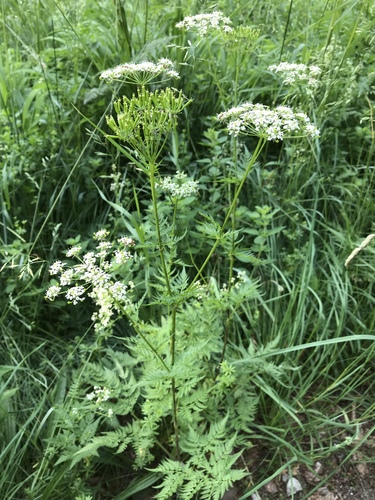
Alexanders is easy to identify in northern Europe. Its compound ternate leaves and yellow flowers are very distinctive. It could potentially be confused with hemlock water-dropwort or wild celery, but both of these species have white flowers. The commonly cultivated herb lovage resembles alexanders in its dark shiny foliage, but can be distinguished by its more sharply toothed leaves, lack of latex in the petiole, and more erect growth habit.
In Britain, alexanders is widespread, and frequent in southern coastal areas. It becomes progressively rarer moving north towards Scotland, and is entirely absent from Orkney and Shetland. Inland, it is often found growing close to the sites of medieval monastery gardens and other historical locations such as castles. In Ireland, it is common around the south and east coasts, but rare inland and in the west. Across Europe more generally, it occurs throughout the Mediterranean region, where it is recorded in all coastal areas including islands, and extends as far east as Crimea and the Black Sea. It is also found along the Atlantic coast of the continent from the Iberian Peninsula northwards through France, Belgium, the Netherlands, Denmark, and (more recently) into Norway, and westwards to the Azores. In north Africa, it is restricted to Mediterranean and Atlantic regions, including the Canary Islands.
Its conservation status is Least Concern in Britain and France, and it is not considered threatened in any region, though it is rare in some countries such as Belgium. It is recorded as an introduced species in New Zealand, Australia and Bermuda. It is a strictly lowland plant in northern Europe; in Britain, the highest elevation it has been recorded at is 290 m, at Davidstow Airfield in Cornwall.
In Britain and more northerly parts of Europe, alexanders' main habitat is tall grassland, typically on road verges and woodland edges. It benefits from some initial soil disturbance, and once established it can become dominant enough to suppress most other plants. In the British National Vegetation Classification, this habitat is classed as a herb-rich variant of the MG1 false oat-grass community, which would usually be dominated by cow parsley. Similar habitat occurs at the edges of scrub communities such as W21 hawthorn, W22 blackthorn or W24 bramble scrub. It is common on waste ground and field margins, especially near the sea, where it may also grow on cliff paths and near the shore.
Its Ellenberg values in Britain are L = 7, F = 5, R = 7, N = 7, and S = 0, which indicate it prefers fairly well-lit locations, well-drained neutral pH soils with medium fertility, and does not require salinity. Though it is more common near the coast than inland, it has little tolerance for salt, and its coastal occurrence is more likely due to the milder temperatures found near the sea. In France, it is considered a characteristic species of seasonally dry river valleys with chaste tree scrub in the Mediterranean region. Elsewhere in the Mediterranean, its habitat is similarly associated with patches of bare ground, but it is also commonly found in phrygana, olive groves and orchards.
Alexanders' unspecialised flowers are fragrant and visited by a wide variety of insects. This is enabled by the stylopodium, the bulbous base of umbellifer flowers, which secretes large amounts of easily accessible nectar. In Britain, over 150 insect species have been recorded visiting alexanders flowers, including many flies and bees, several beetles, butterflies and moths, and multiple other insect types. Plants are often infected by alexanders rust (Puccinia smyrnii), which produces orange/yellow galls on both sides of leaves and thickens stems, followed by dark brown telia that only form on the undersides of leaves.
At least nine insect species are associated with alexanders in Britain and western Europe. Three produce leaf mines: the celery fly (Euleia heraclei), which creates dark patches on the leaf surface; a beetle (Orthochaetes insignis), whose larvae produce irregular tunnels; and another fly (Phytomyza smyrnii, which has not been found in Britain but is known from Portugal) that creates linear mines. Other plant-eating insects include the obscure beetle Liophloeus tessulatus, which feeds on the roots and leaves. Three species of aphid (Dysaphis apiifolia, D. crataegi the hawthorn-carrot aphid, and D. lauberti) all suck sap from the plant. The remaining two are micro-moths: Agonopterix heracliana, whose larvae spin leaves, and Udea prunalis, whose caterpillars feed on leaves.
Alexanders is best collected before flowers open, and its stems can be cooked like asparagus. It was once highly valued in northern Europe as an early seasonal vegetable, and was one of the few fresh plants available to eat in February or March. In western Britain, it had a reputation among sailors for "clearing the blood" and curing scurvy; in Dorset it was known as "helrut", possibly a corruption of "heal root". Its seeds have also been used as a cure for scurvy. A 17th century text describes young shoots used in salads or a "vernal pottage", and an early 18th century recipe for Irish Lenten Potage recorded by Caleb Threlkeld includes alexanders, watercress and nettles. In Turkey, where it is called Baldiran or Göret, young shoots and leaves are cooked and eaten with yoghurt, or eaten fresh as a salad, while the roots are also eaten either cooked or fresh. The roots are considered the best part of the plant, and are dug during winter when the tubers are most fleshy, though British foragers often overlook them because uprooting wild plants is illegal there. Young alexanders foliage has a flavour between that of celery and parsley, while its seeds have an acrid, peppery taste. It fell out of common use in the 18th century after celery began to be mass produced to replace wild herbs and vegetables. It is not commonly used as a food product in the modern era, but has seen some renewed use in exotic "foraged" food recipes and restaurants. It is also fed to livestock. In the 19th century, bundles of alexanders stalks from Steep Holm were used for fuel, as reported by Rev. John Skinner. Though many authors claim that alexanders seeds smell of myrrh, likely due to its genus name Smyrnium, there are no documented reports of it being used as myrrh. Studies have identified many aromatic compounds in different parts of the plant, but no compounds are currently extracted from it for commercial purposes.