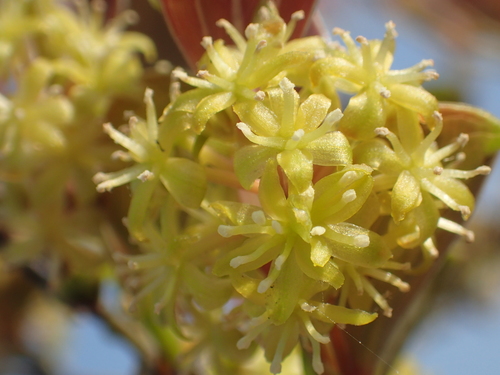
About Smilax rotundifolia L.
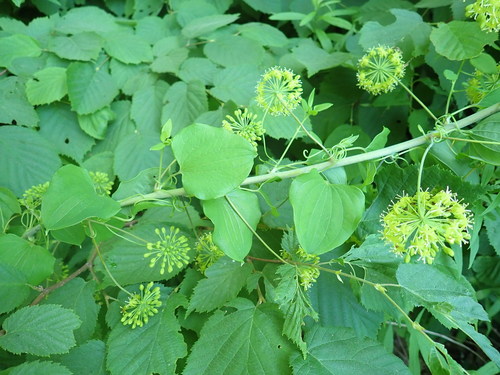
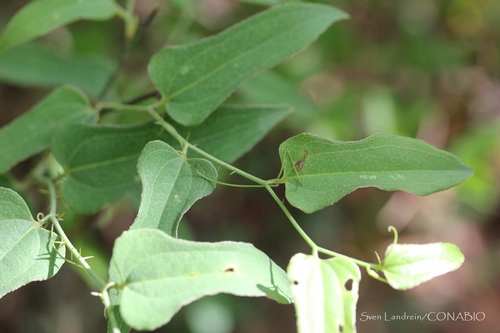
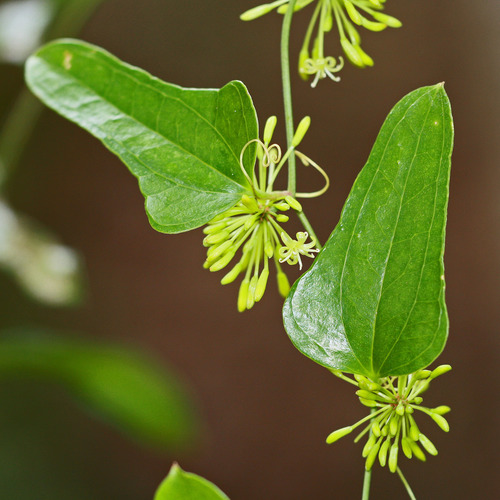
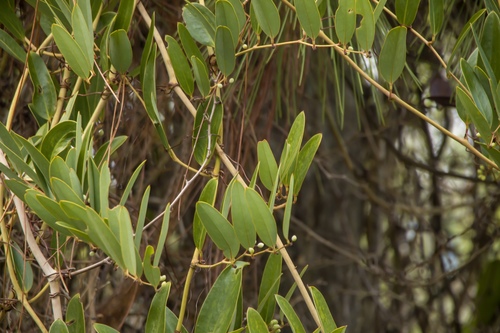
Smilax rotundifolia L., commonly called common greenbrier, is a green thorny vine. As its common names suggest, it is a crawling vine that can tangle within other plants and climb using small tendrils. It can reach up to 20 feet long when climbing objects and vegetation, and will grow along the ground if it has nothing to climb on. Its stems are woody, pale green, and glabrous; the youngest stems are often square-shaped, and dead stems turn from green to dark brown. Most stems bear 1/3-inch-long thorns with black tips, though some stems do not have thorns. Its leaves are rounded, alternate, 2 to 5 inches long, glabrous, and never glaucous. The upper leaf surface is darker than the underside. Each leaf has 3 to 5 primary veins; small prickles may sometimes be found along the underside of these primary veins. The petioles are a quarter to half an inch long, light green, glabrous, and have small sheaths with terminal tendrils at their base. Common greenbrier produces small greenish-white flowers arranged in umbels of 3 to 20 flowers. The peduncles holding these flower umbels grow from the leaf axils. This dioecious species produces male and female flowers on separate individual plants. Both types of flower are about a quarter inch long, and bloom for around two weeks in late spring and early summer. After blooming, fertilized female flowers develop into berries that hold up to three seeds each. Smilax rotundifolia is native to the United States. It occurs in the eastern half of the continental United States, including Texas, South Dakota, and Oklahoma, with the exception of Vermont. Its range extends from Florida north into Northern Ontario. It grows along roadsides, in landscapes, clearings, and woods, and often forms dense, impassable thickets in clearings. It can grow in almost all habitat types, including wetlands. Smilax rotundifolia grows from rhizomes, which lets it resprout and survive fire. Fires that open the canopy of dense forests encourage its growth. In a low-intensity prescribed burn (with 20 inch/50 cm flame heights) in a New Hampshire white pine forest, Smilax rotundifolia showed rapid, vigorous vegetative growth in the spring and fall after the fire. After two years, the population of Smilax rotundifolia returned to its original pre-burn density. No difference in growth outcome was observed when using different fire frequencies and intensities. Almost all parts of Smilax rotundifolia are edible. Young shoots are said to be excellent when cooked like asparagus. Young leaves and tendrils can be prepared like spinach or added raw to salads. Consumption of this plant is a common local practice in the South Carolina Lowcountry, where it is often called 'chaineybriar'. Its roots contain a natural gelling agent that can be extracted and used as a thickening agent. Young shoots, uncurled leaves, and tendrils can be eaten either raw or cooked.