About Skimmia japonica Thunb.
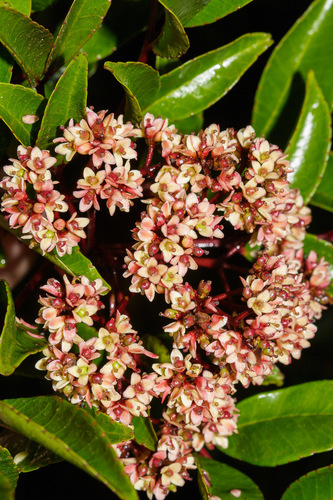
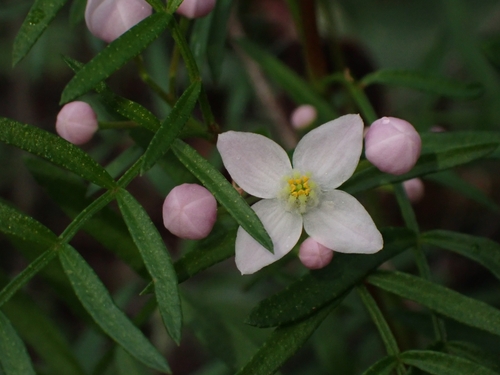
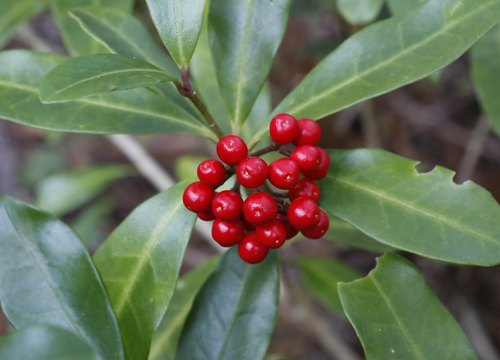
Skimmia japonica Thunb. is a dense evergreen shrub. It grows 60 to 200 centimeters tall, and its entire structure is smooth except for flower clusters, which have a fine fuzz. Its branches angle upward, are grayish, and have small glandular bumps called tubercles. Leaves are arranged alternately, though they may appear loosely whorled. Each leaf has a short stalk 0.5 to 1 cm long. Leaf blades are narrow and elongated, measuring 6 to 12 cm long and 2.5 to 3.5 cm wide; the leaf tip narrows abruptly before ending in a rounded point. The leaf base tapers, leaf margins are smooth, the upper leaf surface is glossy, and the underside is yellowish with scattered oil glands. Female plants of this species usually grow wider than male plants. Flower clusters form at the ends of branches, creating small branching cymes that are 2 to 5 cm long and 4 to 8 cm across. The cyme stalks have fine fuzz. This species flowers in spring. Its blossoms are typically four-parted, 5 to 6 mm across, with tiny triangular sepals and bracts edged with minute hairs. Petals are narrow, 4 to 5 mm long, and dotted with a small number of clear glands. Stamens are the same length as the petals. The style is short, measuring 0.8 mm, falls off early, and bears a somewhat rounded stigma split into four lobes. The flowers are fragrant. With the exception of S. japonica var. reevesiana, the species is dioecious. Vestigial organs of the opposite sex can be prominent, which is especially true in female flowers: their stamens may be almost full-sized, but remain whitish and do not produce yellow fertile pollen. Fruits are spherical drupes 6 to 9 mm wide. Each fruit contains two to five stones, and each stone holds a single seed. Seeds contain endosperm. The native range of Skimmia japonica includes Japan, Taiwan, and Sakhalin. In Japan, S. japonica var. japonica grows in low-mountain forests on Honshu (from the Kanto region westward), Shikoku, and Kyushu, and can be common locally. In Japan, S. japonica var. intermedia occurs in the southern Kuriles, Hokkaido, Honshu, Shikoku and Kyushu. These plants grow on the floor of deciduous forests, and are especially widespread in heavy-snow regions of Hokkaido and the Sea of Japan side of Honshu. They are much less common in colder, high-elevation deciduous forests on the Pacific side of Honshu west of Kanto, as well as in Shikoku and Kyushu. Outside Japan, this variety is also found in the Kuriles and Sakhalin. Skimmia japonica var. japonica and var. reevesiana range into the subtropics; var. reevesiana reaches the Philippines and southern Vietnam, and is also found in the Guangdong and Guangxi provinces of southern China and on Mount Omei in Sichuan province. Skimmia japonica shares parts of its range with S. laureola subsp. laureola and Skimmia arborescens subsp. nitida; it is separated from S. laureola subsp. laureola by habitat altitude, and is possibly reproductively isolated from S. arborescens subsp. nitida by a difference in chromosome count. Skimmia japonica is cultivated in shaded sites for its evergreen leaves, lightly fragrant spring flowers, and the fruits that develop on female plants in autumn. It has no notable pest or disease problems. It is suitable for shrub borders, woodland gardens, foundation plantings, hedges, and other partly shaded understory settings. It grows best in moist, humus-rich, moderately fertile well-drained soils, in conditions from partial shade to full shade. Its leaves can scorch if exposed to full sun. S. japonica was the first member of its genus to be grown in Britain; the earliest recorded cultivation, referring to S. japonica var. reevesiana, is from Kew Garden in 1858.