About Sitaris muralis (Forster, 1771)
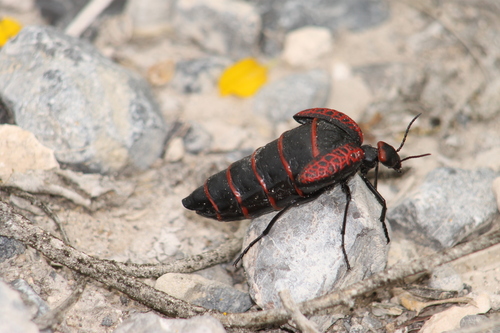
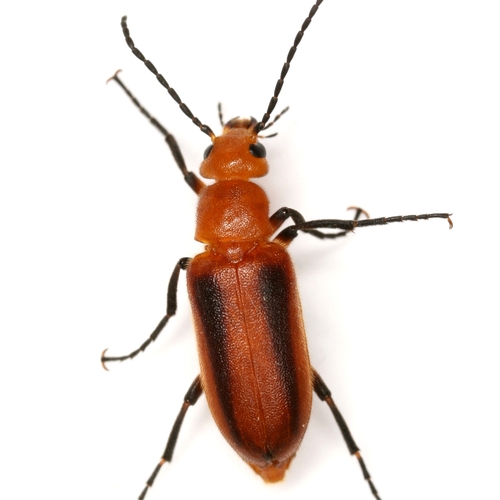
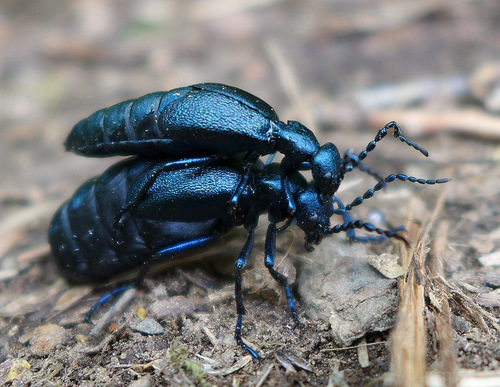
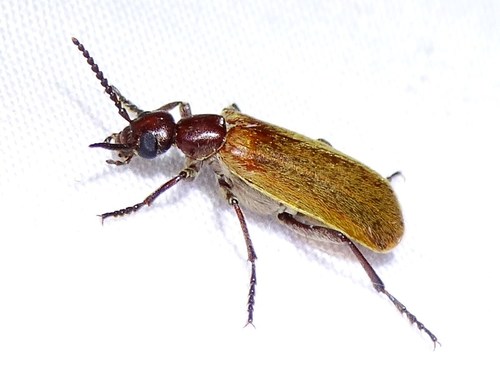
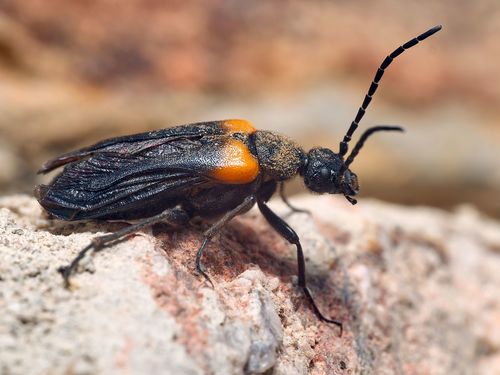
Sitaris muralis is a species of blister beetle belonging to the subfamily Nemognathinae within the family Meloidae. This species is native to Western Europe, and its documented range includes the British Isles, Spain, France, Luxembourg, Germany, Austria, Czech Republic and Italy. It is classified as an eastern Palaearctic species, and is very rare in southern England, which sits at the northwestern edge of its total range. Adults of Sitaris muralis are found near the nests of the digger bees they parasitize. Their typical habitats include steep loess slopes, old sun-warmed house walls, and gravel infill under building balconies. Sitaris muralis is a black beetle with buff-orange patches on the front portion of its elytra. It is a kleptoparasite of digger bees in the genus Anthophora, and has a complex life cycle. In September, female Sitaris muralis lay clutches of two thousand or more eggs near the underground galleries and chambers that host digger bees build to raise their own offspring. When the beetle eggs hatch, the newly emerged larvae gather in a small heap mixed with empty egg case remains. The larvae soon enter diapause that lasts until the following May. After diapause ends, the larvae seek out male digger bees, and a small number of larvae climb onto a male bee, clinging to its hairs. Eventually, this male bee mates with a female digger bee, and the beetle larvae transfer onto the female bee. The female bee excavates new chambers in walls or cliffs, fills each chamber with nectar, lays a single egg that floats like a raft on the surface of the stored honey, then seals the chamber. At the right timing, one beetle larva releases its grip on the female bee and drops onto the floating bee egg. The larva feeds here, first consuming the bee egg, a process that takes around one week, then feeding on the stored honey. The larva cannot digest honey until after it has finished eating the egg and has shed its outer skin.