About Sisymbrium officinale (L.) Scop.
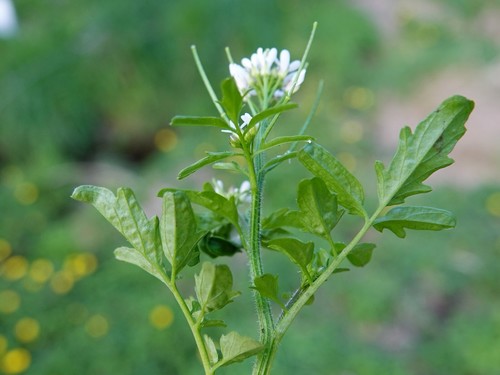
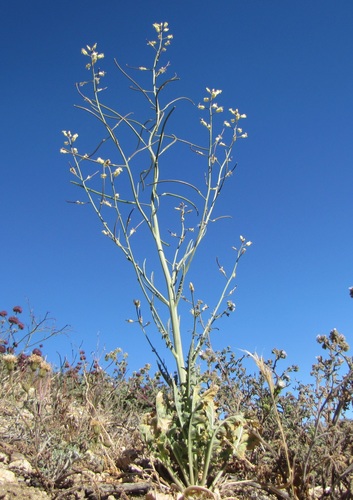
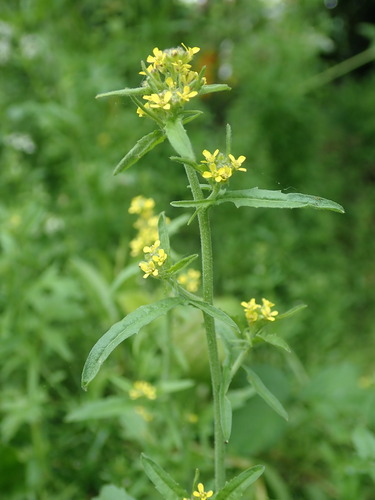
Sisymbrium officinale (L.) Scop., commonly called hedge-mustard, is distinct from mustard plants of the genus Brassica. It shares similarities with other species in the Sisymbrium genus, but can be distinguished by its tall, erect stems that bear tiny flowers and fruits held compact parallel to the stem rather than hanging freely. This species grows up to 80 cm in height. Its lower leaves are broad, with two or three lateral lobes. The yellow flowers measure approximately 4 mm across. The fruits are long, hairless when young and develop hairs as they mature; they reach 18 mm in length, growing on racemes pressed close to the stems. Hedge-mustard serves as a food source for the caterpillars of some Lepidoptera, including the small white (Pieris rapae). Originally indigenous to North Africa and southern Europe, this plant is now found in Ireland, Wales, England, and the highlands of Scotland, and is well-established across the entire world. It grows on roadsides, in wastelands, and occurs as a weed of arable land. This plant is widely cultivated across Europe for its edible leaves and seeds. In Northern Europe, particularly Denmark, Norway, and Germany, it is commonly used as a condiment. In parts of the Levant, it is also eaten when combined with yogurt. Cultivated leaves have a bitter, cabbage-like flavour, and are used either raw in salads or cooked as a leaf vegetable. Across Europe, the seeds have been used to make mustard pastes. In traditional Greek belief, this plant was considered an antidote to all poisons. In folk medicine, it was used to soothe sore throats; this use is reflected in its French name herbe aux chantres, or the singers' plant. It grows commonly as a weed along roadsides and on waste ground, with a noted tendency to collect and retain dust. Up to the reign of Louis XIV, it was considered an infallible remedy for loss of voice. Playwright Jean Racine recommended that Nicolas Boileau try a syrup made from the plant to cure his voicelessness. It was considered good for all diseases of the chest and lungs, as well as hoarseness of voice. Juice made into a syrup with honey or sugar was said to be equally effective for coughs, wheezing, and shortness of breath, and the seeds were held to be a specific remedy against poison and venom. It was formerly used to treat hoarseness, weak lungs, and to restore the voice. Modern herbalists use the plant's juice and flowers to treat bronchitis, stomach ailments, and other conditions, and also use it as a revitalizer. In Tibetan medicine, it is used to reduce the symptoms of food poisoning.