About Sisymbrium linifolium (Nutt.) Nutt.
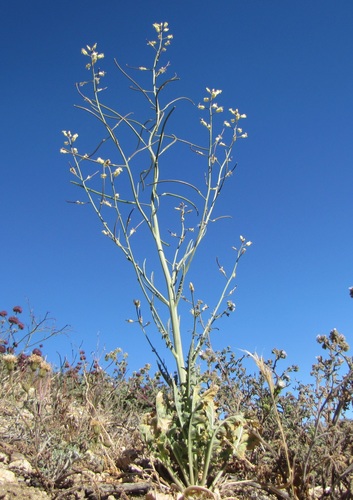
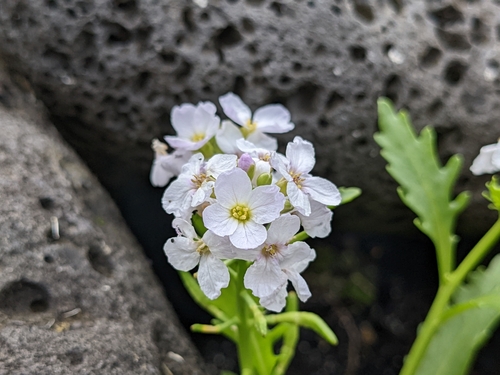
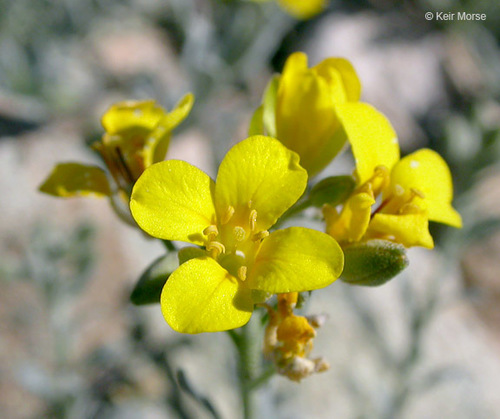
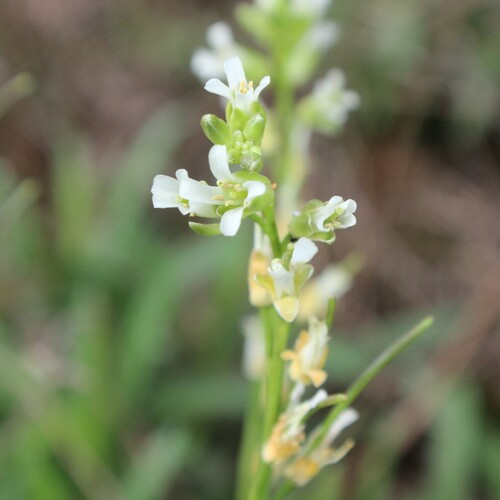
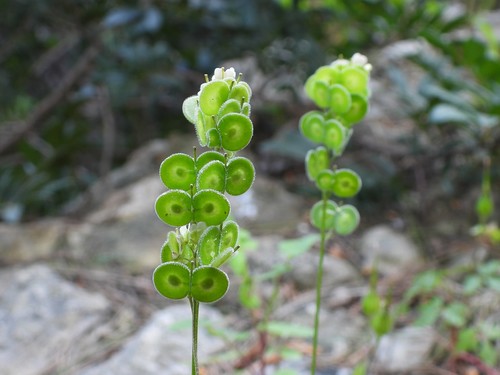
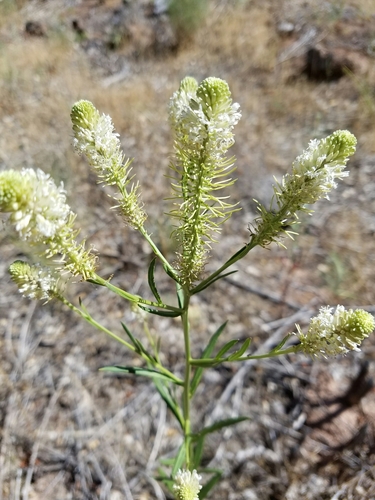
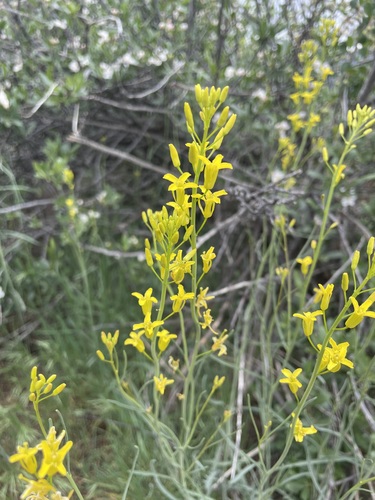
Sisymbrium linifolium (Nutt.) Nutt., which has Schoenocrambe linifolia among its synonyms, is a flowering plant species in the mustard family. Its common names are flaxleaf plainsmustard, skeleton mustard, and Salmon River plains-mustard. It is native to western North America, with a distribution ranging from British Columbia east of the Cascade Range east to Saskatchewan in Canada, and south to Arizona and New Mexico in the United States. It is an extremely common plant, and is most abundant in the Columbia Basin, Great Basin, and Colorado Basin. This perennial plant grows from a long, deep rhizome and a caudex, and produces erect stems that can reach up to half a meter tall. Its leaves are linear, and are sometimes divided near the base of the plant. Its fruit is a slender silique that can grow up to 6 centimeters (2.4 inches) long. It reproduces both by seed and by resprouting from its rhizome and caudex. Resprouting allows the plant to recover quickly after wildfire. It grows in many different habitat types, including salt-desert shrubland, sagebrush, pinyon-juniper woodland, mountain shrub, and habitats dominated by Ponderosa pine (Pinus ponderosa) and trembling aspen (Populus tremuloides). It is the most common forb in multiple regions, including the pinyon-sagebrush transition zone in northeastern Utah and the grasslands of the Snake River Plain. Its leaves are spicy enough to be used as a wasabi substitute, and can also be mixed into salads and other dishes.