About Sirystes sibilator (Vieillot, 1818)
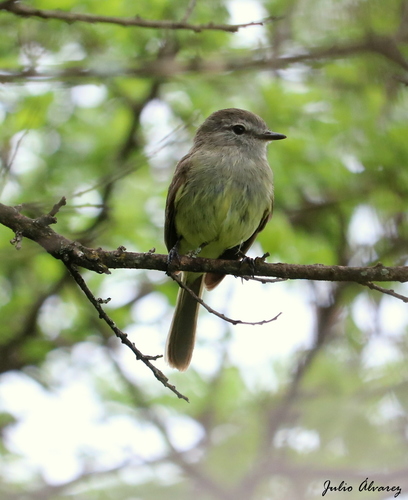
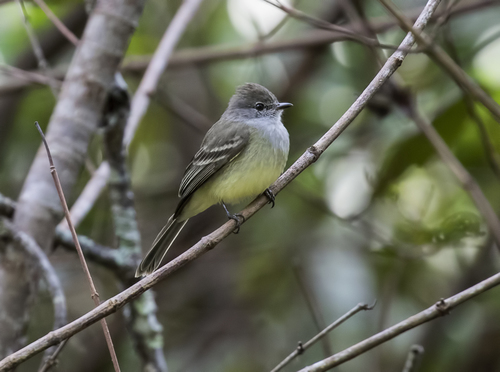
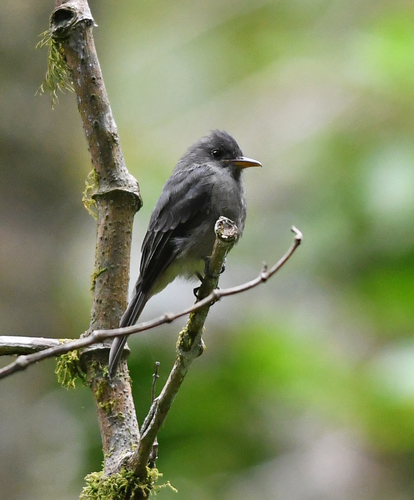
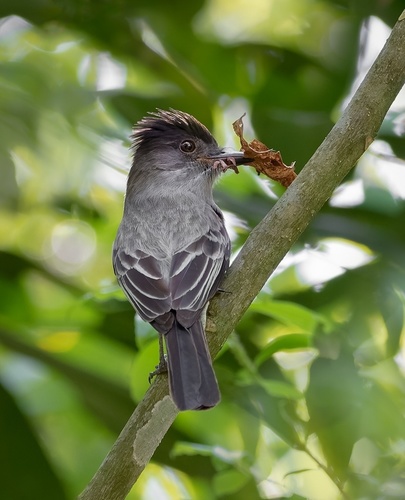
The sibilant sirystes (scientific name Sirystes sibilator) measures 18 to 18.5 cm (7.1 to 7.3 inches) in length and weighs approximately 26 to 28 g (0.92 to 0.99 oz). Both sexes share identical plumage. Adult nominate subspecies have a black crown with a small crest, and the rest of the face is slate gray. The nape and back are mottled gray with an olivaceous tint in most individuals, while the rump has a gray wash; birds in the northern part of the species' range have white-tipped rump feathers. The wings are blackish, with wide gray edges on the coverts and inner flight feathers. The tail is long, blackish, and ends in a square tip. The throat and breast are gray, fading to grayish white on the belly. The subspecies S. s. atimastus has yellowish tips on its rump feathers, a pale ashy throat, and white breast and belly. Differences between the two subspecies appear to be clinal. Juveniles look similar to adults, but have a faint overall buffy wash across the body. Both subspecies have a dark reddish brown iris, a black bill, and blackish legs and feet. The nominate subspecies of the sibilant sirystes has a much larger range than the other subspecies. It is found in Brazil in an area roughly bounded by central Amazonas and northeastern Pará, narrowing southward through Mato Grosso and Goiás, then widening east to Minas Gerais and Espírito Santo, and continuing south to northern Rio Grande do Sul. Its range extends into eastern Paraguay and northern Argentina as far as northeastern Corrientes Province. It also occurs as a non-breeding visitor in Bolivia. Subspecies S. s. atimastus is found only in the area near Chapada dos Guimarães in Mato Grosso. The sibilant sirystes lives in a variety of forested habitats, including primary forest, mature secondary woodland, riparian forest, and dry cerradão forest. It almost always stays within the forest canopy. In Brazil, it can be found at elevations of at least 1,000 m (3,300 ft), and may occur as high as 1,400 m (4,600 ft).